

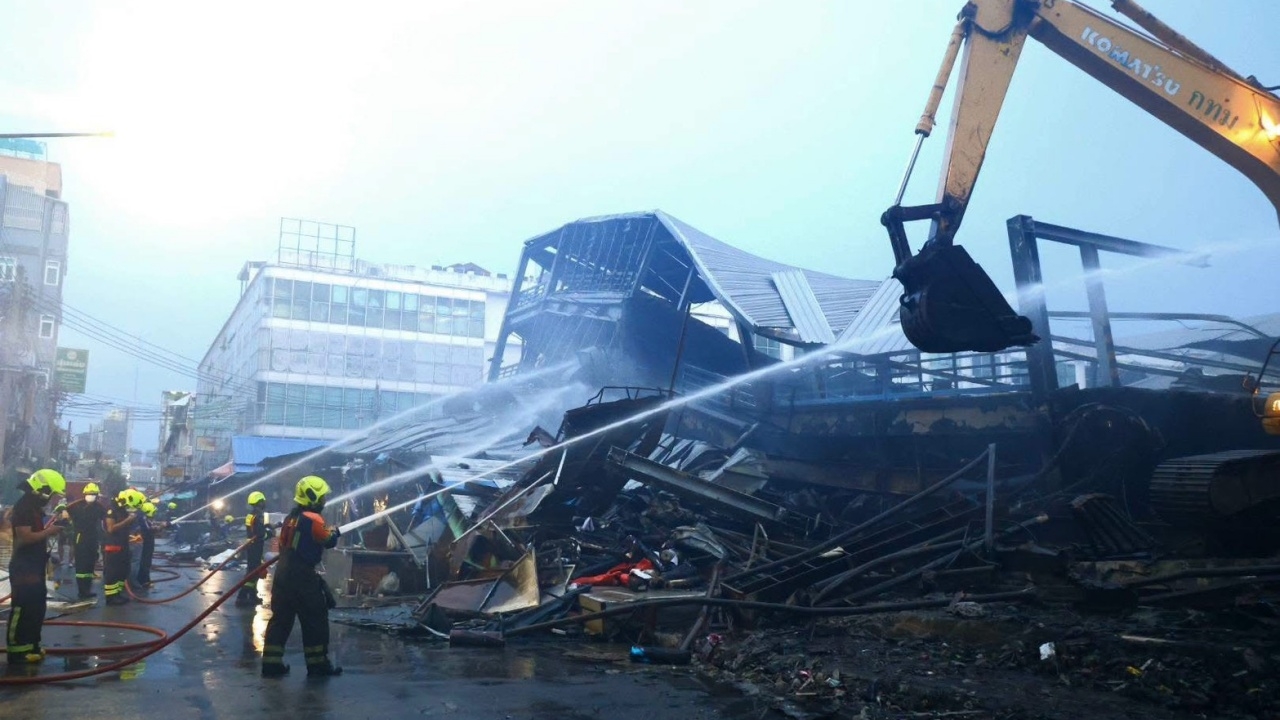
Bangkok updates air quality around "Khlong Thom Center" following a fire incident. No toxic substances exceeding standard limits have been detected, with ongoing monitoring emphasized.
On 29 August 2026, Mr. Pornprom Na S. Wikitset, Deputy Governor of Bangkok, stated that the Bangkok Metropolitan Administration (BMA), through the Environment and Health Departments, continues to monitor air quality around the site of the Khlong Thom Center fire using both stationary and mobile measurement stations to watch for particulate matter and pollutants from the burning.

Data from monitoring stations on the night of 28 August showed increased particulate matter in Pom Prap Sattru Phai, Samphanthawong, Dusit, and Phaya Thai districts. The Pom Prap Sattru Phai station recorded a peak PM2.5 level of 54.6 micrograms per cubic meter at 10:00 p.m., about 6.8 times higher than levels before the incident, with levels gradually decreasing after the fire was controlled.
Specific measurements near the fire site recorded PM2.5 levels between approximately 640 and 800 micrograms per cubic meter, and PM10 between 4,000 and 4,325 micrograms per cubic meter, due to proximity to the source and debris. These values represent spot measurements at that time for situational assessment, not 24-hour averages.

Most recently, measurements from a mobile unit near Klang Hospital on 29 August at 6:00 p.m. showed all parameters within standard or surveillance limits. PM10 was 32 micrograms per cubic meter, below the 24-hour standard of 100 micrograms per cubic meter. Carbon monoxide (CO) was 1.5 ppm, under the 30 ppm standard, and nitrogen dioxide (NO₂) was 30 ppb, below the 120 ppb limit.
Combustion-related substances detected included 1,3-butadiene at 0.91 micrograms per cubic meter and benzene at 1.44 micrograms per cubic meter, both below established surveillance thresholds.

Mr. Pornprom explained that Bangkok monitors more than just PM2.5, also tracking volatile organic compounds (VOCs) and BTEX group chemicals, since the materials at the fire site included car parts, oil, paint, solvents, plastics, rubber, and electronic equipment, which can release pollutants when heated or incompletely burned.
During measurements near Klang Hospital, winds were blowing from the northwest at approximately 2.2 meters per second. The BMA continues to track pollution levels and wind direction together on an ongoing basis.

Initially, Bangkok focuses on the area within about 500 meters of the fire site, especially downwind areas. A 3 to 5 kilometer zone along the smoke's path is designated as an initial surveillance boundary—not an evacuation radius—and may change depending on wind direction.
Additionally, the Environmental Sanitation Office of the Health Department has compiled air quality data from various points and made the results available via Google My Maps, allowing the public to check locations and readings themselves. Air quality results can be checked here (Click)
The BMA urges the public to stay informed. If smoke or burning odors are still noticed, residents should keep doors and windows closed, reduce outdoor activities, and wear N95 masks when going outside, especially vulnerable groups.
