

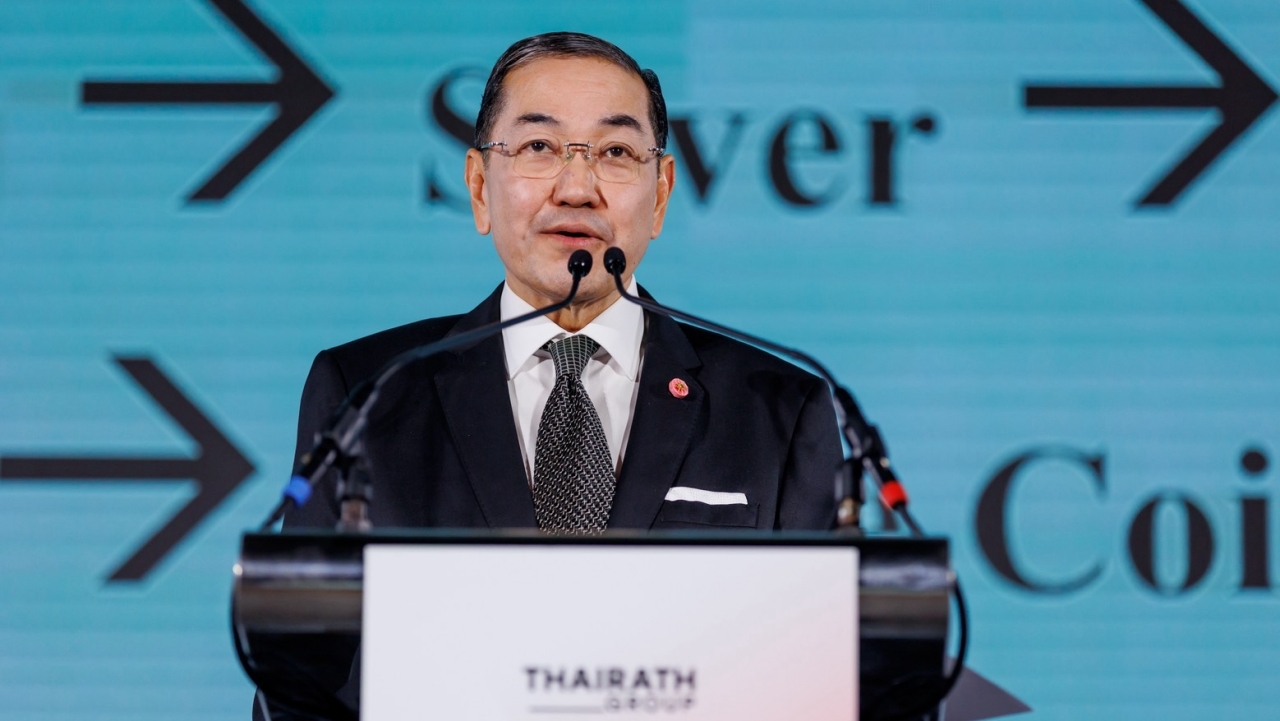
Dr. Surakiart delivered a keynote at the THAIRATH FORUM 2026 stage, revealing Thailand's survival direction under the new global order. The opportunity and path to survival lie in building skills for human resources to become more self-reliant.
On 31 Aug 2026, Thairath Group hosted a significant panel discussion titled “THAIRATH FORUM 2026: THAILAND IN THE NEW GLOBAL ORDER,” gathering national public and business leaders to exchange strategic visions under the theme “Transforming Thailand’s Economic Strategy” for survival and growth amid the new global order.
The event featured Professor Emeritus Dr. Surakiart Sathirathai, Chairman of Chulalongkorn University Council and former Deputy Prime Minister, who delivered a keynote titled “Thailand’s Blueprint for the New Global Order: Thailand’s Direction and Survival under the New Global Order,” stating that Thailand’s survival depends on genuine collective effort.
Thailand faces eight challenges that must be analyzed to determine the country's survival prospects, as these disruptions are occurring simultaneously, interacting and interconnected. Both the private sector and government must decode what global disruption means for their organizations and how to respond once it happens.

First is technological disruption, which has completely changed our work methods and thinking. Many countries dislike AI because it causes job losses. The question is how much Thais should fear AI. Personally, I do not think AI will replace humans but believe those who use AI will outcompete those who don’t. The key question is how to enable Thais to use AI effectively and create intelligence themselves.
Next is demographic disruption: Thailand is becoming an aging society, while neighboring countries remain young societies. This affects economic size because older people are said to spend less. We must consider how to engage those over 60 who remain healthy to return to the workforce.
Pandemic disruption involves preparedness for disease outbreaks and emergency management, ensuring vulnerable, poor, and remote groups have better access to healthcare. Environmental disruption is well known for its impact on business, such as floods and PM2.5 pollution, causing significant national damage.

Education disruption means learning can occur anytime, anywhere, often alongside work, or some never return to formal education but continuously reskill and upskill. Teachers must shift from lecturers to coaches or advisors. To produce a new generation of graduates, we need new kinds of teachers with real experience to coach effectively.
Energy disruption arises as the world focuses on a green economy, but conflicts in the Middle East disrupt energy supplies like gas, affecting Asia. Such supply issues drive a return to green transition and the shift to alternative energy sources.
Additionally, geo-economic disruption involves massive shifts in global economic geopolitics, including trade and finance. Many countries trade using alternative currencies, moving toward gold-backed trading, platinum, and others.
Finally, the U.S. has triggered a new world view. Those thinking Thailand can return to the old status quo are mistaken. The United Nations has failed to issue resolutions to end conflicts because the five major powers lack interest.

Moreover, global change is irreversible. Reciprocal tariffs have led to multilateral trade system failures, with tariffs rising but rarely falling, risking economic damage during wars. The key question is how well we understand U.S. politics. To engage the U.S. effectively, we must address issues important to them and build resistance. We have never engaged with the U.S. at the state level, unlike Singapore, which sends special envoys to each state to identify cooperation areas. I have repeatedly proposed that Thailand appoint special representatives to U.S. states to understand state politics and identify key contacts, including legal lobbying firms.
Leadership perspectives worldwide are shifting from 'Efficiency First,' focused on lowest cost, to 'Security First,' which accepts higher costs but ensures supply security. Leaders now ask how to produce low-cost goods while maintaining stock to avoid shortages. The mindset is changing from minimal inventory to maintaining reserves for crises, such as energy, fertilizer, food, medicine, supply chains, and technology. The world is moving from fragmented globalization toward diversified sourcing, which is key to adaptability.
How should Thailand reposition itself? Dr. Surakiart suggests becoming a Resilient Regional Hub, shifting from lowest-cost producer to one with acceptable costs. Thailand serves as a reliable bridge connecting various countries and must establish itself as a trustworthy nation with skilled personnel aligned to market needs, indispensable to all parties.

In uncertain times, leaders must identify over-dependencies, diversify risks, build adequate reserves, commit to transitioning into the new world, strengthen regional ties, keep the country open, and lead change and reform.
Thailand’s survival under the new order requires readiness for ongoing global disruption impacts that may last one to two years even if wars end tonight. Experts agree the current situation won’t escalate to world war but peace is unlikely. Solutions will be temporary. We must accept a longer-lasting crisis or new normal. Leaders continuing past approaches risk failure; complacency is the enemy of success, and the greatest danger is inaction.
In summary, we are entering a new world marked by various disruptions, conflicts, and wars, with economic impacts lasting beyond conflicts. Leaders are shifting thinking toward survival options emphasizing self-reliance but still requiring international cooperation. Commodity prices rise, SME incomes fall, purchasing power declines, and access to capital tightens. Countries are compelled to reform and adapt in many areas, but new opportunities arise for Thailand, especially in health-driven economies, longevity, care, green transition, EVs, solar energy, logistics, and tourism, as Thailand is viewed as safe.

Our opportunity lies in developing human resource skills by overhauling education, emphasizing lifelong learning, transforming lecturers into coaches, employing AI, investing in research to create intelligence, and focusing investment on building human capital capacity to cultivate a new generation of skilled workers.
The event was broadcast live on Facebook:Thairath TV,Thairath - Thairath Onlineand on YouTube channelThairath News - Thairath Newsfrom 18:00 to 20:30 GMT+7.