

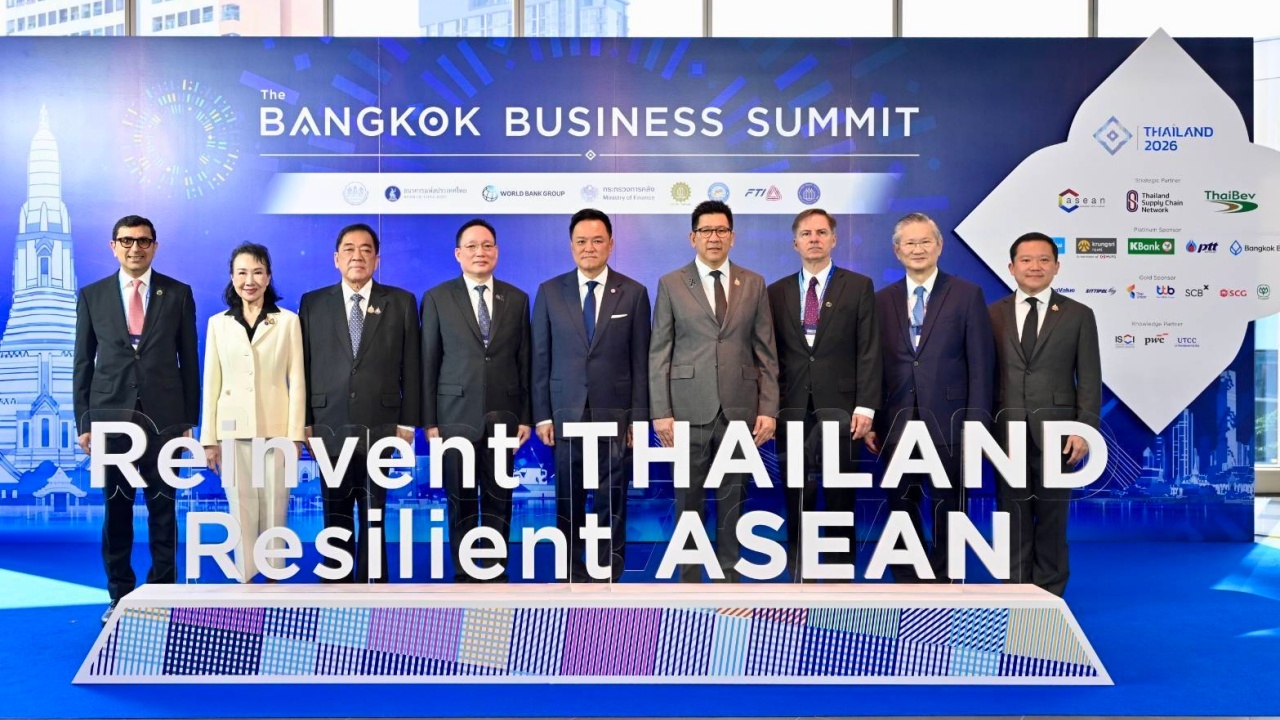
ThaiBev is helping drive the future of Thailand’s economy toward ASEAN and the global stage at "The Bangkok Business Summit 2026" leadership conference.
Thai Beverage Public Company Limited (ThaiBev) supported the organization of "The Bangkok Business Summit 2026" under the theme "Reinvent Thailand, Resilient ASEAN." The event was hosted by the Joint Private Sector Advisory Committee (JSCC) comprising the Thai Bankers' Association, the Thai Chamber of Commerce, and the Federation of Thai Industries, together with the Ministry of Finance, Bank of Thailand, the National Economic and Social Development Council, and the World Bank. The summit aimed to discuss cooperation between the public and private sectors to strengthen Thailand’s economic potential within the ASEAN region on 3 September 2026 at the Queen Sirikit National Convention Center.

On this occasion, ThaiBev co-hosted a special panel titled "Growth Reaches Communities: Sufficiency Economy Philosophy," featuring Associate Professor Dr. Jirayut Isarangkun Na Ayuthaya, Privy Councillor, and Mr. Warawut Silpa-archa, Minister of Industry, as panelists.
Mr. Thapana Sirivadhanabhakdi, CEO of ThaiBev, spoke about integrating the Sufficiency Economy Philosophy (SEP) as a business approach to navigate global economic changes. He said, "Thailand’s selection as host for the IMF–World Bank Group Annual Meetings this October not only showcases the country’s economic potential
but also opens the opportunity for us to jointly define strategies for strong and sustainable growth that delivers benefits widely and inclusively to citizens and communities. At the same time, it allows us to consider how to steer Thailand’s economy to respond effectively to ongoing changes in geopolitics, economy, technology, and environment. The Sufficiency Economy Philosophy, as conceived by His Majesty King Bhumibol Adulyadej the Great, remains a valuable concept aligned with today’s global context.
I would like to sincerely thank Associate Professor Dr. Jirayut Isarangkun Na Ayuthaya for honoring us with his participation, sharing his extensive experience and deep understanding of the Sufficiency Economy Philosophy, and his key role in promoting its application for sustainable economic and social development. I also thank Mr. Warawut Silpa-archa, Minister of Industry, as a leader driving Thailand’s industrial development, for exchanging important perspectives on how this philosophy supports continuous industrial growth and enhances the nation’s competitiveness."

Mr. Thapana Sirivadhanabhakdi further emphasized that the Sufficiency Economy Philosophy can be applied in daily life and decision-making to help individuals and communities manage uncertainty, commit to ongoing learning and self-improvement, and progress steadily over the long term.
Associate Professor Dr. Jirayut Isarangkun Na Ayuthaya, Privy Councillor, spoke about balancing progress with strong resilience. He cited the 1997 Asian financial crisis, known in Thailand as the “Tom Yum Goong crisis,” as a severe economic shock and a critical lesson for Thai businesses revealing vulnerabilities. During that difficult time, the Sufficiency Economy Philosophy, bestowed by His Majesty King Bhumibol Adulyadej the Great, provided a meaningful framework and guidance amid the crisis. The core of the philosophy

consists of three principles: moderation, reasonableness, and self-immunity, grounded in knowledge and virtue. In that major crisis, these three principles helped make more concrete decisions, such as questioning which activities were truly necessary, which risks needed to be accepted, and which could be avoided.
Associate Professor Dr. Jirayut added, "The Sufficiency Economy is more than an abstract concept; it is a thinking framework that enables us to make concrete decisions."
Mr. Warawut Silpa-archa, Minister of Industry, reflected that “The world faces structural volatility in geopolitics, technology, climate, demographic shifts, and fragile supply chains, resulting in a K-shaped economy globally and in Thailand. The upper arm of the K represents modern industries focused on advanced technology, mostly led by multinational corporations, reflecting rapid digital economic growth. The lower arm represents SMEs, local supply chains, and a large vulnerable workforce that lags behind. If these two arms continue to diverge, it will pose systemic risks rather than sustainable growth.

Therefore, the Ministry of Industry uses the Sufficiency Economy Philosophy as a compass to restructure Thailand’s industry by applying moderation, reasonableness, and immunity principles to the business sector. A key tool is the Thai Industrial Standard (TIS) 9999, which adapts these principles into organizational management aiming for long-term business survival aligned with global standards of environmental, social, and governance (ESG) responsibility. The ministry also promotes TIS 9999 usage among SMEs to enhance their competitiveness.
The goal of modern Thai industry is not only national economic growth but also ensuring all Thai people have opportunities to grow together. The government cannot drive this alone; collaboration with investors, industry leaders, entrepreneurs, and international partners is essential to help Thai SMEs access global markets.
Mr. Warawut Silpa-archa emphasized, "We must build an industrial economy where growth and resilience advance hand in hand—not as mutually exclusive goals but as mutually reinforcing forces."

ThaiBev’s participation highlights the private sector’s role in advancing Thailand’s economic reform agenda to adapt to change and prepare the country to host the "2026 Annual Meetings of the International Monetary Fund and the World Bank Group" this October.