

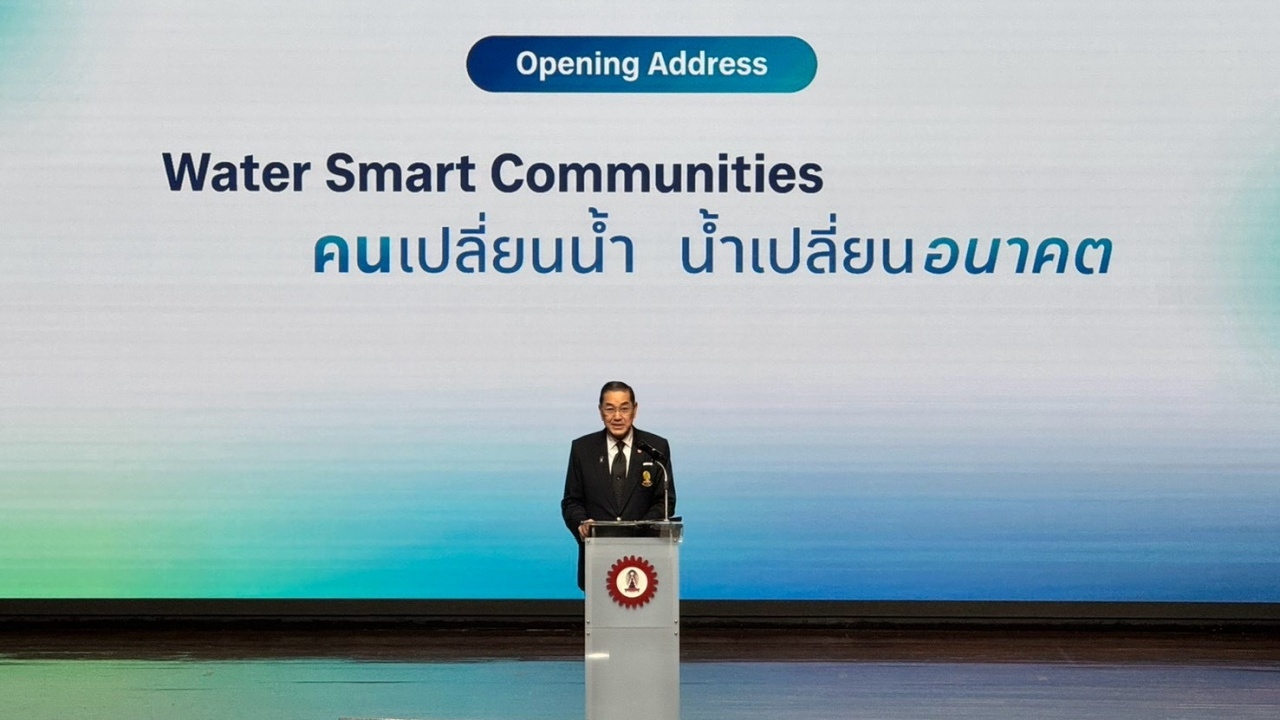
Special Professor Dr. Surakiart Sathirathai opened the event, "Water Resilience Forum". Water Resilience Forum. The forum aims to drive proper water management, preparing for water-related risks and turning them into opportunities for future development.
On 4 Sep 2026 at the Faculty of Engineering, Chulalongkorn University, Special Professor Dr. Surakiart Sathirathai, President of Chulalongkorn University Council, officially opened the "Water Resilience Forum 3/2026: WATER SMART COMMUNITIES."
He expressed his great pleasure in opening the 3rd Water Resilience Forum under the theme "WATER SMART COMMUNITIES – People Change Water, Water Changes the Future." He also thanked Professor Dr. Yossanun Wongsawat, Deputy Prime Minister and Minister of Higher Education, Science, Research and Innovation, for valuing the Faculty of Engineering's activities at Chulalongkorn and for delivering the keynote address at the brainstorming session.

He emphasized that water has always been important to him because it is like the lifeblood of Thai people, whose lives have been connected to waterways from past to present. From his experience assisting communities affected by water disasters in Chiang Rai, Hat Yai, and most recently Nan Province, as Vice Chairman of the Volunteer Foundation's advisory board under the Thai Red Cross Society, he witnessed firsthand that water disasters cause not only massive economic losses but also the loss of homes, farmland, property, livelihoods, incomes, families, and lives. Some families lost their life’s accumulation overnight.
The 2011 great flood caused approximately 1.43 trillion baht in economic damage and loss. The 2025 floods in Hat Yai and several southern provinces were estimated to affect economic activities by no less than 25 billion baht. To this day, many businesses, families, and individuals have yet to recover and restart.
More worrying than past damages is the future risk of recurring and potentially more severe floods in multiple dimensions.
The World Bank estimates that if a flood similar to the 2011 disaster recurs in 2030, Thailand could lose nearly 10% of that year’s GDP. These figures tell us we must not wait for disasters to occur before responding but need to prepare and prevent in advance. He believes Thailand can do this, as many areas have proven that water is not just a risk; if managed properly, it can transform crises into opportunities, generating income, improving quality of life, and strengthening communities.
Nakhon Pathom is an interesting case study of post-disaster recovery. The province suffered about 6 billion baht in damages from the 2011 floods, including approximately 1 billion baht impacting agriculture. However, it has successfully restored residents’ quality of life and economic activities continuously, with its agricultural sector now valued at around 17 billion baht in gross product.
The Songwad community is another example of a riverside community demonstrating that when locals collaborate to manage water risks and leverage cultural capital, lifestyle, and creativity, they can generate new economic opportunities, turning into a creative tourism destination that attracts visitors and generates income for the area.

The Volunteer Foundation’s community disaster warning and management networks, established under the guidance of HRH Princess Bajrakitiyabha Narendiradebyavati, chairperson of the foundation's board, aim to strengthen disaster-prone communities. They do so by involving residents in learning and accessing government information, using climate and rainfall data to monitor and warn, preparing to move assets to higher ground, evacuate if needed, and assist one another and nearby communities to move people to safety or provide rescue during disasters.

This exemplifies strengthening communities in hazard-prone areas through cooperation and local capacity in monitoring, warning, and disaster response. Many networked communities use technology and local wisdom to prevent floods sustainably and apply knowledge for daily livelihoods. Government agencies provide modern technology to monitor climate and water levels, but without community access, analysis, and utilization of such data, or internal mechanisms for monitoring and response, and trust in technology, reducing losses to life and property is difficult.
While floods cannot always be prevented, losses can be minimized or mitigated. These examples convince him that water risks can be transformed into development assets. However, this requires people, knowledge, cooperation, and technology. Community members need to understand their area, water sources and flows, risk points, and how to manage incidents collaboratively.

Science and technology help us anticipate and make accurate decisions through telemetry, water level monitoring, forecasting systems, and other technologies developed jointly by government, academia, and private sectors, integrating with local wisdom. This is the essence of Water Smart Communities—not those with the most technology but those with knowledge, data, cooperation, and the ability to blend community wisdom and participation with science and technology for self-managed water management, based on Community-Based Disaster Risk Management (CBDRM). Many communities use both technology and local wisdom to prevent floods.

Today, the discussion goes beyond "how to prevent flooding" to the more important question of how communities can know, prepare for, live with water, and transform it into future opportunities. Another question is how successful community practices can be transferred and expanded to other communities and ultimately to every province in Thailand.
He hopes today’s forum will be the starting point for knowledge exchange and collaboration to expand Water Smart Communities widely. He thanked the Deputy Prime Minister for the keynote speech, all speakers, agencies, communities, and media for jointly advancing this vital issue concerning water and life.
