

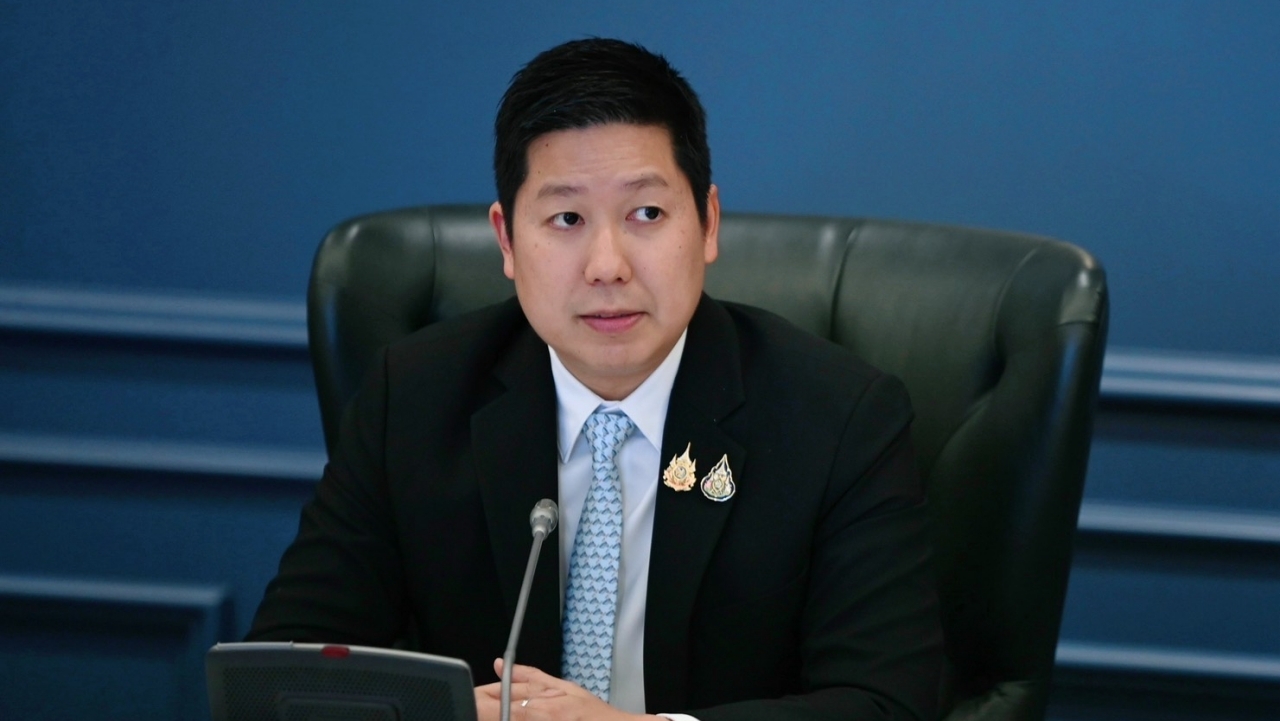
Worawong Rangmankoon urges Supachai to clarify whether the U.S. tax exceeds 12.5%, highlighting the need to compare with competitors. If the tax does not match the 10% level, Thailand will be at a disadvantage. He poses three questions for clarification.
Worawong Rangmankoon, former Deputy Minister of Commerce, commented on Deputy Prime Minister and Commerce Minister Supachai Sutthumpun’s statement on 22 September 2026 that Thailand had reached a principal agreement on the ART trade deal with the U.S. and was finalizing details to keep the total tax rate at 19%, "equal to regional competitors." He said this explanation did not answer his questions raised since 8 September but instead caused more confusion among the public and business sector.
"I asked earlier this month whether the figures—no more than 19% and the 12.5% Thailand currently pays—refer to the same tax basis or different ones. Two weeks have passed with no direct answer, only repeated mention of combined numbers. I urge the Deputy Prime Minister not to use complex figures as excuses because exporters only want to know the final tax rate on Thai products and whether they can compete," Worawong said.
19% was once an achievement, but today it cannot be the target.
Worawong reviewed the timeline, stating Thailand’s tax rate on U.S. market goods has legally shifted several times within less than a year. Originally, Thailand faced a 36% retaliatory tax under the IEEPA law, before the negotiation team under former Prime Minister Paethongtarn Shinawatra, including former Deputy Prime Minister and Finance Minister Pichai Chunhawat and former Commerce Minister Pichai Naripthaphan, successfully reduced it to 19%, announced on 1 August 2025.
"The 19% retaliatory tax resulted from negotiations under the previous government, matching rates for Malaysia, Indonesia, and Cambodia, and better than Vietnam and China at that time. I ask the Deputy Prime Minister to provide factual information and not convey to the public that part of that negotiation remains unsettled," Worawong said.
On 20 February 2026, the U.S. Supreme Court ruled 6-3 that the IEEPA law does not authorize the president to impose customs or retaliatory taxes, nullifying that entire tax scheme. The U.S. then applied a temporary 10% tax under Section 122 from all countries until 24 July 2026. On the same day, the U.S. Trade Representative imposed Section 301 taxes on 60 partners, with Thailand taxed at 12.5%, while Cambodia, Indonesia, and Malaysia were taxed at 10%.
"The 19% figure was good in the context of 2025, but with the legal basis changed, it should not be a target for 2026. The minister’s statement aiming to maintain a 19% framework mixes figures from different laws, causing confusion as a political excuse. Setting such a target may mean accepting a higher rate than Thailand should currently have," Worawong said.
"Equal to competitors" must mean comparing the same tax basis.
The former Deputy Minister of Commerce explained that "equal to competitors" only makes sense when comparing the same tax basis. The reality today is that under Section 301, Thai exporters bear a tax cost about 2.5 percentage points higher than Cambodia, Indonesia, and Malaysia, which directly compete with Thailand in many product categories. Although Vietnam is taxed at 12.5% like Thailand, this does not mean Thailand is not at a disadvantage, since the other three competitors enjoy lower rates.

Three questions for the Deputy Prime Minister to answer.
Worawong requested Supachai to answer three questions: Will the ART negotiation result in Thailand paying more than 12.5% under Section 301? Can Thailand reduce the U.S. tax to 10%, matching regional competitors? Has the deal truly been closed, and when will the government disclose negotiation details?
Inconsistent communication with repeated "deal closure" claims.
Worawong noted the government’s inconsistent communication: on 1 September 2026, the Deputy Prime Minister expressed confidence after talks with U.S. trade representatives that Thailand’s total tax would not exceed 19%. On 5 September, the Bhumjaithai Party’s page announced the deal with the U.S. was closed. Then on 7 September, the Commerce Ministry spokesman clarified that the "deal closure" news might cause misunderstanding, with the final tax rate still uncertain. On 17 September, the Deputy Prime Minister said the target was to keep the rate within 19%, and on 22 September, reaffirmed that a principal agreement had been reached.
"Within less than a month, the public heard both that the deal was closed and not closed, and then only a principal agreement was made. Investors and businesses rely on this information for decisions. The government must speak consistently and clearly, not adjust explanations according to the situation," Worawong said.
Must assess impact on trade balance and current account.
Besides tax rates, Worawong emphasized the government must evaluate the agreement’s effects on macroeconomic stability, especially if increased U.S. imports cause imports to grow faster than exports. Recent data show that in the first seven months of 2026 (Jan–Jul), Thailand had a trade deficit of USD 35.3545 billion (about 1.23 trillion baht) and a current account deficit of USD 17.7 billion (about 575 billion baht) in Q2.
"I do not oppose negotiations with the U.S., but before signing anything, the government must clearly disclose each tax rate, what Thailand gains, what the U.S. gains, and what Thailand must concede. It must also address concerns about transshipment to assure the U.S. that Thailand is not a transit route for goods from other countries, allowing Thai exporters to compete fairly without tax disadvantages compared to competitors Malaysia, Indonesia, and Cambodia who benefit from lower rates," Worawong concluded.