

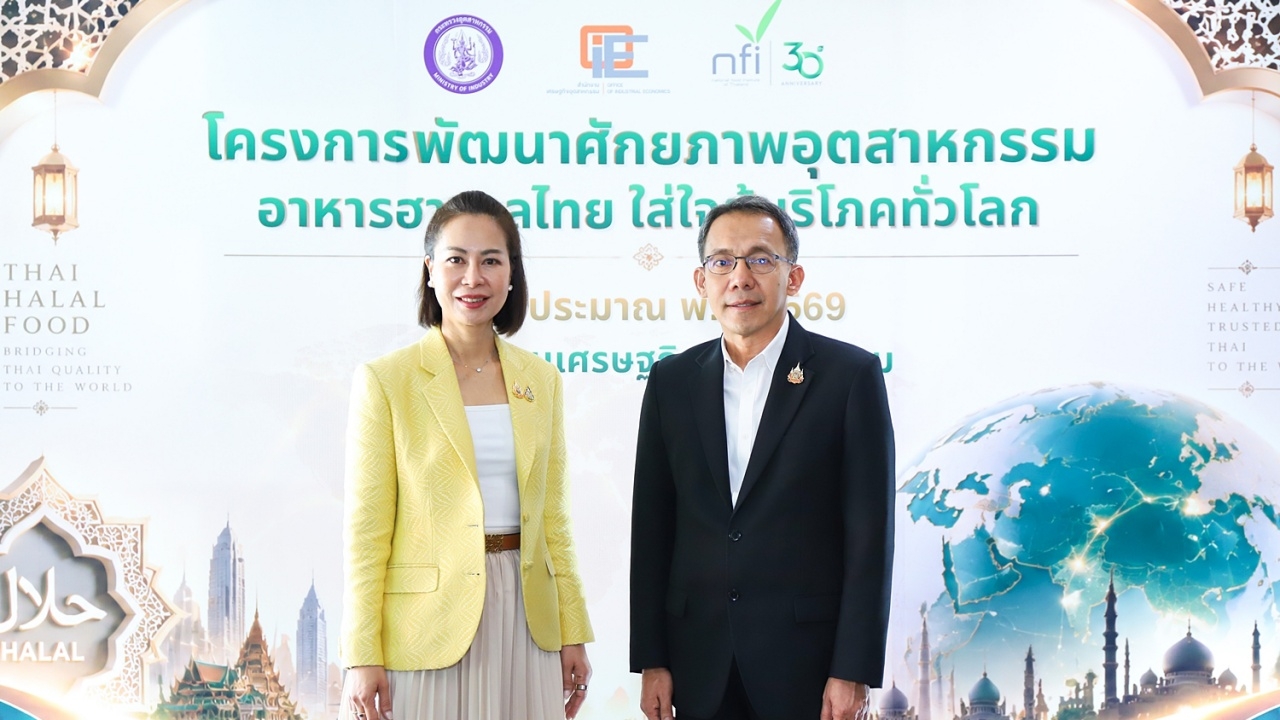
The Industrial Economy Office (IEA) and the Food Institute announced their successful collaboration. They highlighted the "2026 Project to Enhance the Capacity of Thailand's Halal Food Industry with Global Consumer Care." This initiative has generated an economic value exceeding 1.4 billion baht.
Mr. Supakit Boonsiri, Director of the Industrial Economy Office (IEA), stated that the 2026 fiscal year project to enhance Thailand's halal food industry capacity is part of the action plan to develop the food processing industry. The goal is to position Thailand among the world's top 10 food exporters by 2027. Since January, the IEA has assigned the Food Institute to implement the project.
The project focuses on food industry entrepreneurs as the main target group, adopting a comprehensive approach that includes in-depth studies of overseas halal markets, upgrading production standards, product development with expert halal standard consulting, and organizing market linkage activities. These include participation in leading trade fairs both domestically and abroad to create business opportunities and conduct business matching with potential partners.
Activities have included surveys and assessments of halal food market potential abroad to identify trade opportunities and market demands. Findings indicate that in Turkey, Thai halal products have opportunities through OEM arrangements, raw material exports into the HORECA supply chain, and leveraging strengths such as non-GMO raw materials.

In India, opportunities arise from developing products appealing to both Muslim and vegetarian consumers, alongside strategies to enter diverse channels such as quick commerce, specialty stores, hotels and restaurants (HORECA), and major retail chains.
Mr. Supakit added that market linkage activities, both domestic and international, are key mechanisms of the project. They aim to enable entrepreneurs to present their products to real markets and partners, fostering sustainable business opportunities. Domestically, 38 entrepreneurs participated in the GRAND HALAL BANGKOK 2026 event, resulting in 140 business matching sessions and a projected revenue increase of over 365 million baht, averaging a 32.18% growth.
For international market expansion, 20 entrepreneurs were supported to join SIAL Guangzhou 2026 in Guangzhou, China, a major global food industry platform. The event yielded 118 business matching sessions and an estimated economic value exceeding 195 million baht, with an average revenue increase of 15.32%.
Overall, the project's activities are estimated to generate about 1.438 billion baht in economic value. These results stem from improved production standards, product development, and market linkages at home and abroad, demonstrating that Thai halal food possesses quality, standards, innovation, and potential to grow rapidly on the global stage. Mr. Supakit expressed confidence that this project will be a vital force propelling Thailand to become the "ASEAN Halal Hub" sustainably and securely as planned.
Ms. Paiyada Hanchaisuksakul, Director of the Food Institute, said that as a partner in the project, the Institute leveraged its expertise in halal food industry knowledge to provide in-depth halal standard consulting to 42 participating enterprises. This helped raise halal standard readiness comprehensively, enabling entrepreneurs to expand business opportunities and add value. Market linkage activities led to orders and an estimated commercial value of over 483 million baht, with an average revenue increase of 73.57%.
Additionally, the Institute provided in-depth consulting on developing processed halal food products for 20 entrepreneurs, covering functional foods and alternative protein foods. Concepts such as Halal by Design, Quality by Design, and a risk-based approach were applied from the early stages to ensure product quality, safety, and halal compliance.
This was complemented by market analysis, consumer group study, and target market requirements to enhance commercial potential. It resulted in the development of 20 new halal food products aligned with current consumption trends, including crispy fried soy protein, semi-instant protein-enhanced Vietnamese noodle soup, powdered plant protein drinks, and crispy mung bean rice fortified with prebiotics.
These products combine plant-based and local ingredients with food innovation, estimated to generate commercial value exceeding 395 million baht and an average revenue increase of 21.64%. This enhances nutritional value and adds worth to Thai halal food products, promoting Thai food industry entrepreneurs to achieve international recognition, meet global consumer demands, and become a key industry generating quality economic value for the country.