

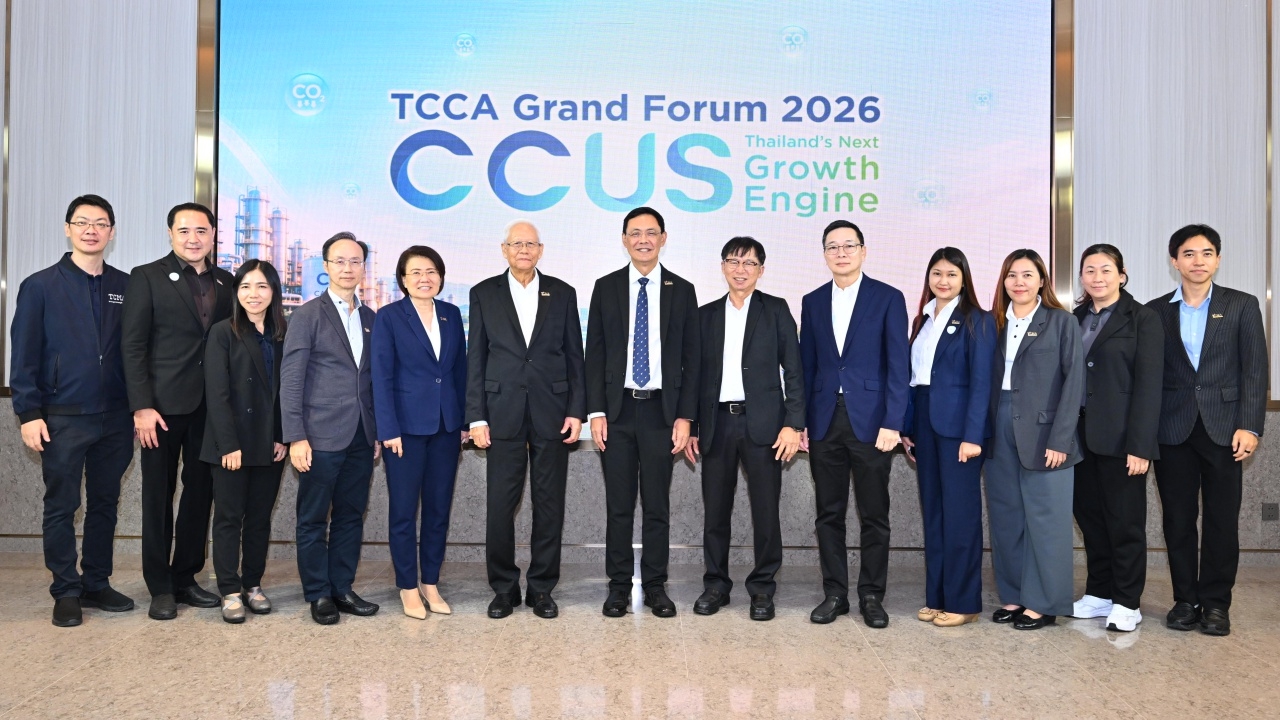
The Thai Cement Manufacturers Association (TCMA) is pushing forward CCUS technology to transform CO2 from an environmental challenge into an economic value opportunity. It connects innovation, research, and partners both within Thailand and internationally, while proposing five key factors to unlock investment. The goal is to enhance the competitiveness of the Thai industry toward the Net Zero 2050 target.
On 12 Nov 2026 GMT+7, the Thai Cement Manufacturers Association (TCMA) announced its drive to lead Thailand’s cement industry toward the Net Zero 2050 goal under the concept “Reimagining Carbon: From Capture to Value Creation.” The initiative aims to advance greenhouse gas reduction by reusing CO2, developing new products, and creating additional economic value through collaboration among government, private sector, research institutions, and international partners. It also proposes ways to unlock CCUS technology development to lay the foundation for a long-term industrial transition.
Mr. Surachai Nimlaor, president of the Thai Cement Manufacturers Association, said at the TCCA Grand Forum 2026 that the cement industry is a fundamental sector playing a key role in the country’s economy and infrastructure development. However, it is also a Hard-to-Abate industry because some CO2 emissions arise directly from chemical reactions in the clinker production process.
The transition therefore requires systematic efforts across technology, energy, materials science, and innovation, while maintaining competitiveness and creating new economic opportunities for the country.
Roadmap for Thailand’s Cement Industry Toward Net Zero 2050
Previously, TCMA members collaborated to produce the Thailand 2050 Net Zero Cement & Concrete Roadmap to set long-term carbon reduction directions for the industry. They have continuously driven measures including improving energy efficiency, transitioning to clean energy, and increasing the share of alternative fuels, currently around 30–40%.
Additionally, they emphasize developing low-carbon cement, particularly hydraulic cement, and advancing innovations like LC3 (Limestone Calcined Clay Cement) as another option to reduce carbon emissions throughout production.
However, energy and fuel measures alone cannot fully cut CO2 emissions because clinker production releases CO2 directly from chemical reactions. Thus, CCUS (Carbon Capture, Utilization and Storage) technology plays a crucial role in supplementing carbon reduction efforts and is a key mechanism to help the industry reach the Net Zero 2050 target.

Turning CO2 into Raw Materials to Create Products and Economic Value
TCMA sees global CCUS development moving beyond simply capturing and storing CO2 toward reusing it as raw material for new products and economic activities. Thailand can start with Carbon Capture and Utilization (CCU) to test technology, learn from practical use, and innovate with CO2, while simultaneously studying and preparing for Carbon Capture and Storage (CCS) to support long-term carbon reduction.
Mr. Surachai said, “CCUS is not just an environmental investment but also an opportunity to create new products, add economic value, and strengthen Thailand’s competitiveness. Carbon capture should link to utilization and value creation, starting with experimentation, learning, and innovation development from CO2, alongside CCS readiness.”
Linking International Partners to Pilot Mobile Carbon Capture in Thailand’s Cement Industry
To advance CCUS technology from concept to practical use, TCMA acts as a connector between industry needs and knowledge, technology, and experience from domestic and international partners. A major project is piloting the Mobile Carbon Capture Unit (MCCU) for the first time in Thailand’s cement industry at the Saraburi Sandbox site.
This technology was developed by the Clean Energy Technologies Research Institute (CETRI) at the University of Regina, Canada, under the “Decarbonization of the Cement and Concrete Sectors in Thailand” project. It is supported by Canada’s Environment and Climate Change Ministry (ECCC), with backing from the Global Cement and Concrete Association (GCCA), Chulalongkorn University, and managed by the United Nations Industrial Development Organization (UNIDO).
The project allows TCMA members to study and pilot the technology in real conditions. The MCCU’s benefits go beyond the CO2 captured by the prototype; it also includes data collection and knowledge building from testing to assess feasibility and prepare for scaling to industrial levels in the future.
At the same time, TCMA promotes collaboration to study CO2’s conversion into new products such as Low-Carbon Methanol and the development of construction materials using CO2 curing processes, like fiber cement and concrete blocks. This approach uses and stores CO2 in materials while studying strength and durability to expand low-carbon construction options for the market.
Highlighting Five Key Factors to Unlock CCUS and Attract Industrial Investment
Mr. Surachai added that to implement CCUS technology at an industrial scale requires comprehensive support from upstream to downstream. Five key factors must be developed simultaneously:
1. Policy and Regulatory Framework Establish clear regulations, permits, CO2 management and transport, and relevant standards to build confidence among operators and investors.
2. Finance and Investment Incentives Provide tax benefits, funding for pilot projects, and financial tools to reduce risks and promote CCUS technology investment.
3. Shared Infrastructure and Collaboration Develop CO2 collection and transportation systems and encourage shared infrastructure use among industries to improve efficiency and reduce costs.
4. Technology Readiness and Innovation Support research, development, and field testing of technology, linking research knowledge to commercial application.
5. Demand and Carbon Value Creation Promote CO2-based product development and connect producers, technology developers, and users to create markets and real demand.
CCUS as a New Economic Opportunity Expected to Generate Over One Trillion Baht in Value
Beyond environmental benefits, CCUS development has the potential to create new industries and supply chains, enabling Thai businesses and SMEs to participate in related sectors such as engineering, equipment manufacturing, digital systems, R&D, and workforce skills development. This will generate jobs and add economic value to Thailand.

According to the Thailand CCUS Industrialization Master Plan, if Thailand can develop CO2 management capacity to about 60 million tons per year by 2050, it could generate approximately 1.06 trillion baht in cumulative economic value and support about 585,194 jobs from 2025 to 2050.
These figures show that CCUS is not only a tool to reduce greenhouse gas emissions but also an opportunity to advance innovation, create new businesses, and enhance the country’s long-term competitiveness.
Mr. Surachai concluded, “The next step is to move from study to action, from pilot projects to investment, and from collaboration to creating new economic opportunities. TCMA is ready to act as a Climate Solutions Partner, linking strategies, technology, research, and partners to turn carbon management potential into economic value and tangible outcomes for Thailand.”
Under the concept “Reimagining Carbon: From Capture to Value Creation,” TCMA aims to build a collaborative CCUS ecosystem to accelerate the Thai cement industry’s transition to Net Zero 2050, fostering innovation, creating business opportunities, and supporting sustainable national growth.