

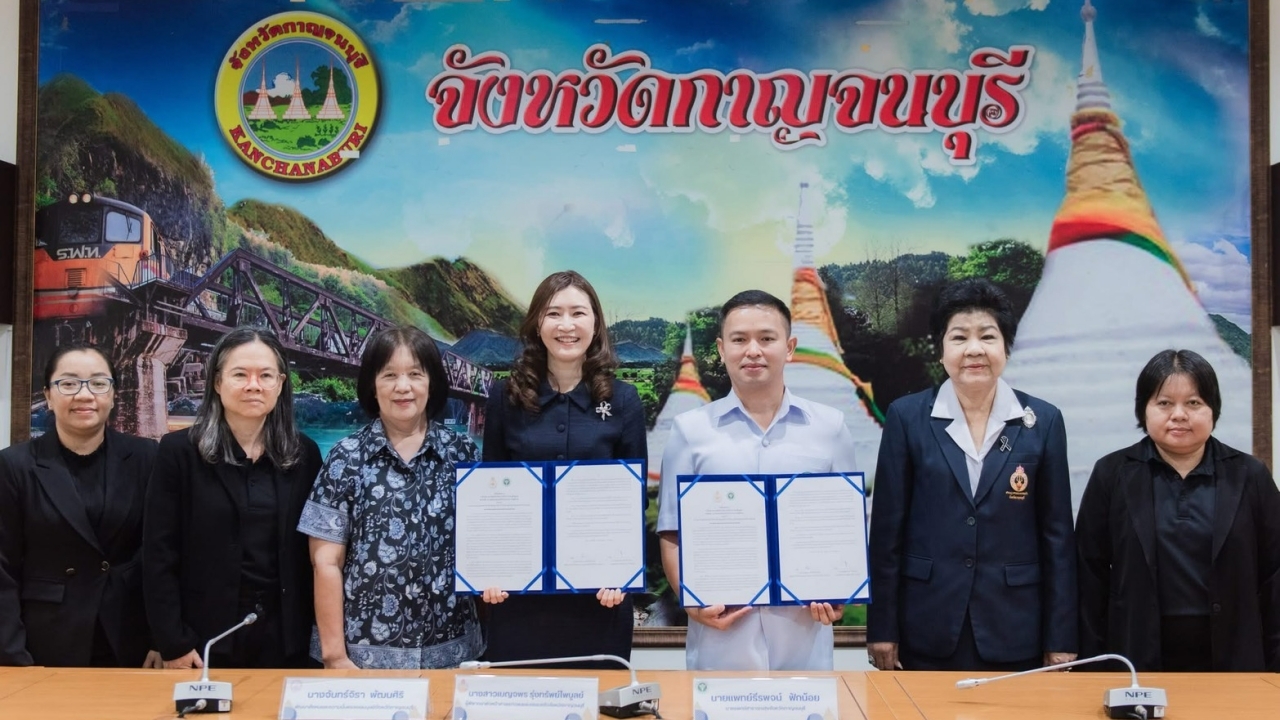
The Kanchanaburi Juvenile Court signed an MOU with the Kanchanaburi Provincial Health Office to facilitate justice and enhance the quality of life for children and youth, while also developing systems for care, treatment, rehabilitation, and referral of offenders.
At 10:30 a.m. on 15 Jun 2026 GMT+7, in the Kwae Yai meeting room on the 5th floor of the Kanchanaburi Provincial Hall, Ms. Benjaporn Rungsappaiboon, Chief Judge of the Kanchanaburi Juvenile and Family Court, presided over the signing ceremony of a Memorandum of Understanding (MOU) between the court and the Kanchanaburi Provincial Health Office. The MOU aims to facilitate justice and improve the quality of life for children, youth, and families involved in Kanchanaburi’s justice system. It also seeks to develop systems for care, correction, treatment, rehabilitation, and referral of offenders, victims, those suffering from violence, and related families to receive appropriate and continuous support. Dr. Theerapoj Faknoi, Provincial Health Officer of Kanchanaburi, joined the signing.
Witnesses included Mrs. Janjira Pattanasiri, Kanchanaburi Provincial Social Development and Human Security Officer; Ms. Urairat Khookaeo, Head of the Kanchanaburi Child and Family Shelter; associate judges and mediators of the Juvenile and Family Court; and representatives from the Kanchanaburi Juvenile Detention and Protection Center.
After the opening, Ms. Benjaporn Rungsappaiboon, Chief Judge of the Kanchanaburi Juvenile and Family Court, said the MOU signing between justice system networks for children, youth, and families aims to facilitate justice and enhance their quality of life within Kanchanaburi’s justice process. It also serves to strengthen systems for care, correction, treatment, rehabilitation of offenders, victims, those subjected to violence, and related families. This aligns with policies to establish family quality enhancement centers and care monitoring centers at the Juvenile and Family Court of Kanchanaburi.

The main mission is cooperation to assist, strengthen, support, and care for children, youth, and families beyond mere supervision or probation systems. It focuses on fostering positive attitudes through family, community, and government agency participation, which has great power to transform society.
The signing today marks a positive milestone in collaboration between the two agencies to create opportunities and a better future for children and youth in the justice system. It also strengthens family institutions, communities, and society, ultimately benefiting the people of Kanchanaburi province.
When asked how the MOU revises the integrated working approach with network agencies, the Kanchanaburi Juvenile and Family Court emphasized a focus on correction, treatment, rehabilitation, and safeguarding the rights and welfare of children, youth, and family members.
Previously, in criminal cases, the court received good cooperation and support from partner agencies in offender care and correction. However, the court particularly prioritizes the psychological impact on children and youth in family cases, which are civil matters such as divorce, compensation claims from an adulterer, or child custody issues. During case proceedings, parental conflicts may adversely affect children’s mental health and cause stress that parents may not anticipate.
This MOU is thus a key mechanism to link responsibilities and drive collaborative work. When the court assesses that a child, youth, or family member requires sustainable mental and physical health care,
the cooperation aligns with the Supreme Court President’s policy to establish family quality enhancement centers and care monitoring centers at the Kanchanaburi Juvenile and Family Court. It aims to engage families, communities, and relevant agencies in continuous care, assistance, and rehabilitation—not only under probation supervision but also to provide opportunities and develop potential for children and youth to reintegrate into society with quality.
Dr. Theerapoj Faknoi, Provincial Health Officer of Kanchanaburi, stated that the MOU signing on cooperation for correction, treatment, rehabilitation, and referral of children, youth, and families in the justice process aims to elevate care and support for children and youth involved in court proceedings, ensuring they receive appropriate and continuous assistance.
The cooperation’s objective is to integrate work between the Kanchanaburi Juvenile and Family Court and the Kanchanaburi Provincial Health Office in caring for physical and mental health, treating substance abuse problems, and supporting behavioral changes in children and youth to enable their normal life within families, communities, and society.
Additionally, both agencies will jointly conduct monitoring and care for children and youth under court conditions, participate in restorative group meetings, support legal experts, exchange knowledge in law, medicine, and public health, and coordinate efforts to ensure efficient, prompt, and beneficial services for children, youth, and families in Kanchanaburi province.
This MOU signing represents a significant step in building a cooperative network between the justice system and public health to promote quality of life and sustainable reintegration opportunities for children and youth.