

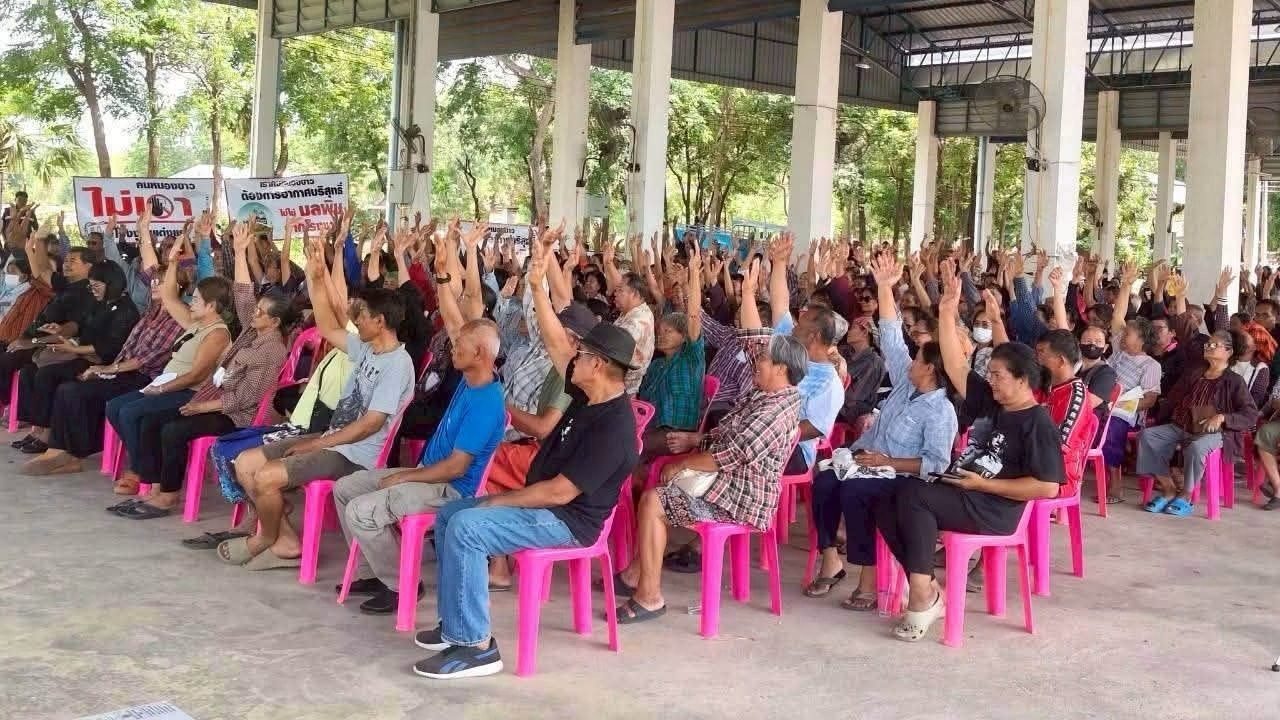
Residents of Nong Khao, Kanchanaburi Province, have submitted opposition to the establishment of a mineral processing plant in the area, fearing pollution impacts. The factory representative presented another perspective, affirmed having standard pollution prevention measures, and expressed willingness to listen to public opinion.
Progress on the planned construction of a mineral processing plant at Ban Rang Chik, Village No. 7, Nong Khao Subdistrict, Tha Muang District, Kanchanaburi Province, under the jurisdiction of Nong Ya Dok Khao Municipality, covers about 19 rai. The land is zoned purple, designated for industry and warehouses, so factory construction is permitted. However, residents are concerned about potential pollution and impacts on agriculture because the plant site is adjacent to the royal irrigation project canal Tha Lo-U Thong in Suphanburi Province, which runs parallel to the Tha Muang-Phanom Thuan irrigation canal.
This morning (8 Jul 2026), local leaders including the subdistrict headman, village chiefs, and nearly 1,000 residents from all 13 villages of Nong Khao Subdistrict gathered at Sala 3 of Wat Intaram (Nong Khao Temple) in Nong Khao, Tha Muang District, Kanchanaburi. They expressed their firm opposition by signing documents against the construction of the mineral processing plant. Former Kanchanaburi MP for Constituency 2, Mr. Chatphan Dechkitsuntorn, also known as Man, led the protest. Community leaders took turns speaking, police from Nong Khao Police Station maintained security, and other government agencies observed the event.

Additionally, Mr. Chatphan Dechkitsuntorn submitted a letter to a representative from the Lawyers Council who provided legal assistance. Mr. Chukiat Jeenaphak, MP for Kanchanaburi from the Bhumjaithai Party, Constituency 2, sent a representative to receive the letter and observe the proceedings. The event lasted about two hours. Afterwards, Mr. Chatphan led the media to visit the actual site.
Mr. Chatphan explained afterward that their opposition is not against development per se, but they are deeply concerned because the mineral processing plant is located next to an irrigation canal which is vital for the people. This canal supplies raw water used for drinking water production by the Nong Khao Municipality and also serves Phanom Thuan District, which covers the entire district population. The canal is essential for consumption and agriculture and connects to Chorakhe Samphan Subdistrict in U Thong District, Suphanburi Province. Furthermore, the royal irrigation project Tha Lo-U Thong canal runs parallel nearby. Thus, the plant site is close to both canals. They urge the company to find a more suitable location for the plant.
Ms. Naree Noonmuang, Assistant Manager of the company, clarified about the mineral processing plant project that the company has followed proper procedures to obtain permits from the Kanchanaburi Provincial Industry Office and the municipality. The company aims to provide accurate information to local residents to build correct understanding that the minerals processed contain no hazardous substances and pose no environmental or health risks. They even presented samples of fluorite minerals to demonstrate.
Our factory is not a mineral smelting plant as reported, but a mineral processing plant where minerals are washed and cleaned without discharging wastewater externally or using public water sources. Instead, the factory drills its own groundwater well and employs a closed water circulation system. It uses filtration to separate mineral residue and clean materials. The project is a small-scale mineral processing plant and does not require an Environmental Impact Assessment (EIA) because its production capacity is below 50 tons per month, the legal threshold. This explanation is not to make excuses but to show good faith and emphasize the company's readiness to disclose project information for public knowledge. We have standard pollution control measures to prevent environmental and health impacts on the community.
Ms. Naree added that although the company could not present its explanation today due to residents' opposition, she understands and respects their rights. The purpose of coming today was to affirm the company's transparency, confirm it operates legally, and express willingness to listen to all opinions.

Regarding readiness and pollution control measures, the mineral processing process follows environmental standards to prevent impacts on the environment and community health. Obtaining permits for such a plant involves governmental review and oversight, complying with legal requirements. The company is transparent and welcomes inspections by authorities to reassure the public. If inspections reveal pollution exceeding standards, authorities can immediately suspend operations.
Currently, the company operates two mineral processing plants: one in Kanchanaburi and another in Chiang Mai. Over the past eight years, the company affirms it has never caused environmental damage or health problems in the communities where it operates.