

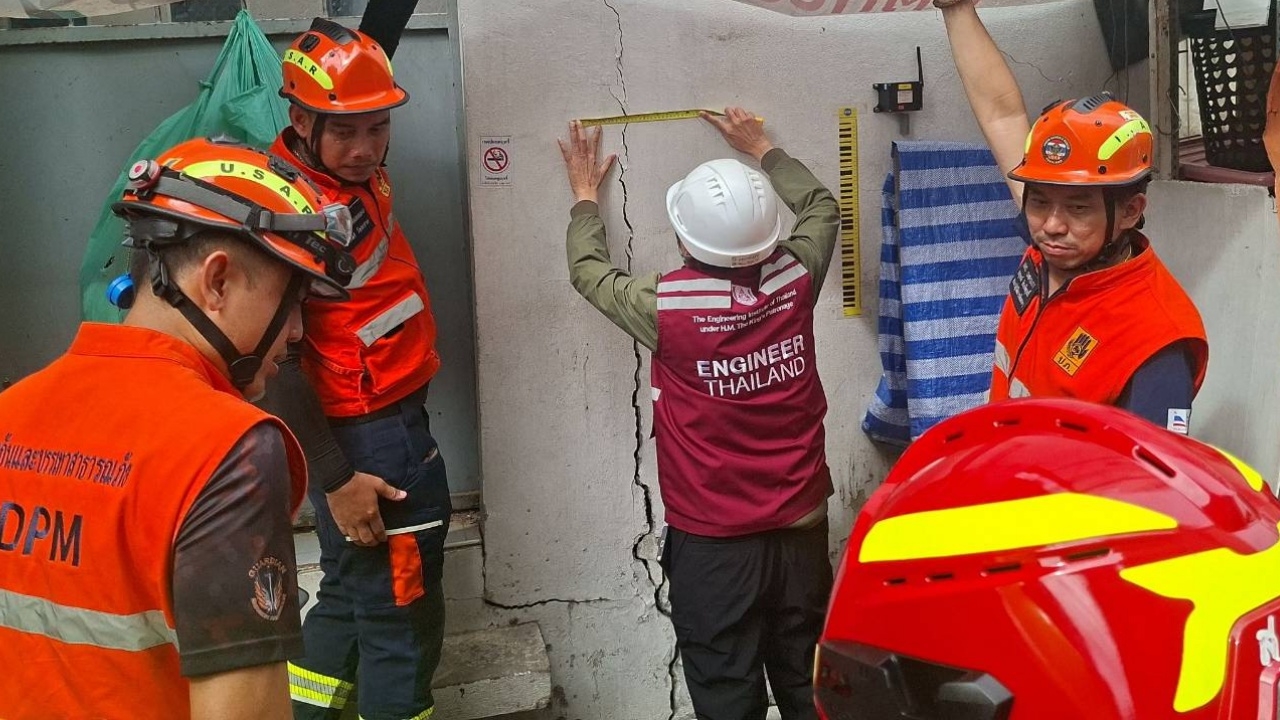
The President of the Structural Engineers Association of Thailand visited the site of building subsidence near the Wongwian Yai BTS tunnel. He revealed that water leakage points must be assessed daily. The situation is improving but requires caution. He emphasized that residents can still live there but should closely follow official updates.
At 10:00 a.m. on 10 July 2026, Professor Dr. Amorn Pimarnmas, President of the Structural Engineers Association of Thailand, inspected the water leakage incident at the underground Purple Line BTS tunnel construction site at Wongwian Yai intersection. This has caused subsidence and cracks in nearby buildings and structures. He told reporters that initial checks confirmed affected buildings near the construction site have indeed developed cracks, especially close to the construction pit, which is the lowest point of the underground tunnel.

Professor Dr. Amorn explained that normally, constructing an underground BTS tunnel requires building a water collection pit to handle water from track washing or tunnel drainage, which is then pumped out. Engineering designs specify ground improvement by injecting cement or chemicals to strengthen the soil before excavation or underground construction, preventing water and soil from flowing into the tunnel.
However, preliminary information indicates construction at this point has been completed, raising questions whether the ground improvement fully covered the affected area. If proper procedures were followed, the chance of water leaking into the tunnel would be reduced. This is a key issue that requires further investigation.

Professor Dr. Amorn added that the current corrective measure involves additional cement injection into soil layers to strengthen them and reduce water flow into the tunnel. The main concern is not just the water leakage but the soil erosion caused by water carrying soil into the tunnel. Soil loss can cause road surface subsidence and affect foundations of surrounding buildings, especially older buildings supported by short piles, which are more vulnerable to subsidence when supporting soil is lost.
The Structural Engineers Association of Thailand has measured building subsidence levels since the previous day to establish a baseline. They plan to re-measure daily to track the rate of subsidence and correlate it with cracks inside buildings. This will help evaluate the effectiveness of ongoing remedial measures.

The president said one key measure currently underway is reducing underground water pressure by digging deep wells and pumping out water, to enhance the effectiveness of grout injection at four leak points. He also suggested that authorities prepare contingency plans in case current methods fail, including alternatives such as water injection to create pressure barriers against soil flow or using ground freezing technology to solidify soil—methods experts should evaluate for suitability.
He stressed the utmost importance of continuous monitoring of water inflow to the tunnel, timely pumping, subsidence levels of roads and buildings, and close surveillance of cracks. Measurements should be taken hourly using survey instruments and level cameras that can operate continuously.
When asked about previous observations of about 20 centimeters of subsidence, Professor Dr. Amorn said that subsidence naturally does not reverse. The critical factor to monitor is whether the subsidence rate slows down. Since underground repairs are ongoing, an immediate halt to subsidence is unlikely. If the rate decreases and water pumping is controlled, it is a positive sign. But if subsidence increases, additional contingency plans are needed immediately.

He noted that the subsidence area forms a depression consistent with the construction pit location, which is about 30 meters deep. Areas near this center and the nearby footbridge are considered the highest risk zones.
However, he advised against public panic, noting this case differs from the previous incident near Vajira Hospital. The previous area was at a station joint with many gaps allowing easy soil flow, while Wongwian Yai is the tunnel's lowest point, not a station joint. Although soil flow into the tunnel is possible, the volume is expected to be less than in the Vajira Hospital case.
Nonetheless, Professor Dr. Amorn emphasized that structural differences do not guarantee safety, so close monitoring of inspection results is still needed to assess if the situation is under control.
Regarding residents living in nearby buildings and homes, he said they can still stay for now but must await daily inspection results. No significant increase in subsidence has been detected yet, suggesting some level of control. However, official information from responsible agencies, which have installed monitoring instruments, must be followed.
On heavy rain, he said it is a critical factor to watch, as rainfall raises underground water levels, increasing water pressure and the chance of leaks into the tunnel. Weather conditions cannot be underestimated, even though related agencies report improving trends. Complete cessation of subsidence cannot be expected immediately.

Asked about the risk of a severe event like the Vajira Hospital case, Professor Dr. Amorn said the key factor is damage to the tunnel structure. Currently, the tunnel is believed undamaged except for leaks at joints, which require detailed inspection. If the structure remains intact, the risk of large soil inflow is lower. But if water pressure is uncontrolled, it could cause tunnel displacement, so continuous monitoring of tunnel movement is necessary.
Regarding the contractor, he said it was initially thought the issue occurred during construction, but since construction at the point is completed, a full review of construction processes is necessary. Particularly, whether soil improvement before pit excavation was effective and met engineering standards, as soil movement could cause such incidents.
For further engineering examination, Professor Dr. Amorn, as a member of the Parliamentary Transport Commission, will bring the matter to the commission for review. He will invite agencies and stakeholders to explain and allow inspection of construction designs and related documents. So far, only contract structural plans have been seen, not the actual construction drawings or method statements, which are vital for assessing grouting, soil improvement, waterproofing, and construction details. This will aid in analyzing the cause and future risk after project completion.

He added that underground BTS tunnel structures generally have high strength standards. Issues usually arise at joints between different structural parts, where construction joints exist. If waterproofing is inadequate, leaks and spread can occur.
He urged local residents not to be complacent. If new cracks appear or existing ones worsen, they should immediately notify authorities for inspection to confirm building safety.
Regarding whether residents can continue to live in affected buildings, Professor Dr. Amorn said he cannot answer definitively yet, as the situation is time-sensitive. Grouting underground is complex and time-consuming. The most important thing is to continuously monitor underground water levels, subsidence rates, and data from instruments hourly to assess the situation and determine appropriate measures.