

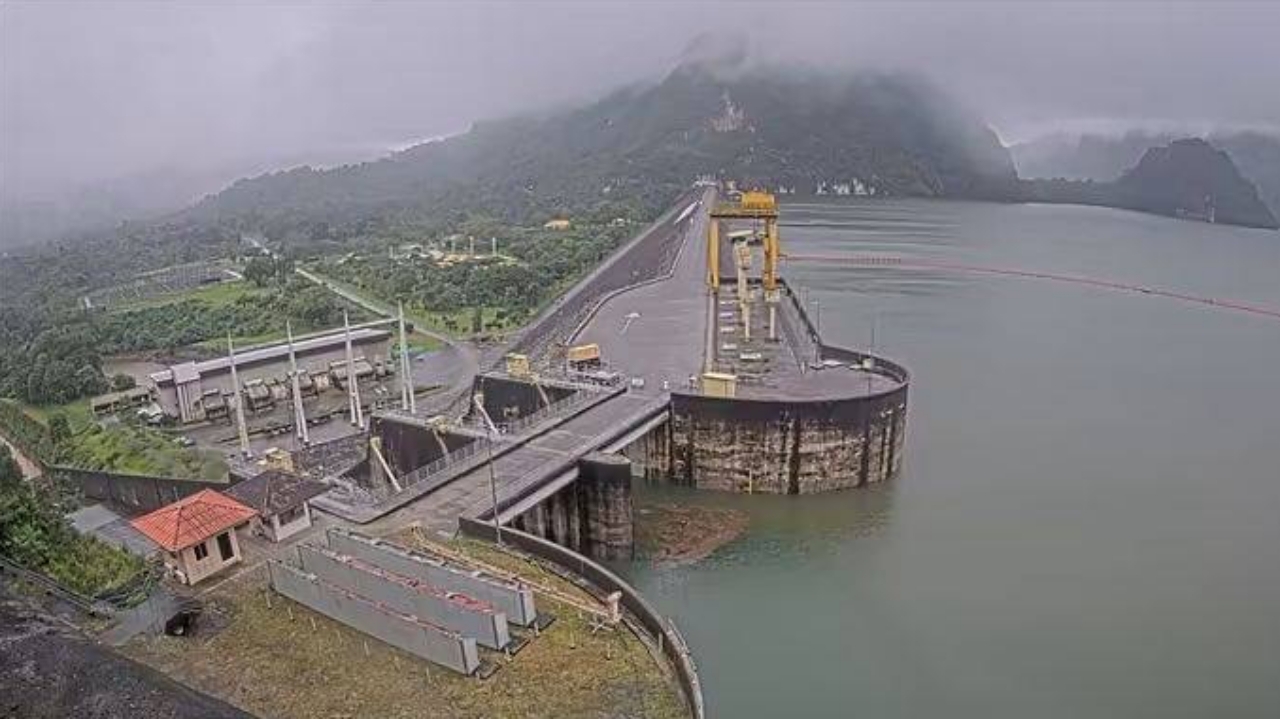
Vajiralongkorn Dam announced an increase in water discharge from 15 to 30 million cubic meters per day (347 cubic meters per second). It warned residents along the Khwae River to move belongings to higher ground and relocate vulnerable groups to safe areas instead of low-lying zones due to rising water levels.
On 29 September 2026, reporters stated that the Electricity Generating Authority of Thailand (EGAT) at Vajiralongkorn Dam reported continuous heavy rainfall in Kanchanaburi Province, causing a steady rise in inflow to the reservoir. As of 19:00 on 28 September 2026, the reservoir held 8,484 million cubic meters, equivalent to 96 percent of its capacity.
Following the decision of the working group on weather analysis and water situation forecasting, supervised by the Office of the National Water Resources (ONWR), it was approved to increase water discharge from Vajiralongkorn Dam to accommodate the additional incoming water as follows.

This water discharge adjustment strictly follows the Vajiralongkorn Dam water management manual. EGAT will closely monitor water and weather conditions and continuously inform the public.
For inquiries or additional information, contact EGAT Vajiralongkorn Dam at 0 3459 8031 or 0 3459 9077 ext. 3110, 3111, or through the EGAT One application available 24 hours a day.

. . . . . . Pr Kanchanaburi, the Public Relations office of Kanchanaburi Province, . . . updated the situation at the Skywalk along the Khwae River at 07:00 today, advising residents living near the river to prepare by moving belongings, electrical appliances, agricultural equipment, and valuables to higher ground or upper floors of their homes.
They should prepare essential items (emergency bags), including medications, dry food, clean drinking water, flashlights, important documents, and mosquito repellent, ready to grab immediately.
For electrical safety, residents should check plugs and wiring. If water begins to reach house floors, immediately switch off the circuit breakers or cut off electricity on the ground floor to prevent short circuits and electric shock.
Plans should be made to relocate vulnerable groups such as the elderly, bedridden patients, young children, and pets to safe locations or village evacuation points. Securely tie up vehicles and boats near the river to prevent them from being swept away by currents. Please drive carefully on the roads. Emergency contact channels are available 24 hours a day.