

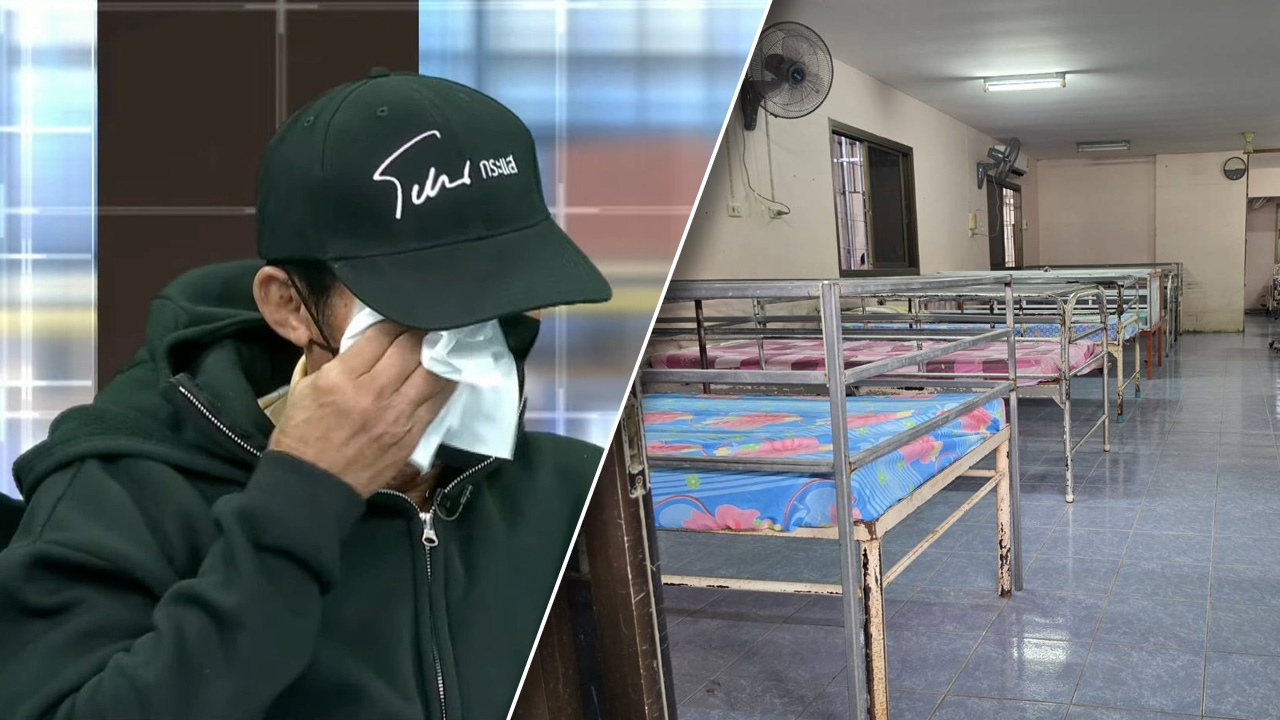
"Uncle Chang," a former resident of Sothornchai Nursing Home in Kanchanaburi Province, insists he was not ill or involved with drugs. He was forcibly brought there by his family and confined to a cage bed on his first day. His sister filed a court case, which led to his release.
On 7 Oct 2026, Mae Phattra filed a complaint that her son had taken her to Sothornchai Nursing Home in Tha Muang Subdistrict, Tha Muang District, Kanchanaburi Province, a care center for the elderly and those with psychiatric conditions. Images of the facility showed separate zones for men and women surrounded by barred cages topped with barbed wire, reportedly to prevent patient escapes. There were also 'cage beds' used for some elderly patients, created because prolonged hand-tying caused swollen hands, as previously reported.
In the latest development, Mae Phattra and former residents of Sothornchai Nursing Home appeared on the program "Hon Krasae" to share their experiences.
Uncle Chang, one of the former residents, said he was taken to Sothornchai Nursing Home by his family because, while running a business with them, he had violent outbursts and disputes over assets. His wife brought him there before April 2025, where he stayed about three months. He did not know who brought him but was handcuffed and locked to a seat, with his wallet and phone confiscated. He noticed the vehicle went the wrong way—he was told they were going to a hospital in Nakhon Pathom but ended up beyond that. Upon arrival, four staff carried him inside, stripped him, put him in a diaper, and placed him in a cage bed where he could not turn over. Uncle Chang insisted he neither used drugs nor had any psychiatric history. When he needed to urinate, he protested, and staff called the center’s owner, Mae Kaew, who told him to urinate into the diaper.
Uncle Chang continued that while inside, staff asked if he was asleep; if not, they said they would give him medication, but he refused. Shortly after, he offered to pay double the monthly fee—his wife paid 18,000 baht per month—to be released and settle family matters. After about an hour in the cage bed, they told him to calm down and removed the cage top. He stayed there three days before being moved to the yellow building for psychiatric patients, sharing a room with a former soldier with mild mental issues. At night, the soldier would peer at him, so he pretended to sleep. They lived in harsh conditions, sometimes defecating and urinating in their own containers; another building housing youths used shared containers. Later, he was moved to a treatment building mainly for youths, each building surrounded by bars.

Uncle Chang said he stayed more than three months. When admitted, he was normal, but upon release his mental health was very poor; sometimes talking about it made him cry. Food was poor quality—unripe bananas with coffee or soy milk; lunch was inconsistent and unpalatable. He often discarded most food daily for about a month, eating only a few bites. Sometimes he had to ask neighbors for potato chips as a substitute. Someone even complained he wasted food daily. When he requested smaller portions, he was scolded; when he wasted food, he was also scolded. He asked for canned fish, which was provided. Before inspections, male patients had to shower naked outside; after inspections, separate bathrooms were installed.
However, Uncle Chang maintained he was never physically abused because he defended himself. He refused medication fearing it might not be proper sedatives.
Mae Phattra said she had been given sedatives; when she was quiet and unresponsive, staff pressured her for answers, then accused her of tantrums and forced her to take medication.
Uncle Chang said he was similarly provoked to anger to justify medicating him, but he remained calm and did not resist, fearing they would use medication to label him mentally ill. Most caregivers were youths and locals; only one or two appeared to be nurses.

Patients who stayed long without escape attempts were assigned duties like distributing meals and drinks or carrying urine and feces bags, which were collected by vehicle later.
Uncle Chang explained he was released after his sister filed a complaint at Pho Kaeo Police Station. Due to delays, she hired a lawyer to sue his wife to have the center confirm and arrange his release, costing over 300,000 baht. The court ruling allowed his release. Contact with his sister was through an acquaintance who supplied medical equipment and helped search by calling centers to inquire about him. The center reportedly said reporting to Tha Muang Police Station would be ineffective.

Uncle Ae revealed he had previously stayed at a center in Nonthaburi Province but escaped due to mistreatment and lived with his sister. His son hired someone to forcibly take him to the center in Kanchanaburi. He admitted family problems: after his wife’s illness and death, his son-in-law was imprisoned, and his daughter was tricked into signing as estate manager, losing bank funds. He never reported this because he was alone without support. Meeting Mae Phattra at Sothornchai Nursing Home, they even planned to escape together. He entered Sothornchai at the end of 2023 and was released late 2025 after signing a power of attorney giving his son control of assets, which led to his release.
While inside, he felt deeply mentally distressed but said he did not sleep in a cage bed. He was in the rear zone, formerly a metal cage without wooden partitions or bathrooms, with all rooms locked. Fees were about 12,000–13,000 baht per month, and food was similar to others’.
Source: Hon Krasae