

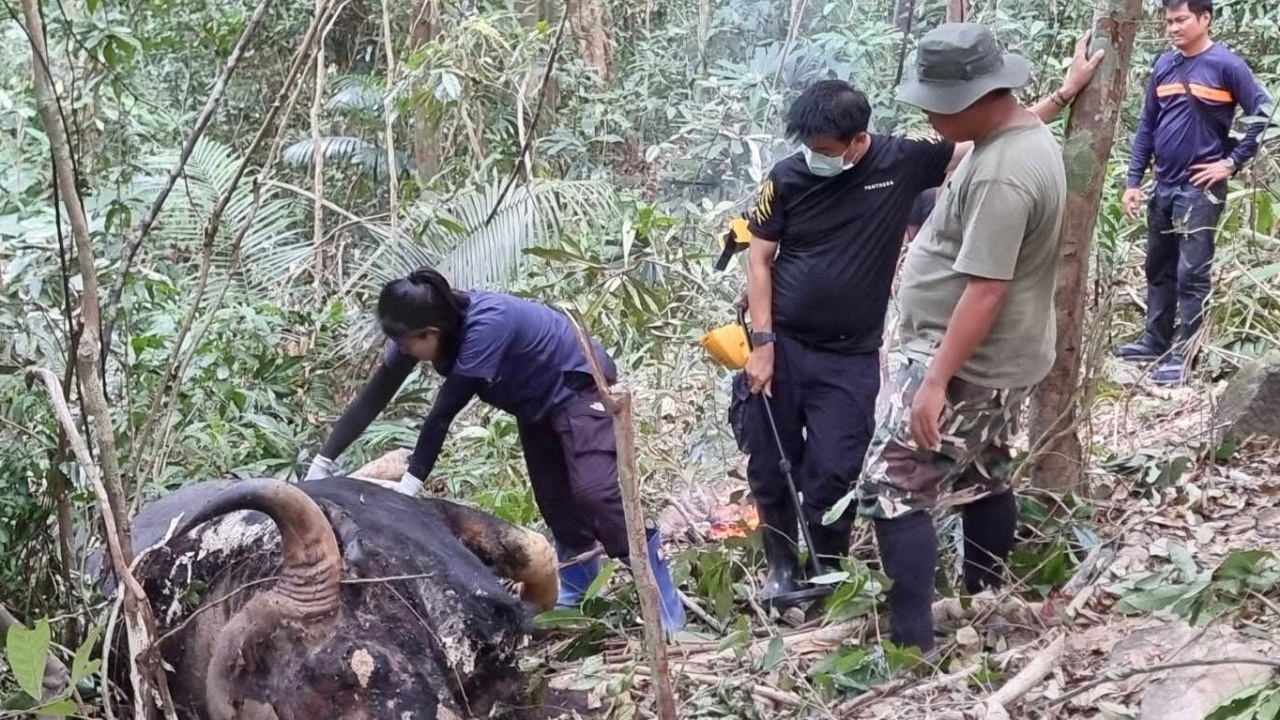
A male banteng carcass was found in the forest in Sarika Subdistrict, Nakhon Nayok Province. It had begun decomposing and emitted a foul odor. Injuries consistent with fighting were observed, suggesting it died after a struggle for herd leadership, falling from the mountain.
Reporters stated that on the evening of 5 Feb 2026, Police Lieutenant Suwapich Raseemin, the duty officer at Mueang Nakhon Nayok Police Station, was notified by staff from Khao Yai National Park Protection Unit 13 (Nang Rong) of a male banteng carcass, approximately 10-15 years old, found dead in the forest near the entrance to Krok Thurian Waterfall, Village No. 2, Sarika Subdistrict, Mueang District, Nakhon Nayok Province. They coordinated with Dr. Chananya Kanchanasakha, or Dr. Bow, head of the Chong Klam Bon Wildlife Breeding Station in Sa Kaeo Province, to inspect the site, accompanied by the Sarika Subdistrict Wild Elephant Surveillance Unit, the Sarika Subdistrict Disaster Prevention and Mitigation Department, and the Nakhon Nayok Elephant Friends group.

At the scene, the male banteng carcass was in a state of decomposition and emitting a foul odor, estimated to have died about 7-10 days earlier. Evidence of fighting among bantengs was found, leading to the animal falling from the mountain and dying. Multiple wounds were visible on the body. A metal detector scan found no abnormalities. The conclusion was that the banteng died from natural fighting to compete for herd leadership.

Officials later agreed that the carcass could not be preserved and, due to the odor, sought approval from the investigating officer to conduct an autopsy and destroy the carcass. The internal organs were decomposed, making it impossible to determine a precise cause of death. The officials then collectively destroyed the banteng's horns and cremated the carcass, completing the operation.