

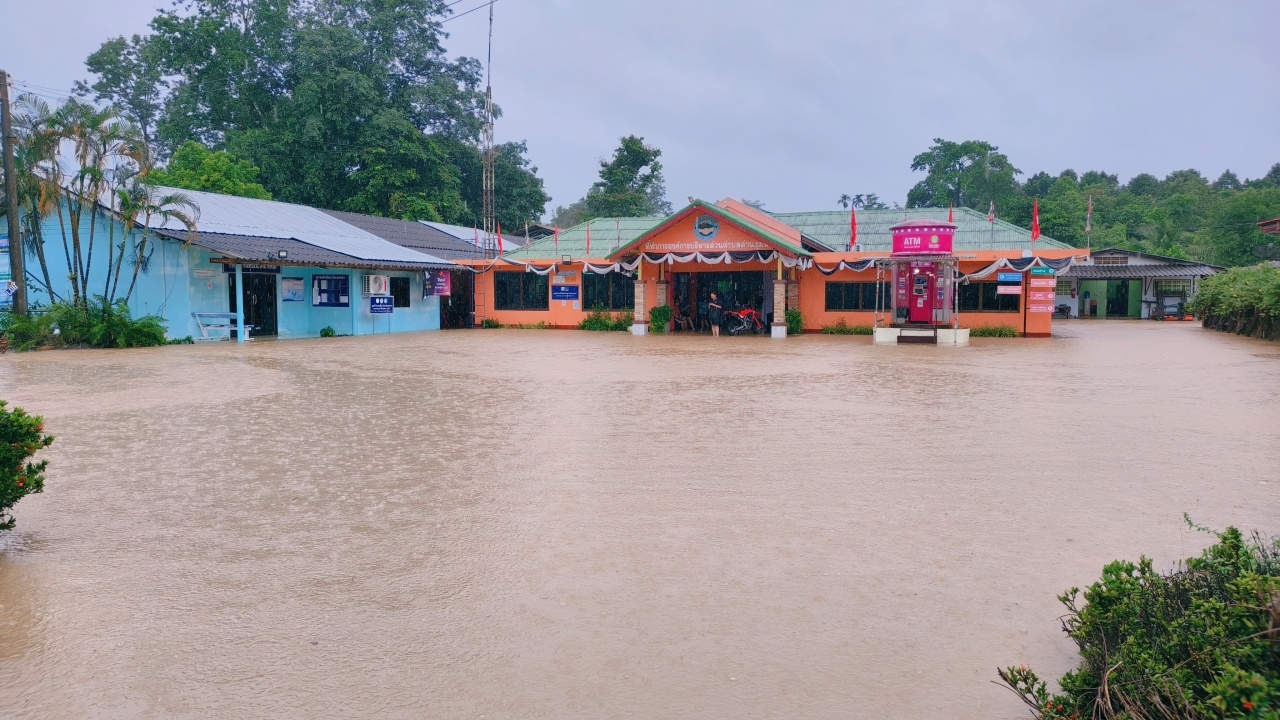
Trat province has been severely affected by continuous heavy rain, triggering flash floods that have inundated many homes in Khao Saming and Bo Rai districts. The Department of Disaster Prevention and Mitigation dispatched 30 boats to assist in relief efforts. Meanwhile, the national park has temporarily closed Khlong Kaeo Waterfall to visitors.
On 4 July 2026 at approximately 11:30 a.m., reporters covered the heavy rain situation in Trat province caused by the influence of Tropical Storm Maysak. This resulted in flash floods in various areas. The latest reports indicate that water levels in key water sources such as Wang Thong Dam in Sato Subdistrict and Sato Canal continue to rise, putting riverside areas at high risk of flooding. Additionally, at Ang Canal, rising water has overflowed into homes along the canal in Nong Bon Subdistrict, affecting one residence so far, with ongoing close monitoring of riverside areas in Nong Bon and Chang Thun Subdistricts.

The heavy rain has also caused severe flash flooding, prompting authorities to close Khlong Kaeo Waterfall in Bo Ploy Subdistrict for safety reasons. Several transportation routes have been impacted as well; water has accumulated on Khlong Puk Road in Sato Subdistrict to a depth that small vehicles cannot pass. Likewise, flooding has occurred at the Nong Mat Soi Bridge in Village 4, Chang Thun Subdistrict, and near the Dan Chumphon Subdistrict Administrative Organization office, with at least four to five households affected by water overflow.
Mr. Pongpat Sinrai, the district chief of Khao Saming, stated that two days of continuous rainfall have produced over 150 millimeters of water, raising water levels significantly. Currently, the dam at Sato Canal in Ban Khao Cha-om is overflowing completely, sending water downstream to three villages: Village 3, Village 7, and Village 9. These villages are facing flooding, especially Village 7 (Ban Thung Krabok), where water levels at Sato Canal are rising and are now less than one meter below the bridge surface.

However, rainfall in the afternoon has lessened compared to the morning, leading to the expectation that water levels will not rise further. Houses along the canals have experienced some flooding but to a limited extent. Additionally, three other subdistricts—Thepnimit, Wang Takhian, and Thung Non Sri—remain under close watch. Water levels at Khao Saming Bridge remain normal and not yet high, and the district authorities are prepared to respond as needed.
In Bo Rai district, Mr. Sumeth Tapienthong, the district chief, reported that heavy rain fell mainly in Nong Bon Subdistrict, causing flooding in Ban Thanam Lang and water flowing down to Khor Lae Bridge in Chang Thun Subdistrict. Water levels reached the bridge surface. Fortunately, the rain stopped in the afternoon, causing water levels to recede.

Meanwhile, in Bo Ploy Subdistrict, water from Khlong Kaeo Waterfall flowed down after heavy rain, becoming intense enough that the national park had to prohibit tourists from swimming. Water levels rose and flowed into Bo Rai Canal but were not enough to flood homes; only some roads were submerged. However, several homes in Dan Chumphon Subdistrict experienced flooding.

In Nong Bon Subdistrict, Bo Rai district, 76-year-old Mrs. Yupin, a resident of Village 1 who lives with her 78-year-old husband who is speech-impaired, said this is the second time their house has been flooded. She explained that the flooding was caused by clogged drainage pipes blocked by debris such as tree branches, tables, and sometimes mattresses discarded by locals. During heavy rains and flooding, these items floated and blocked the drainage pipes, preventing water from flowing out, causing the water to overflow across the road and flood their home.
To provide assistance, the Trat Provincial Office of Disaster Prevention and Mitigation has urgently dispatched 30 flat-bottom boats to the affected areas.
