

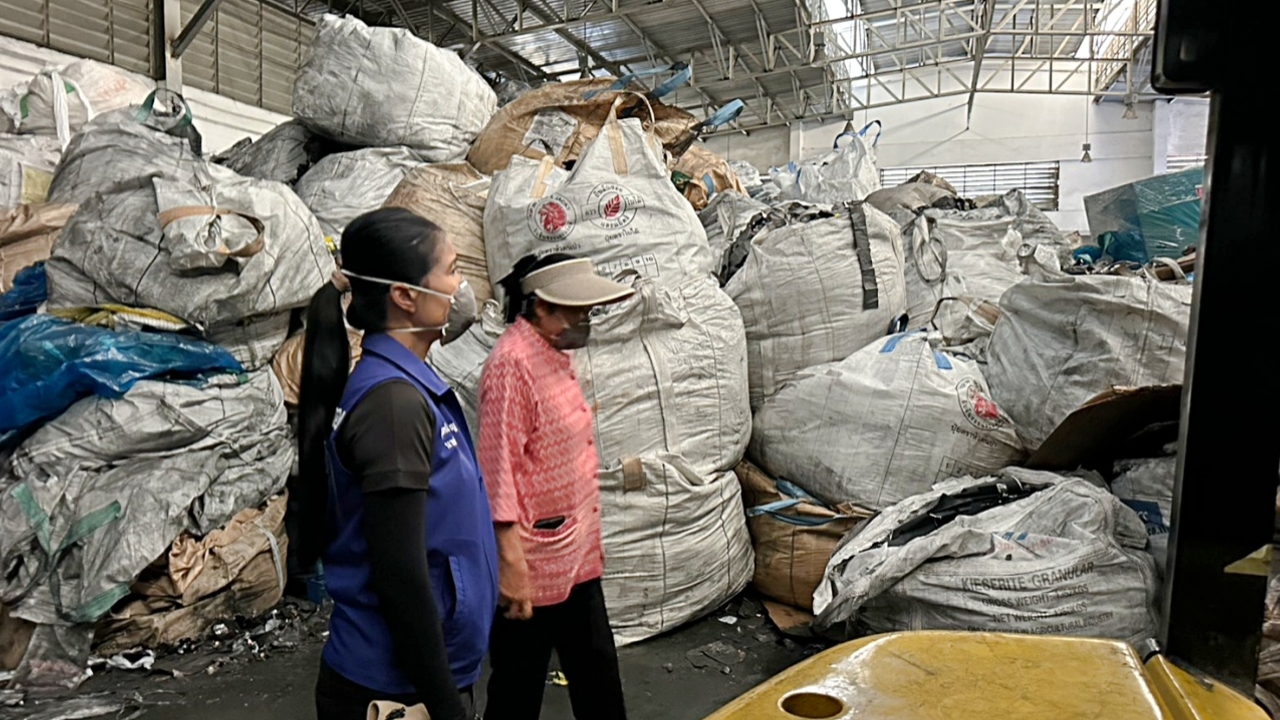
Stunning discovery of thousands of tons of lithium battery waste hidden in a warehouse in Bang Pakong. Authorities have ordered the seizure of evidence from five warehouses and are rushing to check for toxic leaks fearing contamination of the river. Legal action is planned against Thai nominees linked to Chinese investment.
At 11:00 a.m. on 6 November 2026, Ms. Arunrat Phumcharoen, Bang Pakong District Chief, together with Mrs. Somjit Phansuwan, Mayor of Tha Kham Municipality, responded to a request from the Chachoengsao Provincial Industry Office to inspect factory numbers 105 (operations involving sorting or landfill of waste) and 106 (operations involving recycling industrial products into raw materials or new products) located in Tha Kham Subdistrict.
Ms. Arunrat Phumcharoen instructed Ms. Sukanya Taengcharoen, Senior District Officer of Bang Pakong, along with the security district officer, justice district officer, Tha Kham Municipality officials, Bang Pakong police officers, and local administrative officials to jointly conduct an on-site inspection.

The inspection revealed illegal operation without a permit and conducting business types not authorized by the license. Details are as follows:
1. The team inspected a company located in a warehouse area, Village No. 3, Tha Kham Subdistrict, Bang Pakong District, Chachoengsao Province, where lithium batteries were found stored on wooden shelves inside the factory building. Upon checking the business operation licenses, it was found that the company held a factory operation license (Form Ror. 4). However, the company did not have a health hazard business license (Form A.Por. 2).
The team questioned Ms. Kawittrapa, who identified herself as the business owner, and learned that the company had not applied for a health hazard business license from the local authorities. The local officials had previously inspected the factory on 15 October 2026 and ordered the company to remove the lithium batteries within seven days and to apply for the proper license.

However, the company failed to comply with the order. Moreover, Tha Kham Municipality and local authorities received intelligence that lithium batteries and industrial waste products were being secretly moved to other factory buildings nearby. The team then requested permission to inspect as reported and indeed found lithium batteries and industrial waste products in factory buildings W5 and W 2-2, room 1.

2. Further inspection of factory building W 2-2, room 2, which was licensed under another company, revealed two large machines used for sorting industrial waste from lithium batteries. Upon checking the operation license, it was a factory license (Form Ror. 4) for battery manufacturing, which is considered a business type different from the authorized operation.

The application for factory license number 106 was submitted to the provincial industry office but had not been approved yet. Ms. Arunrat Phumcharoen, Bang Pakong District Chief, revealed that all seized items from the five warehouses, weighing nearly 10,000 tons, had been confiscated. She ordered Tha Kham Municipality to urgently inspect water sources, canals, and public waterways connected to the warehouses that flow into the Bang Pakong River to prevent toxic leaks and environmental impact. Legal action will be taken against Thai nominees acting as fronts for Chinese investors operating the business.