

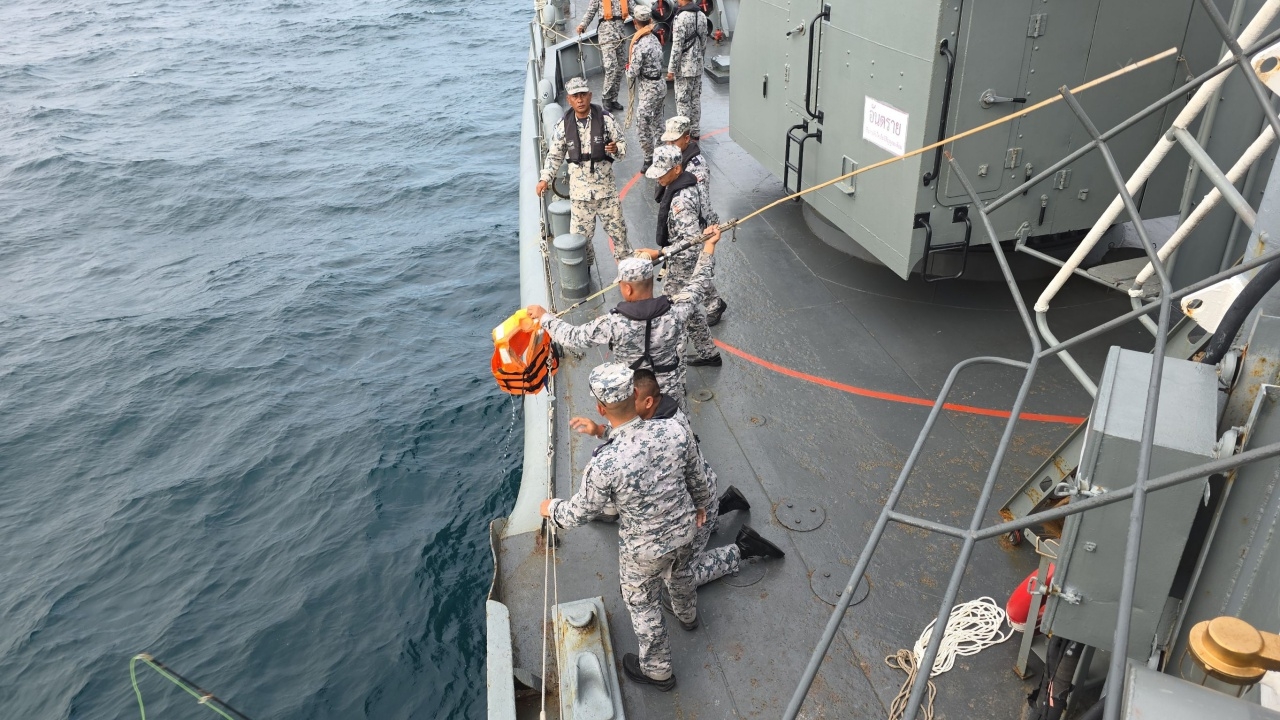
Search efforts continue into the second day for the missing crew of the "Venus 14." The Royal Navy's Chao Phraya patrol ship surveyed near the incident coordinates and found a new orange life jacket floating on the water surface. Authorities are urgently collecting it for forensic examination to determine any connection, while monitoring for potential leakage of 280,000 liters of diesel fuel into the sea.
On 12 Nov 2026 GMT+7, the Maritime National Interests Protection Center Region 1, in cooperation with the First Naval Area Command, continued search and rescue operations for all six crew members on the second consecutive day after the fishing oil tanker "Venus 14" sank in the Gulf of Thailand on 11 Nov.
During the operation, officials deployed patrol boat T.113 with special operations teams, reconnaissance aircraft, vessels from the Marine Department, and personnel from related agencies to continuously search the area, aiming to locate and rescue all six missing crew members as soon as possible.

Simultaneously, authorities closely monitored the environmental situation because the sunken ship carried about 280,000 liters of diesel fuel, which could impact marine ecosystems if leaked. They have prepared personnel, ships, helicopters, and oil spill cleanup equipment ready to deploy immediately in case of an emergency.
The incident occurred near latitude 12 degrees 20 minutes north and longitude 100 degrees 29 minutes east, approximately 28 nautical miles from the coast of Prachuap Khiri Khan Province. The ship sank around 09:00 on 11 Nov 2026 GMT+7.

The Department of Marine and Coastal Resources, through the Central Gulf of Thailand Marine and Coastal Resources Research Center, examined risk areas. The sinking site lies about 28 nautical miles from marine resource areas in Sam Roi Yot District and about 50 nautical miles from Mueang Prachuap Khiri Khan District.
Preliminary checks have found no reports of oil leakage so far. However, related agencies continue to closely monitor the situation due to the large volume of fuel remaining inside the vessel.

A model from the Geo-Informatics and Space Technology Development Agency (GISTDA) estimates that if a leak occurs, the oil slick could move southward from the incident site, then veer west or southwest following water currents and environmental factors. Should the slick enter Prachuap Khiri Khan Gulf, it could affect approximately 61 rai of coral reef areas, including 25 rai at Ko Rad, 15 rai at Khao Lom Muak, 11 rai at Ko Lak, 6 rai at Ko Rom, and 4 rai at Ko Haim.
However, the severity of the impact depends on the type and volume of oil leaked, its concentration, exposure duration of resources, and the sensitivity of local ecosystems. These figures represent model-based risk assessments, not actual damage recorded.
All agencies continue to prioritize the search and rescue of the six crew members while preparing measures to prevent marine environmental damage. The public is urged to send encouragement to the officials working at full capacity on this mission.

At 15:20, the Royal Navy's Chao Phraya, under Rear Admiral Wasan Traijit, Commander of the First Naval Area Command, directing the search, and Commander Lieutenant Commander Thanarot Thanasiripikul, patrolled near the sinking coordinates and found a new orange reflective life jacket floating on the water. They collected it for forensic examination to determine any connection to the six missing crew members. The life jacket bore the inscription “SOLAS-XT1800B1*0525/2022.” Detailed analysis is still ongoing to clarify its link.

