

Unveiling an unseen tourist destination in the Isan region. "Phaya Naga Cave" An adventurous journey into the dark underworld revealing a complete display of geological beauty.
On 7 Jan 2026 GMT+7, a reporter visited Phaya Naga Cave, located at Ban Sam Phak Nam, Na Nong Thum Subdistrict, Chum Phae District, Khon Kaen Province, within Phu Pha Man National Park. This area is rich in natural diversity and hosts several notable tourist sites, especially a bat cave inhabited by many bats. Meanwhile, Phaya Naga Cave stands out for its geological uniqueness and unusual features, attracting tourists from both local and outside areas.

To visit Phaya Naga Cave, tourists must contact the Phu Pha Man National Park office to pay the entrance fee per park regulations. The office sells a souvenir passport for 100 baht for those wishing to keep a memento. Visitors then wait for the scheduled tour, and while waiting, they can take photos with the park sign featuring a backdrop of the camping ground and high mountain ranges, creating a beautiful atmosphere.
At the tour time, staff transport visitors by park vehicle to the trailhead about 10 kilometers from the park office. From the parking area, visitors walk approximately 300 meters on foot to encounter several large stacked rocks with a sign marking Phaya Naga Cave's entrance. The entrance is a shaft requiring visitors to crouch and descend wooden stairs to enter the cave.
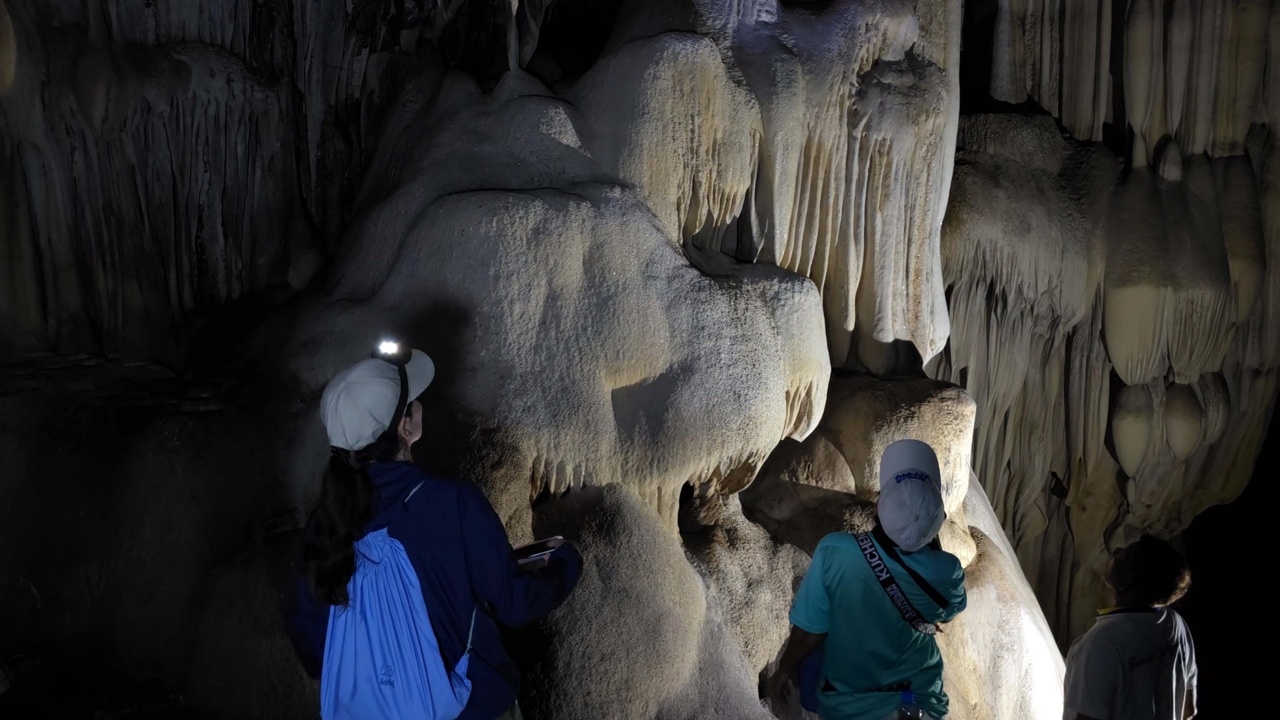
Inside the cave is a large chamber with a cool, humid, and pitch-dark atmosphere, necessitating flashlights for navigation. The interior is filled with various stalactites and stalagmites that sparkle when illuminated, resembling rare natural sculptures. Additionally, there is a distant view of paintings resembling a Chinese deity riding a tiger.
Deeper inside, looking upward reveals some stalactites with blackened areas, as if scorched. According to beliefs, these relate to the creation of amulets. Further on, visitors find tiered pools of water and stalactites resembling curtains. There is also a rock shaped like a princess and a cavernous formation called the “Princess Chamber.” Some rocks resemble large snakes, adding to the cave’s intriguing scenery.
The cave’s path is generally straightforward and easy to navigate without getting lost. However, it gradually slopes downward, connecting to two other caves, suitable for physically fit visitors. Along the way, tourists can take shadow photos with the curtain-like stalactites as guides shine lights for souvenirs. The cave’s total darkness, with only natural light from the entrance, creates a heavenly beam effect, making it a popular photo spot.
Mr. Manut Tiprak, 46, a forest ranger and tour guide, shared that according to elders, Phaya Naga Cave was first discovered in 1988 by a northern-born monk affiliated with the Ji Gong sect. After Phu Pha Man National Park was established in 1991, officials inspected and found it to be a large cave, then developed it continuously into a tourist site. Though these accounts lack strong historical evidence.

The cave’s physical features include limestone formations with unique stalactites, stalagmites, and large stone pillars, resembling an underwater city, leading to beliefs that it was once home to the mythical Phaya Naga serpent. Certain rocks look like giant snake scales, inspiring the cave’s name. Inside, calcite minerals within the limestone reflect light and show translucence due to unique crystallization. The area contains three major caves—Phaya Naga Cave, Kled Kaew Cave, and Lai Tang Cave—connected for nearly one kilometer.
The cave’s interior path is winding and adventurous, requiring visitors to be physically fit since total darkness persists throughout. Phaya Naga Cave is an unseen attraction in Isan, ideal for adventure travelers seeking moderate difficulty. Its stunning and unusual stalactites and stalagmites have earned it recognition as one of the most beautiful caves in the region.
Visitors must always coordinate with Phu Pha Man National Park staff, who provide guides and supervision during the trip. Self-guided visits are not permitted. Entrance fees are 20 baht for adults, 10 baht for children, plus 30 baht for transportation. Cave tours require booking at least one day in advance, with one daily tour at 09:30 and additional tours at 13:30 on weekends, limited to 20 people per tour. Registration opens at 08:00.
The cave tour fees are 150 baht for adults, 100 baht for children under 12, 200 baht for foreign adults, 150 baht for foreign children, or 800 baht flat rate for groups of 1–5. The park provides drinking water, mosquito repellent, transportation, spotlights, and guides throughout. Visitors are advised to wear long pants and sneakers or secure sandals for safety. Phaya Naga Cave is open for tourism from October to May and closed from June to September to allow natural recovery and ensure visitor safety.