

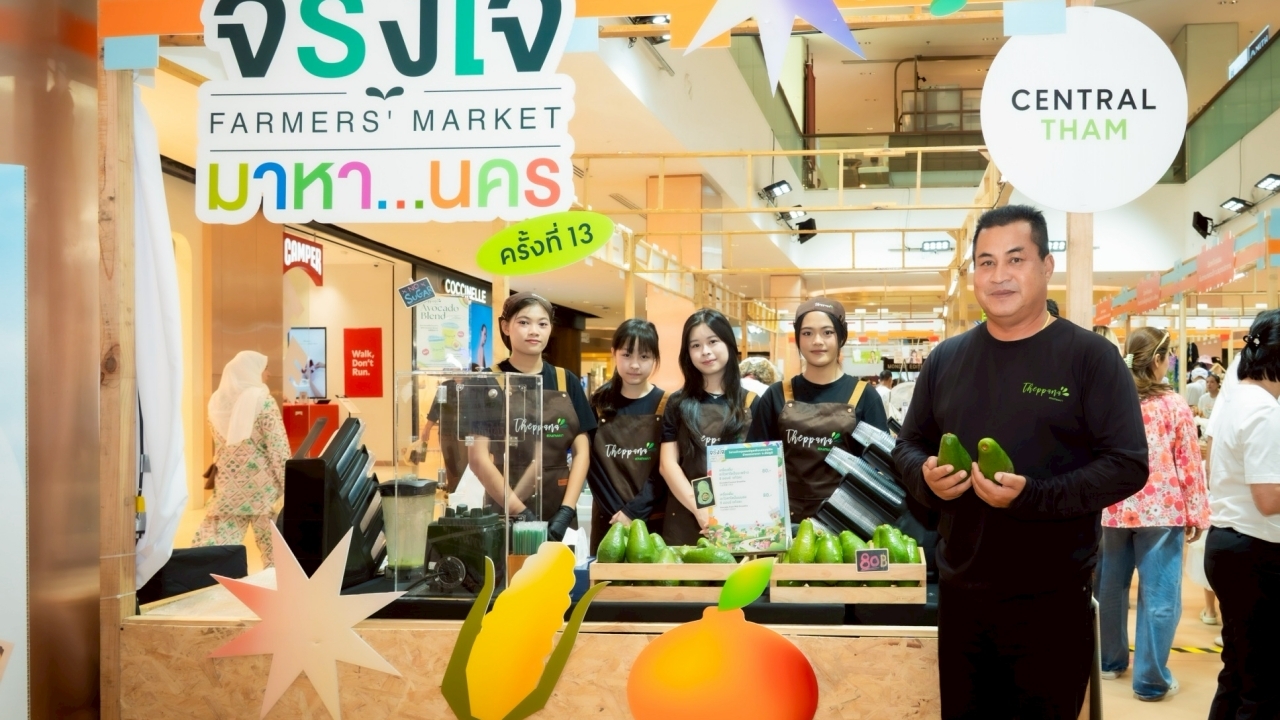
Showcasing the "13 Model Communities" model that transforms local produce into quality market goods recognized by consumers, exemplified by the Melon Community Enterprise in Moo Yai Ruamjai Phatthana, which generated total revenue exceeding 25.5 million baht in 2025.
On 24 July, reporters reported that the Central Group, through the "Central Tam" project—a social and sustainability initiative—shared information on promoting and supporting job creation and livelihoods for local people and farmers. They emphasized that for farmers to thrive sustainably, it's not enough to just grow good produce; there must be stable markets that add value. The "Central Tam" project collaborates with farmers, community enterprises, and partner networks nationwide to comprehensively enhance community capabilities—from production knowledge development, product quality upgrading, processing, packaging design, branding, to market linkage—so farmers can generate stable, self-reliant income long term.
This success is reflected in 13 model communities continuously developed under the "Central Tam" project, which have transformed local produce into quality products recognized by consumers. These products are showcased and sold at the 13th "Jingjai Maha... Nakhon" event, a platform connecting farmers directly with consumers and sharing producers' stories and each community's identity.

One success story is the Melon Community Enterprise in Moo Yai Ruamjai Phatthana, Phra Nakhon Si Ayutthaya Province, which received support in knowledge, product quality development, and market expansion. This enabled steadily increasing income for over 50 member households, with total revenue surpassing 25.5 million baht in 2025.
Another model community is the Thepphana Economic Crop Planting Community Enterprise in Chaiyaphum Province, which developed avocado cultivation into a local economic crop. They enhanced processing and production management, increasing value and generating over 60 million baht in income for farmers last year. They also promote environmentally friendly farming to ensure both economic and natural resource sustainability.

The Organic Agriculture and Sustainable Living Community in Mae Tha, Chiang Mai Province, applies organic farming concepts and resource management alongside value addition to local produce. This has generated stable income exceeding 14 million baht for members and serves as a model for grassroots economic development that grows in harmony with environmental care.

Meanwhile, the Organic Agricultural Community Enterprise in Bua Yai Subdistrict, Nan Province, has upgraded the local native pumpkin variety "Kai Nao" and organic produce by developing product standards such as pumpkin pastries and pies, creating branding, and linking to markets. This has increased product value and expanded recognition widely.

Another model community is the Textile Processing Community Enterprise in Ban Kut Jik, Village 9, Sakon Nakhon Province, which has leveraged traditional weaving wisdom to meet modern market demands. Supported by the "Central Tam" project in product quality development, pattern and product design aligned with consumer needs, packaging upgrades, branding, and diversified sales channels, this has increased the value of local woven fabrics, created stable income for members, and preserved local wisdom alongside sustainable economic opportunities.
Over the years, the "Central Tam" project has collaborated with government, private sector, experts, and partner networks to transfer knowledge in agriculture, product quality development, production standards, processing, branding, and business management. Simultaneously, it has provided farmers access to diverse sales channels, enhancing competitiveness, adding value to produce, and creating long-term stable income.

Currently, the project has generated over 2.24 billion baht in revolving income back to communities, covering development of 13 model communities nationwide. This reflects a commitment to elevating Thai farmers' capabilities, strengthening the grassroots economy, and sustainably advancing local produce into quality markets.