

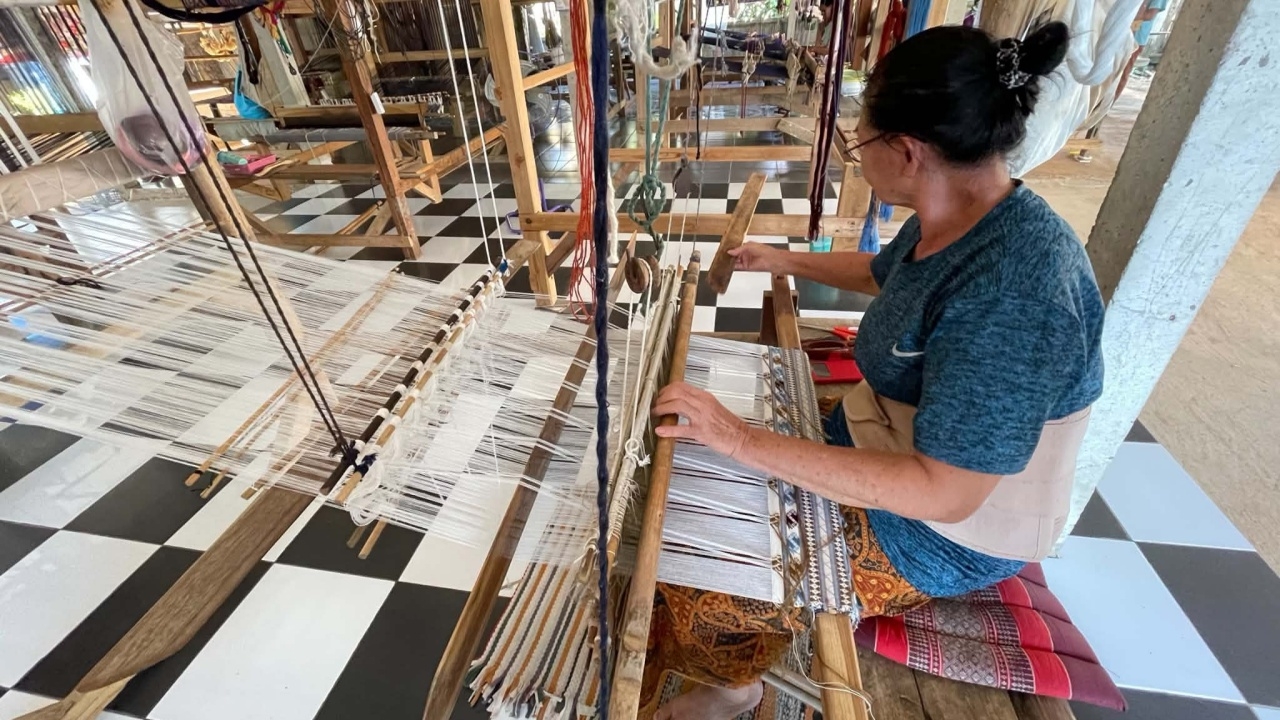
The "Central Tham" project supports the Ban Lai Thung Tai Lue silk weaving community enterprise in Nan province by developing natural fibers from banana stems as raw materials for weaving, creating sustainable jobs, livelihoods, and income.
On 10 Aug, reporters reported that Central Group’s "Central Tham" project shared information on supporting sustainable development by turning agricultural waste into valuable textile products that create jobs, boost the economy, and generate income for the Tai Lue community in Ban Lai Thung, Pon subdistrict, Thung Chang district, Nan province. They use banana stems, once discarded or sold cheaply after harvest, to produce banana fiber—a key raw material for contemporary woven textiles—adding value to local resources, creating jobs and income while preserving the Tai Lue weaving wisdom passed down through generations.
The Ban Lai Thung Tai Lue weaving community enterprise was founded in 2005 by local villagers aiming to preserve the identity of their flowing-patterned cloth, a local motif reflecting Tai Lue life, while upgrading production standards to ensure stable income. Currently, it has 52 members, led by Ms. Chanika Sodanat. The community continuously develops products to meet modern consumer needs. Since 2019, the Central Tham project has provided ongoing support, including funding for building a community shop as a product outlet and tourist welcome center, knowledge transfer on banana fiber weaving, promoting natural dyes and materials, product quality improvement, and establishing a learning center for banana fiber production so the community can convert agricultural waste into high-value, eco-friendly products.

Originally, locals cultivated banana as a main crop. After harvest, most banana stems were discarded or sold cheaply. Thanks to knowledge from the Central Tham project, the community now processes banana stem sheaths into natural fiber through separation, cleaning, drying, and development into weaving raw materials, transforming waste into valuable products that generate income for the community.
Ms. Chanika said their starting point was to preserve Tai Lue weaving wisdom and create community jobs. With Central Tham’s support, they improved product quality and learned to develop banana stems—previously almost worthless—into natural fibers for weaving, adding value to agricultural waste. They also aligned products with market demands and expanded sales channels. Community members have seen continuous income growth, stable year-round work, and renewed interest among younger generations in weaving and preserving ancestral wisdom. At the same time, they maximize local resource use, reduce agricultural waste, and sustainably add new value to the community. She hopes Ban Lai Thung’s woven cloth will represent Tai Lue community stories and continue generating income locally.

Beyond knowledge development, the Central Tham project continuously supports market linkage by bringing community products into the Good Goods store since 2021. They co-designed and developed banana fiber scarves made from natural fibers extracted from banana stems, with contemporary designs preserving Tai Lue weaving identity and appealing to modern consumers. This expanded market access and added value to community raw materials. The project also provided opportunities for the community to sell products at the "Jing Jai Ma Ha... Nakorn" event, raising awareness and market opportunities nationwide for local wisdom and banana fiber products.
A highlight of Ban Lai Thung community is using banana stem sheaths—local agricultural waste—to develop natural fiber, mixed appropriately with cotton fiber, dyed with natural colors, and woven with the community’s distinctive flowing patterns. The result is textile products outstanding in design, quality, and environmental friendliness, reflecting the integration of local wisdom with modern design to meet consumers prioritizing sustainable goods.

Enhancing the value of community resources and wisdom has continuously boosted the community enterprise’s income growth through producing woven banana fiber cloth.. Approximately monthly30,000 to 100,000 baht, demonstrating the potential of adding value to agricultural waste via innovation, local wisdom, and market linkage, thus securing stable income for community members while preserving cultural heritage alongside sustainable grassroots economic development.
