

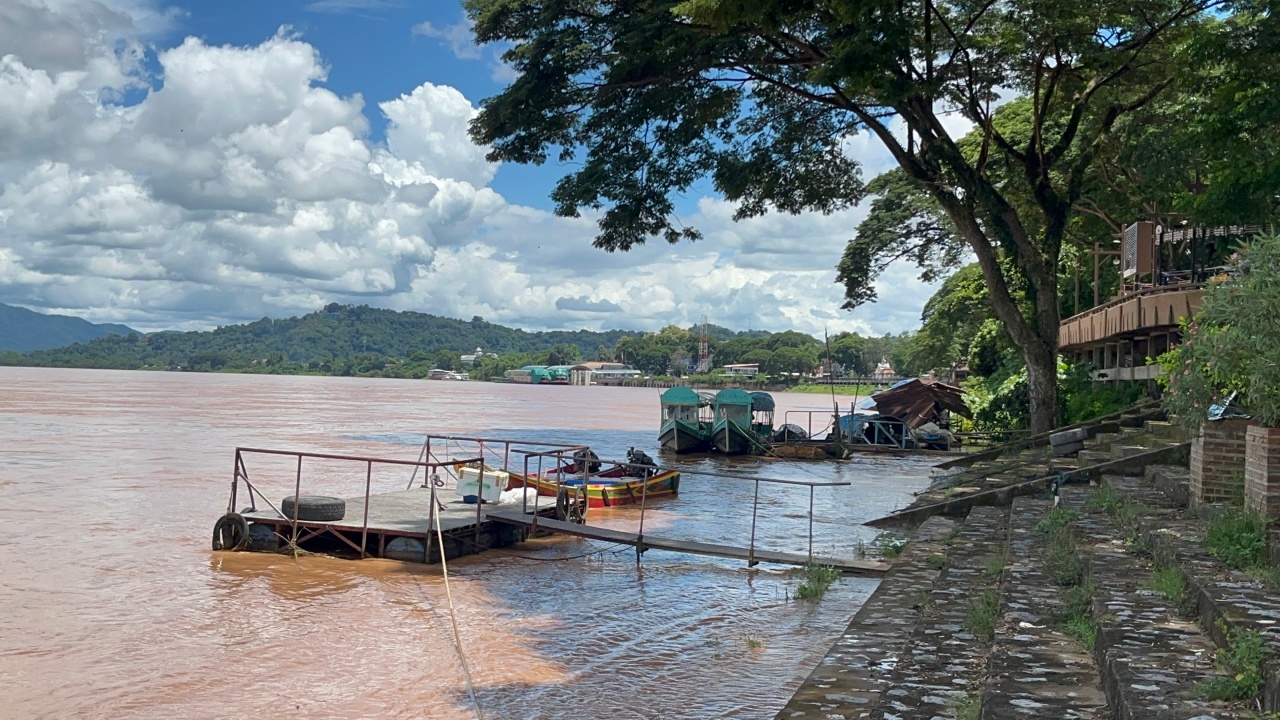
The Chiang Rai Marine Department reports that the latest Mekong River situation is stable with a downward trend, but it remains in the phase of "monitoring and vigilance." It is expected to return to normal soon if there is no additional rainfall.
On 10 Aug 2026 GMT+7, at the Chiang Rai Regional Marine Office, Mr. Suranat Sirichot, Director of the Chiang Rai Regional Marine Office, disclosed that the latest Mekong River level was measured at approximately 7.53 meters. The level has stabilized and begun to decrease compared to yesterday. Monitoring water levels upstream near Sob Kok town in the Lao PDR and Jinghong city in China shows water levels are declining, causing the Mekong River in Chiang Rai province to gradually recede accordingly.

However, the still-high Mekong water volume has caused flooding in tributary river mouths such as the Ruak, Kham, Kok, and Ing Rivers, inundating agricultural areas. Local administrative organizations and relevant government agencies have surveyed the affected areas and provided initial assistance. At present, these water levels have not significantly affected residential homes.

Mr. Suranat further stated that the current Mekong water level at 7.53 meters remains within the "monitoring and vigilance" range. The critical flood level starts at about 8.50 meters or higher, since the lowest riverbank points in Chiang Rai, such as Ban Saeo subdistrict, are around 9 meters. Provided there is no heavy accumulated rainfall upstream in areas like the Lao PDR, Myanmar, or southern China, the situation is expected to return to normal soon.

Additionally, Chiang Rai Marine Department has issued warnings to operators and vessel controllers to exercise extra caution during navigation due to strong currents and floating debris such as wood and trash, which could entangle propellers and cause accidents. They emphasize thorough engine checks and strict enforcement of safety measures, especially for passenger boats, which must have complete life-saving equipment as required by law to be allowed to operate.