

On the second day in Mae Sai, Yotsanan launched the smart sediment trap system to pump and extract arsenic at the Ban Mueang Daeng source, filtering water for over 60,000 rai of farmland. He set a deadline to verify results before water release on 25 Dec and scanned the 500,000-cubic-meter Nong Nam Phu reservoir to supplement water reserves.
On 23 Nov 2026, Professor Dr. Yotsanan Wongsawat, Deputy Prime Minister and Minister of Higher Education, Science, Research and Innovation, led a team from the National Nanotechnology Center (NANOTEC) to Mae Sai District, Chiang Rai Province, for the second consecutive day. They inspected the quality of two key water reserves—Ban Mueang Daeng and Nong Nam Phu reservoir—and held on-site discussions with community leaders and farmer representatives. They accelerated the operation of the sediment trap system to extract arsenic in the Ban Mueang Daeng irrigation canal, the main artery supplying water to over 60,000 rai of agricultural land.

The first mission at Ban Mueang Daeng began under NANOTEC’s field tent, where the research team set up equipment to analyze raw water samples from the source and displayed live results on screens. Professor Dr. Yotsanan unfolded a map of the water network and irrigation canals with academic and irrigation officials to explain the contaminant capture structure to the community and media. He emphasized that this is a “sediment trap pond,” not a “weir,” clarifying it does not block the main river as some locals feared. Instead, it enhances the existing irrigation canal system managed by the Royal Irrigation Department, where sediment trap ponds already exist, located away from residential areas. They started with a small sandbox unit so villagers could observe the actual mechanism before scaling up.
While inspecting the project site’s dirt yard and reviewing technical processes, Professor Dr. Yotsanan addressed local concerns about accumulation of hazardous sediment. Unlike typical irrigation weirs which may have long intervals between dredging, they chose a “smart sediment trap pond” equipped with sensors that continuously monitor sediment levels combined with a continuous suction system to prevent buildup. In the pilot phase, extracted sediment is bagged for removal from the area, with all steps demonstrated to the community. The full installation will include a sludge belt press to dewater and compress sediment before disposal.

The Deputy Prime Minister set a deadline for the research team to expedite testing and measure water quality before and after treatment from the source to the outlet to demonstrate clear results before the irrigation water release on 25 Dec. He also instructed that sediment disposal sites and responsible agencies be clearly identified. During discussions with officials, Professor Dr. Yotsanan said this field visit aimed to assess actual conditions and clarify roles among agencies, not to create content.
At one point, the village headman and the chairman of the water users’ group exchanged concerns. The village headman said the community’s primary worry is the safety of drinking and daily use water, followed by water for agriculture. He urged authorities to act promptly and communicate progress regularly to ease community concerns. Meanwhile, the water users’ chairman inquired about water availability for off-season rice cultivation.
Professor Dr. Yotsanan explained that currently farmers can still cultivate crops as contaminant levels remain within standards. However, if sediment filtration systems are not installed at the irrigation canal source, which supports over 60,000 rai of farmland, within one to two years arsenic could accumulate in the soil beyond safe levels, rendering the land unusable. Starting sediment extraction now protects the soil in advance, alongside clear communication to farmers about which areas can use water immediately for off-season rice and which require filtered water. Scientific certification of water quality will assure buyers of product safety and allow farmers to continue cultivation confidently.
Regarding community involvement, Professor Dr. Yotsanan assured leaders that no information is confidential. The village headman, water users’ chairman, and residents can inspect the site anytime—from system installation through to visual confirmation of sediment containers filled with arsenic and their removal. Additionally, the NANOTEC water quality testing equipment used in the field trial will be handed over to local health agencies and community committees for ongoing water quality monitoring by the local population.

Looking ahead, Professor Dr. Yotsanan noted the government prioritizes upstream negotiations with Myanmar to resolve pollution at its source. Yet scientifically, even if upstream pollution stops, residual arsenic sediment already settled in waterways remains and can resuspend during floods. Natural recovery alone could take 20–30 years or even centuries. Installing sediment traps at strategic points in the irrigation network is thus not just a temporary fix but a necessary restoration phase to break the cycle of long-term contamination.
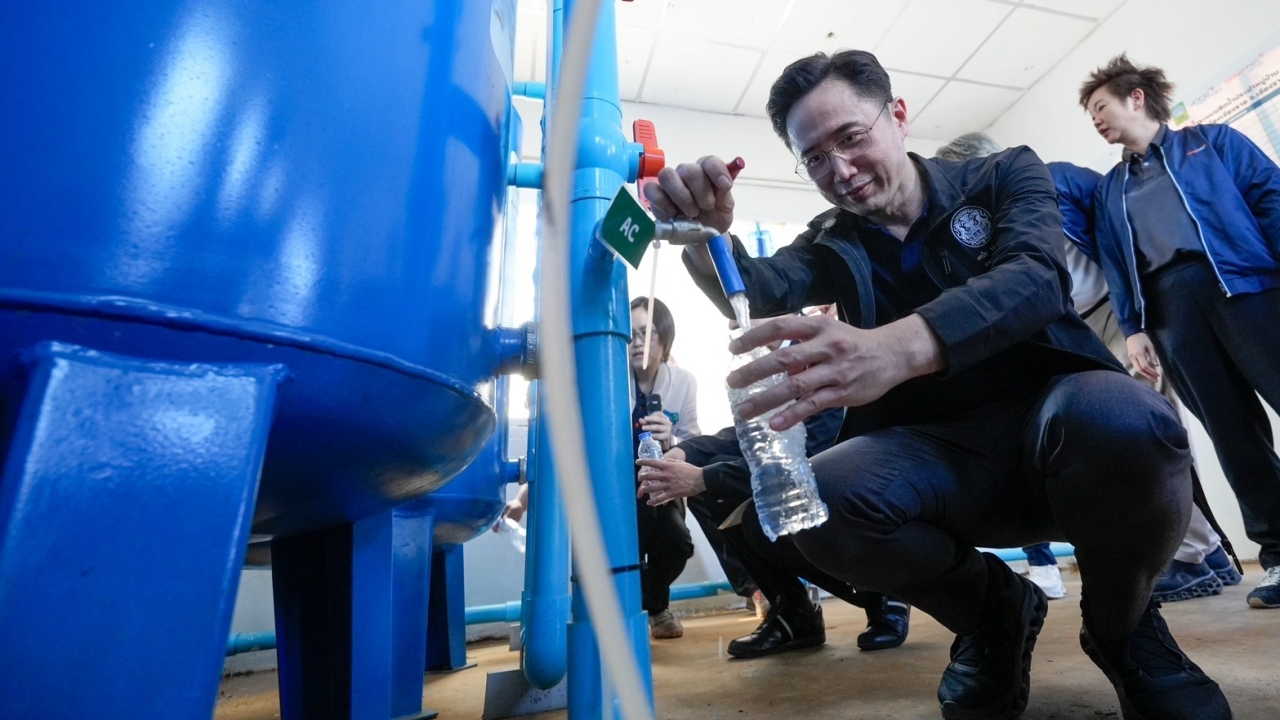
Beyond the irrigation canal, the team also inspected the water filtration system at Ban Mueang Daeng School, developed with the Synchrotron Light Research Institute. Laboratory analysis confirmed the system effectively traps arsenic and reduces heavy metals to safe levels.

Later, the group proceeded to Nong Nam Phu reservoir in Pong Pha Subdistrict, about 9.8 kilometers from Mae Sai town center, to oversee sample collection and contamination assessment by NANOTEC. This reservoir is a major water reserve for the district, comprising an upper basin of 82 rai, averaging 3 meters deep with about 400,000 cubic meters capacity, and a lower basin of 21 rai with similar depth and about 100,000 cubic meters capacity, totaling roughly 500,000 cubic meters.
The second day in Mae Sai marked a shift from simply assessing water reserve volumes to implementing filtration and toxin capture systems at the irrigation canal source feeding over 60,000 rai of farmland. This approach links scientific data verification with community oversight and transfers monitoring tools to local hands, aiming to restore water resources, protect farmers’ livelihoods, and build trust within the community.