

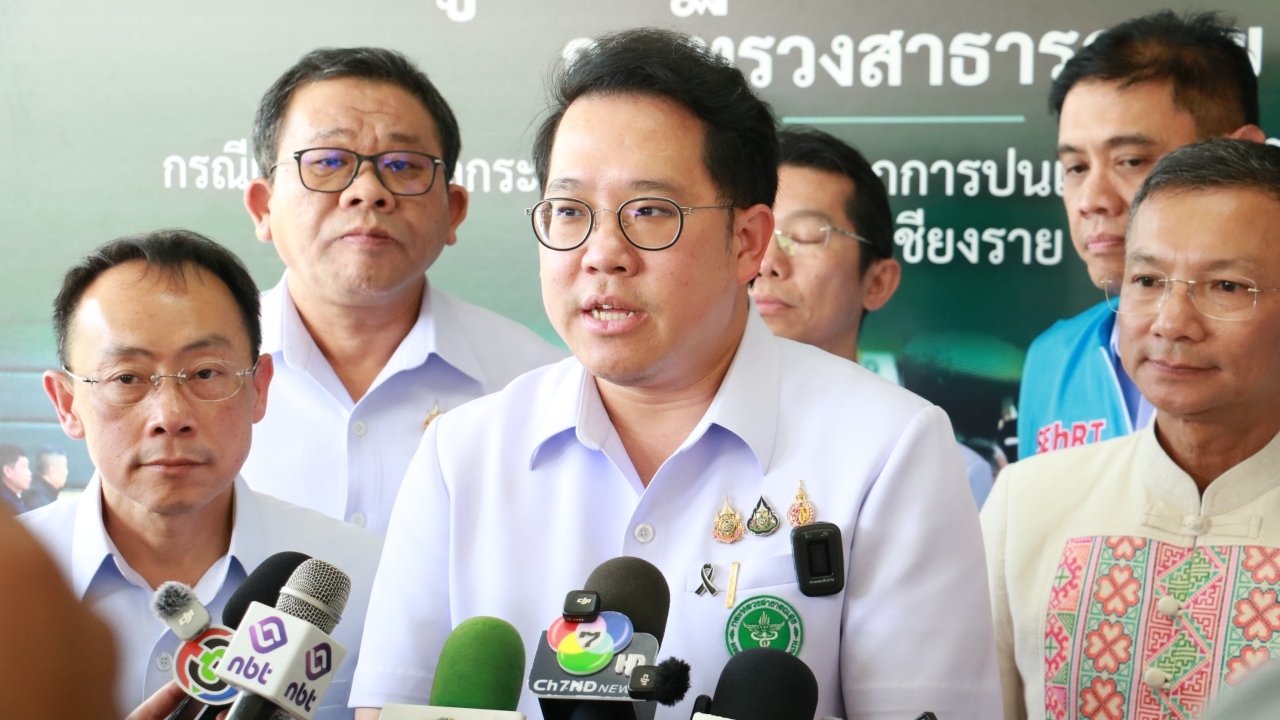
The Ministry of Public Health has opened a frontline operation center in Chiang Rai to address heavy metal contamination in water sources. They reported finding 2-3 residents with elevated arsenic levels in urine, whose conditions are now stable. Plans are underway to send 2,000 additional testing kits and monitor the health of at-risk groups for five years.
At 11:30 a.m. on 25 Nov 2026 GMT+7, at the Chiang Rai Provincial Public Health Office, Mr. Patthana Prompattan, Minister of Public Health, presided over the opening ceremony of the "Ministry of Public Health Frontline Operation Center for Monitoring Health Impacts from Heavy Metal Contamination in Water Sources in Chiang Rai Province." Mr. Prasert Jitpleechip, Deputy Governor of Chiang Rai, welcomed attendees, and Dr. Somruk Jungsaman, Permanent Secretary of the Ministry of Public Health, presented the objectives. The event was attended by executives, medical personnel, village health volunteers (VHV), and partner networks.
Mr. Patthana revealed that the government, led by Prime Minister Anutin Charnvirakul, prioritizes protecting public health from contamination issues in Chiang Rai's water sources, which involve cross-border pollution. The Ministry of Foreign Affairs, Ministry of Natural Resources and Environment, Ministry of Public Health, and relevant agencies have been tasked with integrating efforts both locally and internationally. This frontline operation center will serve as the command hub for coordination and transparent communication with the public.

The Minister of Public Health outlined four key policies for the frontline center and partner networks: closely monitor at-risk individuals, especially those with arsenic levels above reference values in their urine, including family members, ensuring appropriate care; ensure confidence in drinking water and food safety by continuously checking tap water, groundwater quality, and monitoring contaminants in plants and aquatic animals; proactively communicate risks by having health personnel and VHVs disseminate accurate information to reduce confusion and misinformation, clarifying measurement units and contaminant standards; and integrate data and expand cooperation among provincial agencies, local administrative organizations, environmental, agricultural, and fisheries departments to share data and enhance problem-solving and public communication.
After the opening ceremony, Mr. Patthana told reporters that urine tests from some local residents showed about 2–3 individuals with elevated arsenic levels. Medical teams have provided care, and these individuals have now returned to normal health without severe symptoms.
Current surveillance data from the Ministry of Public Health has not identified any patients with acute or severe symptoms resulting from the contamination. Moreover, cancer incidence statistics from communities along the Sai River in Mae Sai district, analyzed by the Department of Medical Services, do not show rates significantly higher than the general average. Nonetheless, the ministry remains vigilant and will continue ongoing health monitoring.
Detecting arsenic levels in the body above reference values does not necessarily mean the individual is ill from arsenic poisoning. A full assessment requires considering exposure history and medical data.

Mr. Patthana explained that the Ministry of Public Health has established a three-phase action plan:
Additionally, the Ministry of Public Health plans to provide about 2,000 additional test kits to local agencies to enhance surveillance capabilities over the next one to two months.
Regarding concerns about long-used groundwater sources with potentially high contamination levels, Mr. Patthana said if tests confirm sustained high contamination, the ministry will advise against using such water for consumption.
Decisions on suspending usage, water quality improvements, and securing replacement water sources require coordination with the province, Pollution Control Department, and relevant authorities. The Ministry of Public Health will assist with health assessments and information support.
As for water quality tests conducted by the Provincial Waterworks Authority, the Minister stated that results remain within standard limits. Inspections of hundreds of bottled drinking water producers show most meet quality standards.

Mr. Patthana also addressed cross-border pollution issues, noting that the government discussed these with neighboring countries and China during the recent APEC meetings. Chinese authorities confirmed they do not support illegal activities by Chinese operators abroad and are willing to cooperate with Thailand to solve the problem.
The government is therefore pursuing solutions both at the source internationally and implementing measures to protect health and minimize impacts on local residents.
This Ministry of Public Health frontline operation center will be based at the Chiang Rai Provincial Public Health Office as the central command. Residents can contact it for academic information, health advice, and coordination for referrals to hospitals or specialists.
The Minister urged residents in risk areas to seek medical attention promptly if experiencing symptoms like diarrhea, headache, nausea, or vomiting. They should consult doctors or contact village health volunteers for diagnosis. He cautioned against self-diagnosing these symptoms as arsenic-related, as other illnesses or conditions may cause similar signs.