

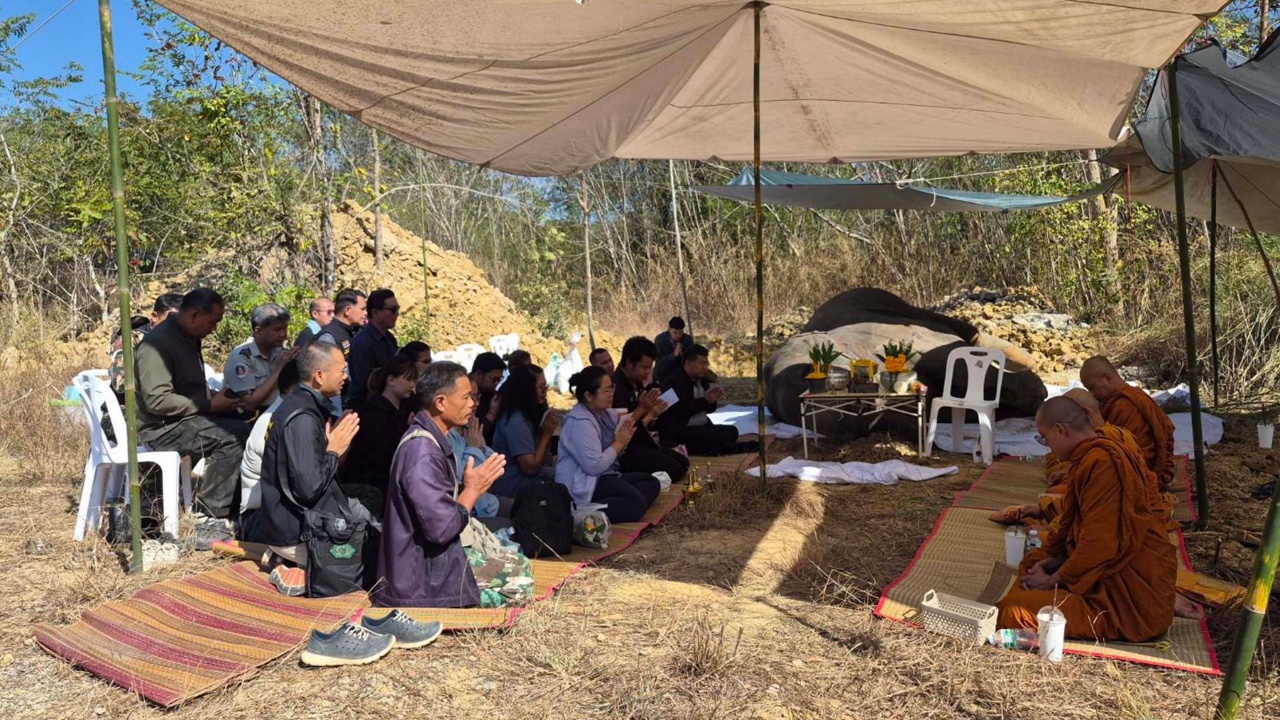
Officials invited monks to chant merit rites for the wild elephant "Sidao Hoo Phap." Locals expressed heartbreak, recounting the moment they stood by the roadside and heard the elephant cry out before collapsing. They emphasized that over the past two years, they had grown attached and adjusted to living alongside the elephant. They urged authorities to promptly clarify the exact cause.
On the night of 3 Feb 2026, staff from Protected Area Regional Office 8 (Khon Kaen), along with over 200 personnel and experts from the Department of National Parks, Wildlife, and Plant Conservation, conducted an operation to relocate the male wild elephant "Sidao Hoo Phap" from Khon Kaen Province to the Phu Luang Wildlife Feeding Restoration Project under the Royal Initiative, Phu Luang District, Loei Province. However, the elephant collapsed inside the transport truck during transit. Veterinary teams immediately stopped the convoy and provided assistance, but were unable to save the elephant’s life, as previously reported.
Later, at 09:00 on 4 Feb 2026, at Phu Wiang National Park, villagers arrived continuously to inquire about the cause of death of the folded-ear wild elephant but were not permitted to enter the park area.
Meanwhile, park officials and related personnel removed Sidao Hoo Phap’s body from the truck and laid it on the ground. Four monks were invited to perform merit chanting for the elephant. The veterinary team from the Wildlife Division (Wildlife Health Management Unit), under the Department of National Parks, Wildlife, and Plant Conservation, conducted a post-mortem examination.

After completing the procedures, Phu Wiang National Park officials buried Sidao Hoo Phap’s body within the park. Throughout all steps, no information was provided to the media, and journalists were strictly prohibited from entering the park or the operation areas, necessitating observation from outside the perimeter.
Reporters attempted to interview Mr. Sutham Wongchan, Head of Phu Wiang National Park, regarding the elephant’s collapse. Mr. Sutham did not respond, stating he was on official duty and attending a meeting in Bangkok and thus unable to comment before ending the call.
At 11:00, reporters visited Na Ta Pae area at the end of Khok Muang Village, Wiang Kao Subdistrict, Wiang Kao District, Khon Kaen Province, the site where Sidao Hoo Phap was relocated the previous night. They found signs of official activity including elephant footprints, tranquilizer syringes, and covered pits used for loading the elephant onto a 10-wheel truck.
Local villagers reported that officials began tranquilizing the folded-ear wild elephant around 19:30. The relocation process then started. By approximately 21:00, excavators and 10-wheel trucks entered the area. They dug deep pits so that trucks could reverse to ground level before local authorities and officials helped push the elephant onto the truck successfully. The convoy departed the area around 23:00.
During transport to Phu Luang Wildlife Sanctuary in Loei Province, Sidao Hoo Phap collapsed in Wiang Kao District, about 10 kilometers from the tranquilizing site. Later that morning, Protected Area Regional Office 8 in Khon Kaen held a religious ceremony with monks and a ritual to apologize to the elephant. The veterinary team planned to conduct a detailed post-mortem to determine the cause of death before burial within Phu Wiang National Park.

Mr. Suriya Voharn, 42, a local resident of Wiang Kao District, said that during the relocation, he watched from his front yard since the elephant’s path passed by his home. He noticed something unusual when the 10-wheel truck stopped nearby and overheard people on the truck saying, "The elephant will not make it." The truck then moved on. Later, he learned the elephant was struggling near Pho Lad Village, and the truck stopped to check on the elephant near Wiang Kao Hospital.
Mr. Suriya added that over the past two years, villagers had adapted and lived alongside the wild elephant peacefully. However, this relocation caused the elephant to collapse and die. He urged responsible agencies to provide a clear explanation of the cause.
Ms. Wannee Amatayakong, 69, from Wiang Kao District, said she watched the relocation last night. When the elephant passed her house, she heard it cry out once before learning it had collapsed. She felt heartbroken and saddened, like other villagers. Although this is the sugarcane harvesting season, which can be unsafe, villagers had grown attached to the wild elephant over the past two years and adapted their lifestyles to coexist. Now, they seek clarity about the cause of the elephant’s collapse.
Sidao Hoo Phap was a male wild elephant, approximately 15–20 years old, that began foraging in Phu Wiang National Park since July 2024. The elephant had previously caused the deaths of two villagers in 2025. Subsequently, Phu Wiang National Park requested approval from the Department of National Parks to determine the guidelines and methods for relocating the wild elephant from the area.