

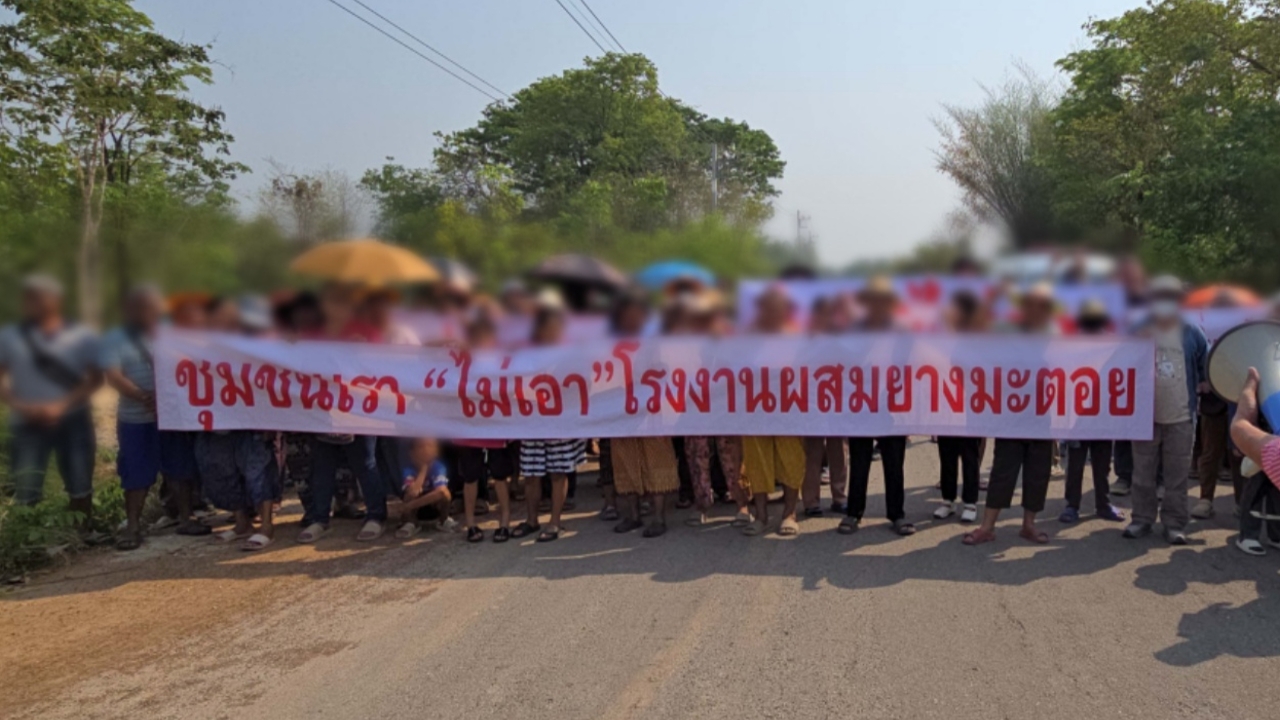
Kaen Tao villagers held signs protesting the construction of an asphaltic concrete plant in Khon Kaen province, fearing pollution and criticizing the unclear public hearing process. They plan to file formal opposition. The company secretary insisted the project followed all procedures and obtained the necessary license.
At 09:30 on 31 March 2026, over 200 villagers from Mu 7, Ban Fang Subdistrict, Ban Fang District, Khon Kaen Province gathered on the road in front of a site where an asphaltic concrete plant of a limited partnership was being built. They held signs opposing the factory, with messages such as "No pollution," "No carcinogens," "Our home is residential, not industrial," and "Our community rejects the asphalt mixing plant," amid police and local administrative security presence.
At the construction site entrance, there was a notice from the Khon Kaen Provincial Industry Office regarding a public hearing to gather opinions about a type 3 factory. The notice stated that the office intended to hear public views regarding the application for a factory operation license by the limited partnership producing asphaltic concrete in Ban Fang Subdistrict, Ban Fang District, Khon Kaen Province, with details attached to the announcement.
Anyone wishing to comment on the above matter was asked to notify the Khon Kaen Provincial Industry Office by 11 April 2026. After that date, the office would proceed with consideration. The announcement was dated 24 March 2026.
Mrs. Aida, 54, one of the Kaen Tao villagers who came to protest the factory construction, said her home is about 1 km from the site and downwind from the plant towards the village. She and many other villagers were unaware of the project because the company never entered the village to inform or hold a public hearing there. Only the village headman and six villagers knew, and villagers from other areas attended a meeting and public hearing at the plant site. She added that neither the village headman nor the six villagers signed any documents presented by the plant; only outsiders signed. They only learned about it when the Khon Kaen Industry Office posted the notice at the construction site, which clarified that dissenting villagers could submit objections.
Villagers from Mu 7, Kaen Tao, therefore united to oppose the factory at this location. They insisted they never knew the land was zoned for industrial use. Since birth and throughout their lives, they believed the surrounding area was agricultural and residential, not industrial. If the government had authorized factory construction and the company invested tens of millions of baht, they would not have abandoned the project. But it would impact the villagers and their descendants now and in the future.
She expressed concern that once the factory is built with frequent truck traffic, it would damage roads and generate dust. After today's gathering, they planned to file complaints with the Khon Kaen Industry Office and the Khon Kaen governor to oppose the asphaltic concrete plant and request the company relocate elsewhere.

Meanwhile, Ms. Supharat, 31, a Kaen Tao villager and one of the six who attended the meeting and public hearing at the plant site on 9 Feb 2026, said she came after hearing from the assistant village headman. The company representatives welcomed them under a tent, along with villagers from other communities. The company detailed the factory construction but did not discuss benefits, drawbacks, or impacts on nearby communities. They distributed documents for signatures, but she, the other five villagers, and the village headman did not sign. During the meeting, the company took photos and videos shared in the village LINE group. Many villagers were unaware of the factory plan and opposed it upon learning.
Mr. Thawat Kosaeng, village headman of Mu 7, Kaen Tao, said as the village leader, he attended the company’s meeting and public hearing. When he asked about potential community impacts, officials gave no answers. Neither he nor the other six villagers who attended signed any documents for the company. They had never known the planned factory site was in a blue zone designated for industrial use, believing it was agricultural land used for farming and gardening.
He said the factory construction did not bring jobs or development to the community. They feared road damage, traffic inconvenience, and safety issues. Villagers opposed it due to pollution concerns and effects on future generations. Thus, they organized protests and appointed a lawyer to represent them in submitting opposition letters to the Khon Kaen Industry Office and the provincial governor.
While villagers protested with signs at the site, the company secretary spoke to reporters, saying the situation would require further discussion about pros and cons. The factory was still under construction with brand-new plant machinery, so no dust or pollution had occurred. The project complied with standards set by the Khon Kaen Industry Office, and community agreement or lack of opposition was confirmed. The new machinery met standards with dust filters and no wastewater discharge. Only typical asphalt odor would be present, similar to new road paving, and the machinery’s odor containment was improved. He asked the community to understand or visit other similar plants to see how they operate. If serious pollution occurred, construction would not be allowed, and modern roads would not exist today.
He added the factory does not operate machinery 24 hours a day as villagers believed. Each road section takes only 2-4 days to complete, then work pauses until the company can bid on more government contracts. Road preparation and paving are not continuous; in a month, there might be only 2 projects over 7-8 days with breaks between bids.
The company secretary further stated they had previously obtained construction permission from relevant agencies and invited nearby community members to a public meeting, which was attended by the district chief or his deputy, local officials, community leaders, and villagers. After completing all steps, they received a construction permit (Por 1). Most of the nearby land belongs to Ban Muang Pho, with fewer plots in Ban Kaen Tao. The company also informed the Mu 7 village headman in Ban Kaen Tao and announced the public meeting via community loudspeakers to encourage participation.
On the day of the public meeting, although attendees’ identities and areas were unclear, photos and videos were taken as evidence. Discussions covered benefits and drawbacks, including future scenarios if pollution problems arose after machinery operation began. The Khon Kaen Industry Office would then require the company to improve conditions until standards were met, as the machinery had dust containment systems.
“We ask villagers to visit other plants to see if reality matches their concerns because nothing has been built yet. The company’s operations are supervised by multiple agencies regarding environment and public health, including the Khon Kaen Industry Office and Kaen Fang Municipality. The public meeting was held and all procedures were completed before the license was granted,” the company secretary concluded.