

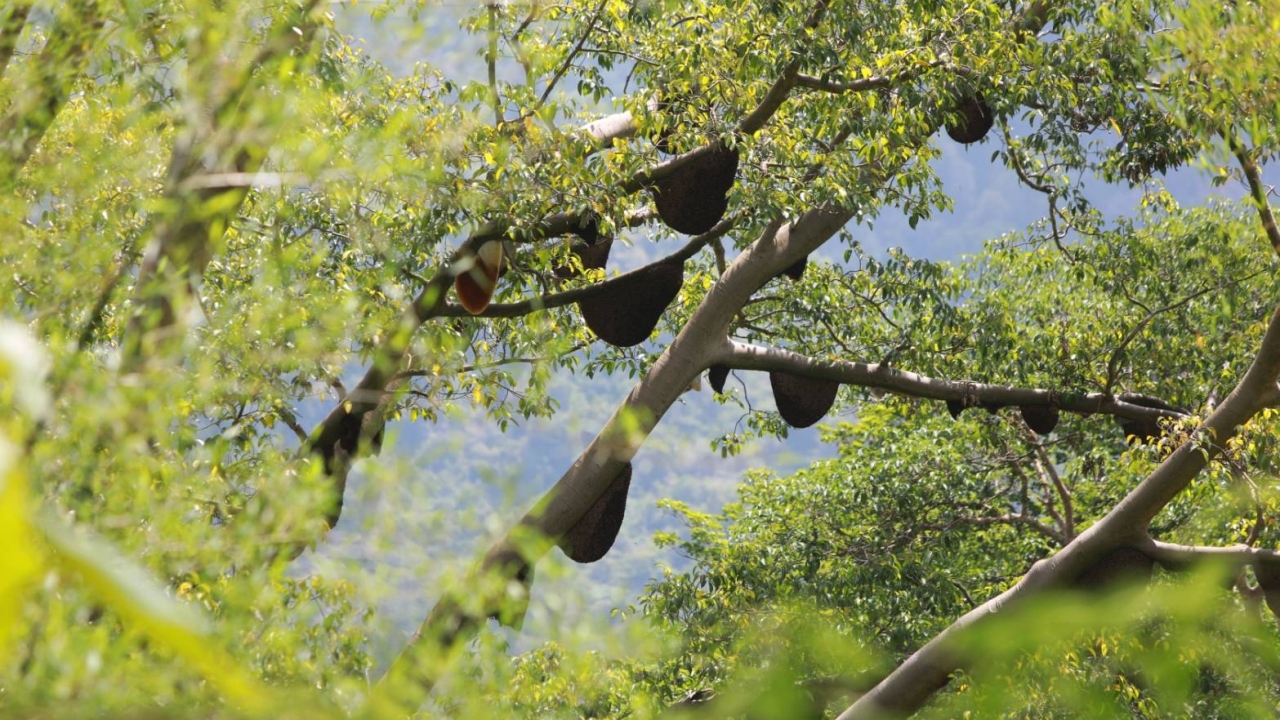
Rarely seen giant honeybees have built more than 30 nests scattered across the branches of 'Yawn' or 'Bee Trees' within Khao Yai National Park, Nakhon Ratchasima.
On 5 May 2026, a reporter had the opportunity to take their family to enjoy nature at Khao Yai National Park, Pak Chong District, Nakhon Ratchasima. Along both sides of Thanarat Road leading to Khao Yai, Thailand’s first national park, large trees spread their branches, creating shade throughout the route to this vital forest area, one of the most important in Thailand and ASEAN.
During the trip up to the park, the reporter stopped by the roadside near kilometers 28-29 on the way up the mountain, on the Pak Chong side before the viewpoint. There, many giant honeybee nests can be seen on a large tree from a distance. Upon closer inspection, over 30 nests of giant honeybees were found spread across the branches of this single tree, ranging from large to medium and small nests.

It is believed that this tree is a 'Bee Tree,' locally called 'Yawn,' a rare species typically found in dense evergreen forests. It is a large deciduous tree that can reach up to 50 meters tall, with a straight trunk and strong branches, making it suitable for building large nests that provide safety by being difficult for predators to access. Each year, many giant honeybees build numerous large nests on this tree, attracting bird photographers and tourists who come to observe and capture rare images.
Khao Yai National Park was recognized by UNESCO as a Natural World Heritage Site in 2005 under the name 'Dong Phayayen-Khao Yai Forest Complex,' covering four provinces: Nakhon Ratchasima, Prachinburi, Nakhon Nayok, and Saraburi. It was also designated as Thailand's and ASEAN's first ASEAN Heritage Park due to its rich biodiversity, serving as habitat for over 800 rare and protected wildlife species, and being an important watershed area. It is recognized internationally as a critically important natural area.

