

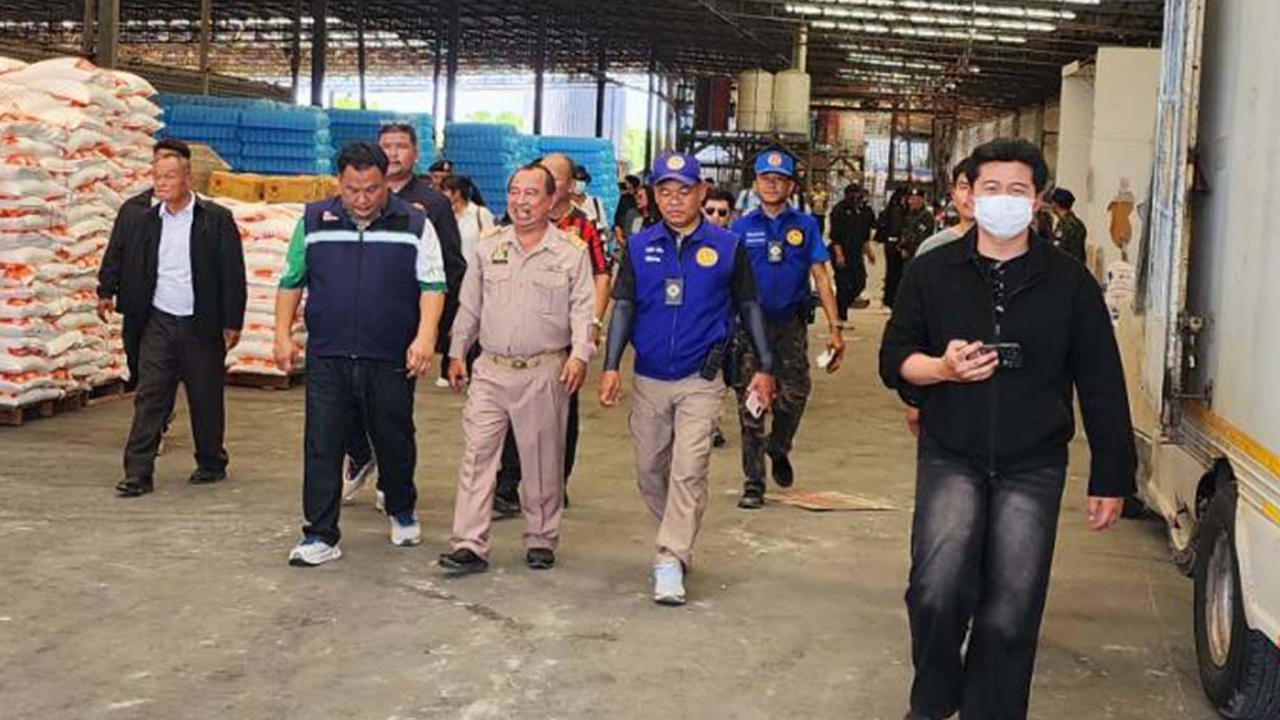
In Khon Kaen, villagers stormed a chemical sales factory, challenging all agencies to verify the truth after enduring wastewater pollution for over four years. They urged all agencies to sincerely resolve the problem. The provincial environmental office discovered water seeping outside the factory, affecting the surrounding agricultural land of local residents.
At 10:00 AM on 11 May 2026, on the road in front of an industrial chemical company in Nong Ko Subdistrict, Kranuan District, Khon Kaen Province, Mr. Bancha Chaichat, 51, village headman of Ban Nong Ko Mai, Moo 17, Nong Ko Subdistrict, led villagers holding signs saying "No Chemical Factory," "No Compensation," and "Move the Factory Away." The villagers then entered the factory grounds to inspect the cause of wastewater discharge into their rice fields, which has reduced rice yields and forced them to buy rice. With the main rice-growing season approaching and the factory failing to resolve the issue, villagers demanded the factory be shut down.
Mr. Bancha said the protest and demand to relocate the factory is not harassment but a result of unbearable conditions. The factory site was formerly a used car tent before becoming a chemical manufacturing and sales factory in 2019. The trouble began when the factory, located west of the village, discharged wastewater into villagers’ rice fields, killing the crops. Where villagers once harvested many sacks of rice, in the past three to four years, their yields dropped to fewer than 10 sacks.
Villagers have repeatedly complained to relevant authorities at the subdistrict, district, and provincial levels every year but received no resolution. They escalated their complaints to the Prime Minister's Office and to MPs from the Kla Party, who represent the villagers and have been asked to investigate whether the factory is faulty or causing harm to the community.
Although officials have visited to inspect following villagers’ complaints, no remedy has been provided. The rice fields have been the villagers’ primary food source for generations, but since the chemical factory was established, it has caused damage without any care or compensation. When villagers reached their limit, they petitioned MPs for an inspection.
Villagers presented four demands to the factory and relevant authorities. If these demands are met, they do not require monetary compensation but insist on full compliance.
The demands are: 1. A high-quality wastewater treatment pond; 2. No wastewater discharge into villagers’ rice fields; 3. Restoration of damaged soil to enable rice farming again; and 4. Overall environmental rehabilitation so villagers can resume rice cultivation. If these cannot be met, the factory must be closed.
Mr. Kamsing, 62, a villager affected by the factory's wastewater, said he has suffered for four years. Previously, he farmed rice sufficient to feed his family, but after the factory discharged wastewater into local fields, 20 households have been able to plant rice but with very low yields as the plants die early. Aquatic life in the ponds such as shrimp, snails, crabs, and fish also died. He filed a complaint to the Prime Minister's Office seeking government aid for farmers, but the matter remains unresolved, leading to complaints to MPs of the Kla Party for help.
Mr. Khem, 76, a villager whose rice fields border the factory, said he has farmed rice since his youth. In the past, he harvested 90 sacks from 15 rai of land. After the chemical factory was established and discharged wastewater into the fields, yields declined due to soil contamination. During the main rice season, rain mixes with wastewater, further degrading the soil. Each year yields drop, forcing some to buy rice. He and neighbors have protested, demanding authorities close the factory to prevent starvation due to poor harvests.
Mr. Ekachai Suebsarakham, MP for Khon Kaen’s 3rd district from the Kla Party, said the site inspection was conducted jointly with relevant government agencies, including the provincial industry office and the provincial natural resources and environment office. Approximately 20 households, farming about 50 rai near the factory, have suffered for about four years with poor rice yields despite farming their own fields. Complaints began in 2021 but remained unaddressed.
The inspection revealed the factory site was formerly a car dealership before being subdivided into a chemical sales company. Wastewater from the factory flows into villagers’ rice fields. Community leaders and villagers confirmed that no public consultation was held before the factory was established. Villagers only realized the factory was there after their rice plants began dying. The factory promised compensation payments but none have been made to date.
Further investigation found the factory has operated for several years but only applied for a building permit in 2025. Authorities will examine why the building permit was delayed despite years of operation and whether government officials failed in their duties.
“After receiving complaints and inspecting the site with related agencies, any identified faults must be corrected by responsible bodies. As the main rice season approaches, the factory must implement improvements. If problems persist despite orders to comply, the factory should be closed,” said officials.
Mr. Thirananon Sararat, the company’s legal representative, told the media he has served as the factory's lawyer for about three years. He acknowledged villagers’ complaints and said officials have regularly inspected the factory. The factory claims to comply with all standards to coexist with the community.
Regarding complaints, he stated that after the factory learned of the issues, he met with villagers to understand their needs. The factory offered compensation of 2,000 baht per rai to 21 families farming about 50 rai with reduced yields. Negotiations proceeded well but payments have not yet been made.
Villagers were initially willing to accept compensation, but third parties influenced opinions, leading to renewed complaints. MPs and related agencies then investigated. The company welcomes inspections and is ready to make improvements as advised by authorities, urging officials to specify needed corrections so the company can act promptly.

After MPs and officials inspected the factory area, they found the factory’s dust, odor, and wastewater treatment pond did not meet required standards. Mr. Naret Sombun, director of the Khon Kaen Provincial Natural Resources and Environment Office, summarized that multiple issues require further investigation and improvement.
In particular, the wastewater management system was visibly below standard, prompting additional water quality testing.
Dust control methods are unclear due to the factory’s open layout, and noise management systems are inadequate. Officials spoke with factory representatives since the owner was absent. The provincial industry office has given the factory seven days to submit a report covering environmental quality issues—water, dust, and noise—to comply with established factory operation regulations.
The natural resources office will conduct further water quality measurements to determine pollutant levels precisely. They will set measures and consult all stakeholders to ensure the factory corrects issues as recommended. Failure to meet standards within the timeframe could lead to license revocation.
The factory is located near the community, with water seeping outside its premises, impacting surrounding agricultural land, which has been unusable for years. All government sectors must collaborate seriously to resolve these problems for affected residents. Factory establishment requires permits and must not cause environmental harm to communities. Cooperation between the factory owner and government agencies is essential to enforce and address issues effectively.
“This factory may have started as a small operation before expanding into a size requiring formal licensing. Records show the factory has existed for about 4–5 years, but its license was issued only about two years ago,” officials explained.
The provincial industry office will involve experts in a follow-up inspection to ensure compliance with laws and regulations. If the factory continues to neglect standards or refuses to improve, officials will be compelled to revoke its license and order closure. These actions are not harassment but necessary to enable the factory to coexist with the community without causing problems or hardship.