

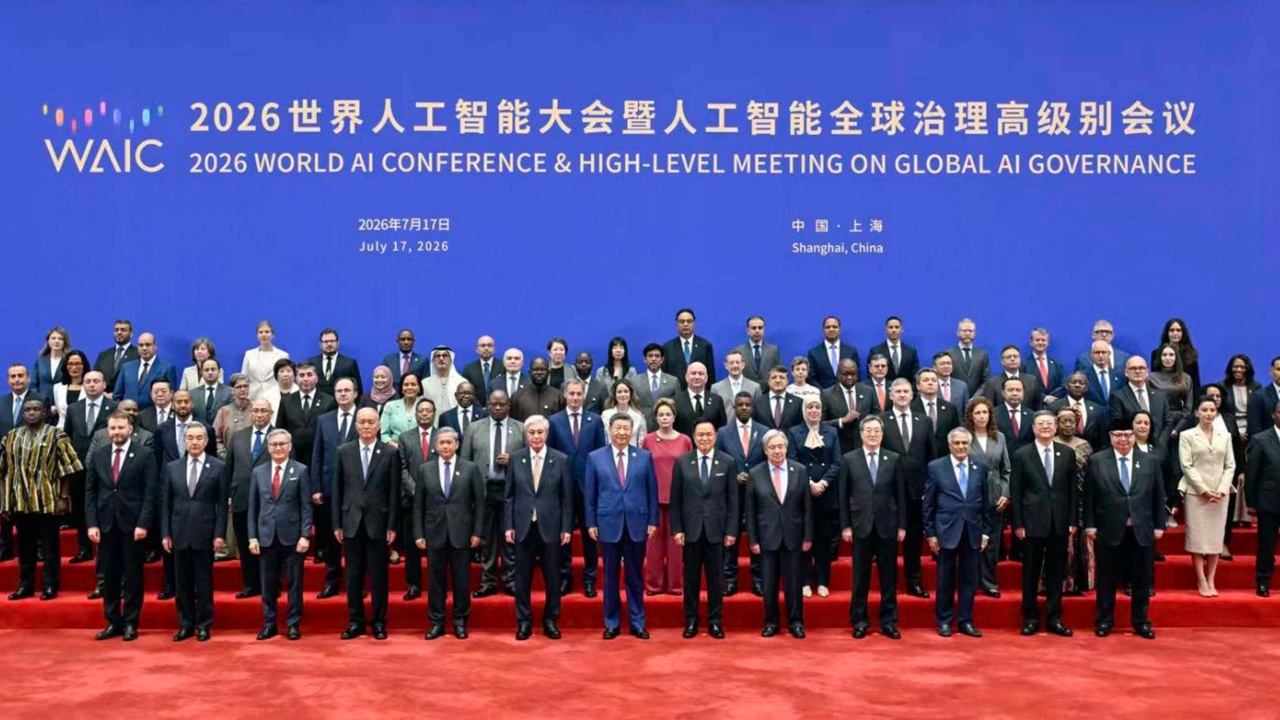
Prime Minister Anutin discussed with Xi Jinping opening a new chapter in Thailand-China cooperation, focusing on AI, investment, and future industries to create economic opportunities and strengthen security in Thailand.
On 22 July, Liu Hongmei, Consul General of the People's Republic of China in Khon Kaen, revealed that from 17 to 20 July 2026, the annual World Artificial Intelligence Conference and the Global AI Governance Summit were held in Shanghai, China. President Xi Jinping honored the event by attending the opening ceremony and delivering a keynote speech titled "Cooperating to Build a Fair and Reasonable Global AI Governance System."
On this occasion, Thai Prime Minister Anutin Charnvirakul participated in the conference and made an official visit to China. This international conference marked a significant milestone in continuing past intentions and opening the future under the main theme "Intelligent Partners, Co-creating the Future," featuring over 140 seminars and more than 1,500 distinguished participants from China and abroad.
President Xi Jinping outlined China’s policy stance and systematic approach to AI development and governance in all dimensions. He stated that rapid global changes are underway this century, with scientific and technological revolutions and a new industrial transformation accelerating remarkable progress. Global AI innovation has reached unprecedented enthusiasm, offering great opportunities but also governance challenges. China believes all countries should uphold human-centered values and virtues to make AI a key driver of shared prosperity and collective security, cooperating to build a fair and reasonable global AI governance system.
President Xi presented four key proposals: adhering to openness and shared benefits to drive development and innovation; enhancing risk awareness to ensure safety and controllability; supporting diversity to promote mutual learning among civilizations; and fostering unity to improve global governance comprehensively.

Emphasizing China’s role as a responsible major country, President Xi affirmed China’s commitment to providing international public goods in AI. Over the next five years, China will offer 5,000 specialized AI training scholarships to developing countries and establish an international AI application cooperation center for ASEAN, the Arab League, the African Union, the Community of Latin American and Caribbean States, the Shanghai Cooperation Organization, and BRICS. China will also promote the operational deployment of the intelligent meteorological early warning system "Majoo" in 30 countries, including Thailand. China is ready to engage all sectors with greater openness, stronger practical measures, and broader vision to jointly seize opportunities and address challenges in AI development, building a better future for humanity.
Prime Minister Anutin Charnvirakul delivered a speech at the conference, positively assessing China’s key role in advancing global AI governance. He emphasized that no country should be left behind in AI development and proposed strengthening AI governance in three areas: protecting people, unlocking potential, and jointly creating prosperity. He also highlighted fostering AI as a bridge connecting partners so technological progress benefits all countries and peoples inclusively.
The conference announced the "Chairman’s Statement of the 2026 World Artificial Intelligence Conference and Global AI Governance Summit." Prior to the event, a signing ceremony was held in Shanghai to establish the World Artificial Intelligence Cooperation Organization, with 29 founding countries participating.

China and Thailand are leaders in global AI and pioneers in AI application in Southeast Asia, respectively. Both share aligned AI development concepts, starting with a human-centered approach aiming for virtuous technology. They prioritize smart healthcare to protect lives and health, explore smart education to inspire rural children's futures, and investigate smart agriculture to increase farmers’ incomes and wealth. Both countries have a broad vision of openness, inclusiveness, and connectivity, supporting digital and AI equity, opposing technological barriers, advocating global AI governance systems that benefit all nations, and aiming to enhance AI’s capacity across diverse professions through the "International AI+ Cooperation Initiative."
Additionally, both countries bear the contemporary mission of "risk prevention and control as well as safety governance." They agree AI must be a trusted human tool and jointly promote legal, regulatory, technical monitoring, risk warning, and emergency response systems to ensure AI remains under human control. They also cooperate to combat misinformation, resist exaggerated national security claims regarding AI, and oppose using AI to foster division or geopolitical competition.
President Xi emphasized China’s commitment to fostering a friendly and honorable bilateral relationship with Thailand as a neighborly diplomatic partner. China pledges to be a reliable strategic cooperation partner for Thailand. He expressed strong confidence that China-Thailand AI cooperation has immense potential and a bright future, which will not only support robust development and improve citizens’ lives in both countries but also jointly build a secure, prosperous, and sustainable China-Thailand community with a shared future and promote digital and AI prosperity in the ASEAN region.
China announced the launch of the joint China-Thailand intelligent meteorological disaster prediction and warning laboratory. China’s open-source large models and cloud services have been widely applied in Thailand. Both parties continue joint projects to produce and develop AI technology personnel consistently.
China will continue supporting Thailand as a regional production base for future industries and welcomes relevant Thai agencies and the private sector to coordinate with China. Together, they will discuss AI cooperation models best suited for Thailand and ASEAN, sharing intellectual benefits and jointly promoting comprehensive mutual benefits equitably.