

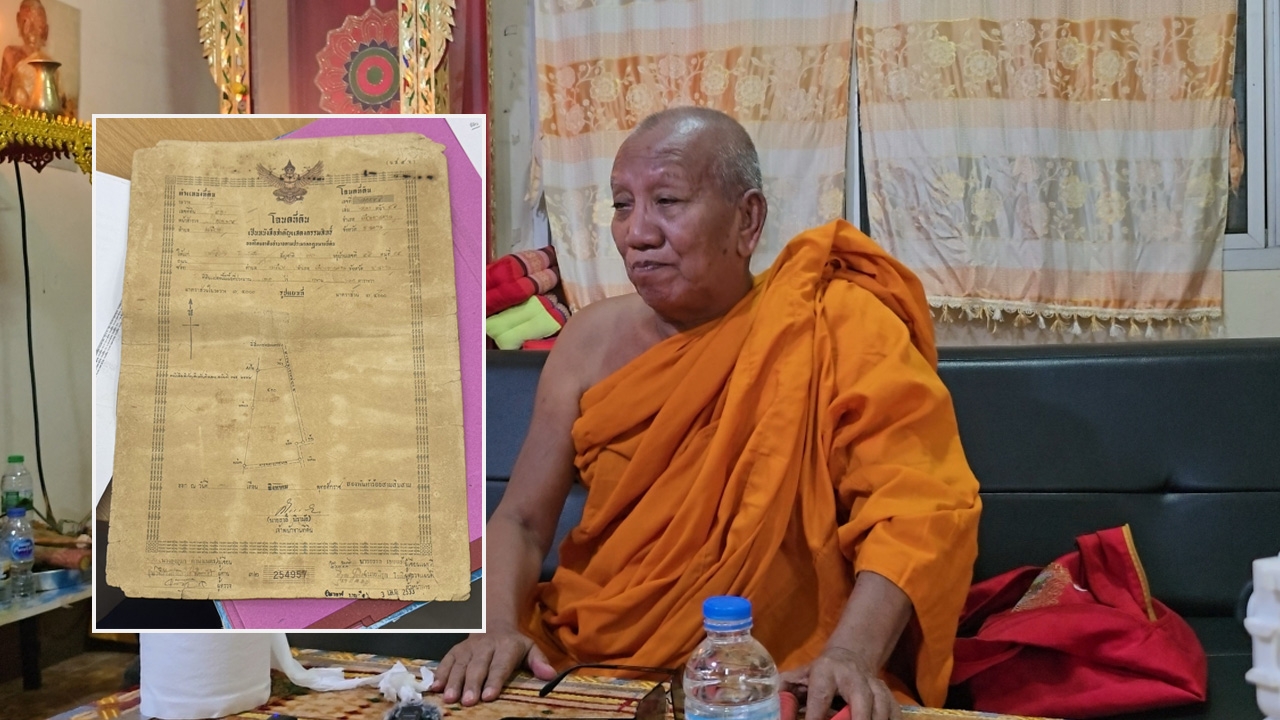
The abbot of Wat Pa Adunyararam did not reveal where the original land title deed is kept, fearing theft. He stated he received the deed from "Mr. Hiang" to legitimately build the temple, explaining that without the deed, they could not apply to establish the temple. He also responded to the other party's criticism about cleanliness.
At 08:00 on 14 Aug 2026 at Wat Pa Adunyararam on Kanlapaphruek Road, Mueang District, Khon Kaen Province, reporters continued to follow the land dispute involving the temple after heirs claimed ownership under the name of Mr. Hiang Phimsri, the former landowner.
The heirs argued that the land donation did not meet the handwritten conditions set by Mr. Hiang Phimsri, stating that if the temple was not completed, the land would not be donated. Since Mr. Hiang died shortly after and the temple had not yet been constructed, the heirs considered the donation void from his death in 1991.
Regarding this, the abbot of Wat Pa Adunyararam said he would welcome legal assistance from lawyers, as no one had previously provided legal guidance. After the court ruling in 2012–2013, he understood that with the court's decision in favor of the temple, the case was closed. Being a monk, he lacked knowledge about legal procedures.
The abbot believes the dispute prolonged due to lack of legal advice. If advice had been provided earlier, the matter would have been resolved long ago. The dispute continued until 2014 when Mrs. Buakai Sonsamut, the fourth daughter of Mr. Hiang, claimed heir status and applied to be estate manager, leading to new litigation. The later case began with an administrative court suit to revoke legal acts before being transferred to civil court, suing the Khon Kaen land officer as main defendant and Wat Pa Adunyararam as second joint defendant. The Khon Kaen Municipality, owner of the land, was the first joint defendant, differing from the first case that was concluded.
The abbot also noted that the civil court examined Mr. Hiang Phimsri’s intent in donating the land, affirming that the donation was not just verbal but supported by the land title deed, with Phra Pheuy as recipient of the donation, accompanied by a Buddhist merit event on 14 Sep 1990.
Regarding photos of the deed handover, which the opposing party claims were only a display and not an actual transfer, the abbot stated it is their right to present such information. However, in reality, without receiving the deed, the temple could not apply for official establishment, as a valid land title deed is required to complete temple registration and obtain an address.

Wat Pa Adunyararam has an official address: No. 350, Village 16, Nai Mueang Subdistrict, Mueang District, Khon Kaen Province. The abbot said anyone is entitled to their opinion, but the temple will not argue. The original deed remains safely stored at an undisclosed location to prevent theft and cannot be publicly shown.
On doubts about the land donation in 1990, Mr. Hiang’s death in 1991, and the temple's official recognition in 1998, the abbot explained that legally, temple construction must proceed before official establishment. The donation involved not only land transfer but also planning and mapping of facilities such as crematorium, sermon hall, bell tower, and monks’ quarters. After defining locations, the temple applied for construction and approval from the then Department of Religious Affairs. Though Mr. Hiang died before the deed name transfer, the temple establishment process legally continued. Permission to build was granted in 1992, and official recognition came in 1998.
The abbot confirmed that after donating the land, construction was carried out and the temple was officially recognized by the Ministry of Education as "Wat Pa Adunyararam." Following recognition, the temple obtained an official address and conducted a census. All resident monks then registered for monk identification cards, marking the completion of construction and official establishment in 1998.
The abbot added that Wat Pa Adunyararam emphasizes nature conservation and does not prioritize building structures. The temple has a sermon hall, two crematoriums, a funeral pavilion, a bell tower, and nearly 20 monks’ quarters, sufficient for housing the monks. Responding to criticisms about dirtiness, the abbot questioned why anyone would want to reclaim the land if the temple were unclean. He lives simply, avoids materialism, declined an air conditioner installation, and uses only one mattress. Regarding building conditions, the temple meets the required facilities. The opposing side wants a main ordination hall (ubosot), which construction began with a circular foundation but was halted due to lack of funds. The temple is poor and cannot continue building despite requests to do so.