

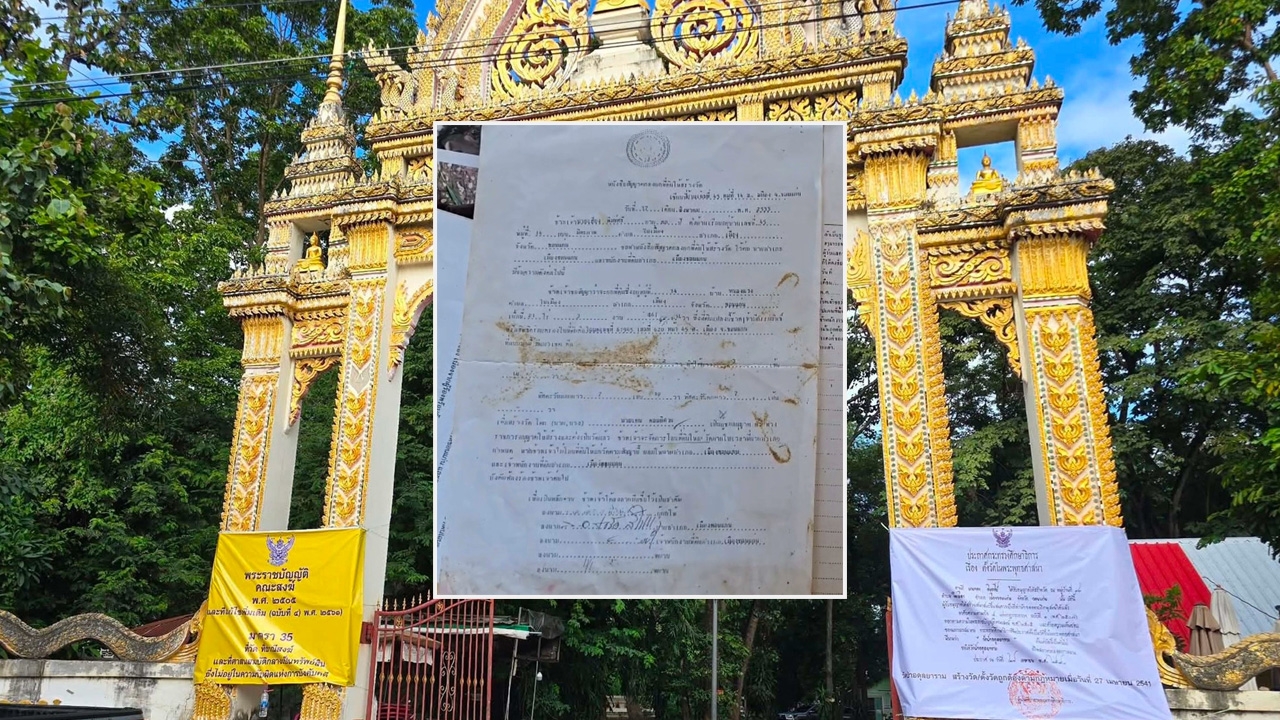
The former director of the Khon Kaen Buddhist Office pointed out that "temple land" is not subject to enforcement actions. He views the contract letter as similar to a will, protecting the deceased's intentions. He emphasized that those involved must expedite completing the process.
On 14 Aug 2026 GMT+7, at Wat Pa Adunyaram on Kanlapaphruek Road, Mueang District, Khon Kaen Province, during a field visit, reporters met the former director of the Khon Kaen Buddhist Office, who happened to be meeting the abbot. He said the contract letter cited by the heirs resembles a will, as the owner expressed the intention to donate land for building a temple. Since the owner passed away suddenly, those involved must urgently complete the process according to the stated intention.
The former director explained that the contract bears the signatures of the district chief and land officer as legal witnesses. Even after the landowner's death, the process must follow the deceased's intention. The contract is prepared in advance to prevent issues such as the owner's death occurring amid proper temple construction, which could cause harm due to ongoing procedures, and to avoid heirs attempting to reclaim the land later. Hence, the contract serves as protection.
Before drafting the contract, several verification steps must be completed, starting with the district land officer confirming the land's rightful ownership, legality, and that the owner lawfully acquired the land. Only if these conditions are met can the land be dedicated for temple construction. Land involved in court cases or under mortgage cannot be used for temple building.
The former Khon Kaen Buddhist Office director stated that upon receiving the contract, the land donation is considered complete. Even if the owner died just one day after signing, temple construction must proceed according to the deceased's wishes. This principle follows Ministerial Regulation No. 1 B.E. 2507 (1964), Section 2, stating that land title deeds represent ownership, while other documents like Nor Sor 3 represent possession rights, requiring a donation contract to prevent disputes. Once legally established, the temple becomes a legal entity.
Regarding heirs claiming the contract includes a handwritten condition by Mr. Hiang that if the temple is not completed, the land will not be donated—and that the donation is void since his death—the former director said this claim is invalid as it would harm the temple and donors who contributed. Therefore, the contract serves like a will, preventing revocation or heirs reclaiming the land after the owner's death. This reflects the ministerial regulation's clear provisions and the need for careful implementation.
The former Khon Kaen Buddhist Office director added that the current dispute highlights the law’s purpose: to prevent heirs from reclaiming ownership after the owner's death and to protect temple land from seizure. Drawing from extensive experience and knowledge of Sangha law, he urged Buddhists to protect and defend Buddhism under Article 67 of Thailand’s 2017 Constitution. The key protection now is for all parties to promptly secure land titles for temples, as these titles provide crucial legal evidence to protect temple land. Additionally, according to the 2018 Sangha Act (No. 4), Section 35, "temple land" is exempt from enforcement actions, meaning even a court ruling against the temple cannot lead to seizure of temple land. Wat Rom Pho Tham is an example. He reiterated that temple land cannot be subject to enforcement and called on Buddhists to unite in protecting Buddhism.