

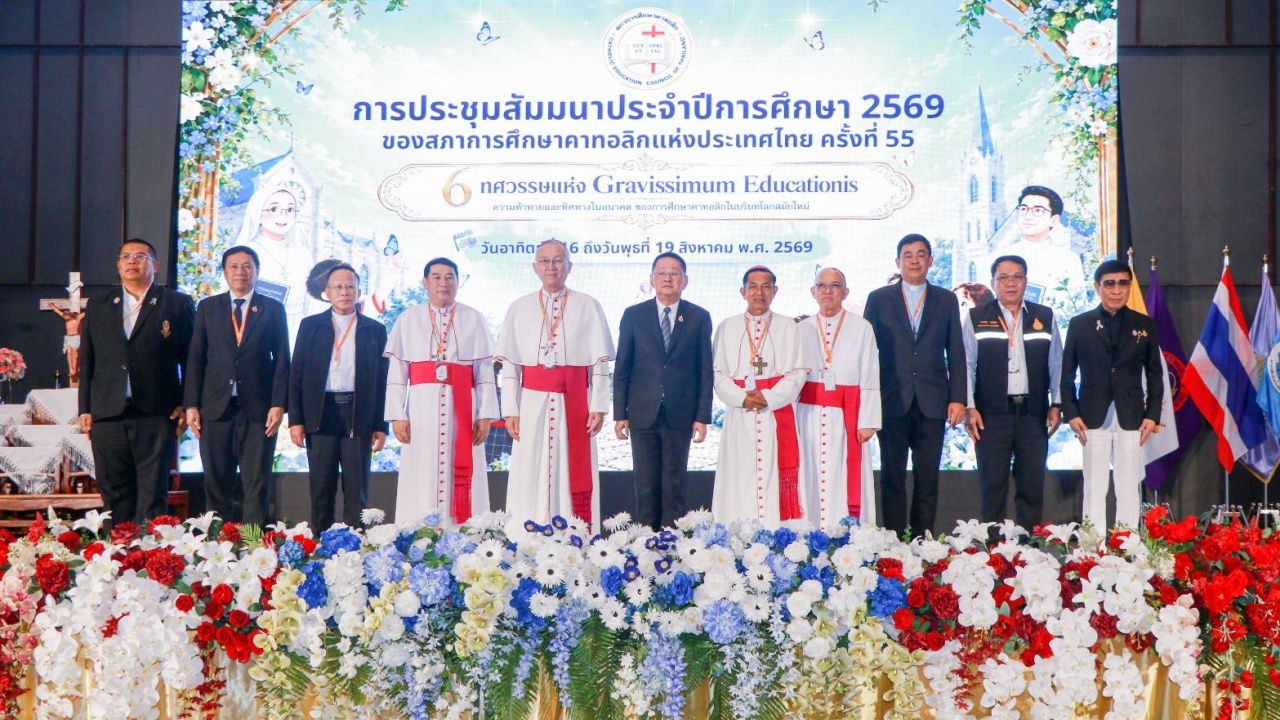
The Catholic Education Council of Thailand opened the 55th annual seminar for the 2026 academic year, jointly guiding the direction of education in the modern world through the Active Learning–GPAS 5 Steps process to develop children who "think independently" before relying on AI.
Amid the rapid changes brought by AI, the key question for Thai education may no longer be "Has the school implemented AI yet?" but rather, "Before letting AI assist with thinking, have we developed children who can think for themselves?"
This important message arose at the Catholic Education Council of Thailand's 55th annual seminar for the 2026 academic year held in Khao Yai, Nakhon Ratchasima Province, where education administrators, academics, and school networks nationwide jointly emphasized that education in the new era must seriously return focus to the "thinking process" of learners.
Mr. Prasert Chantraruangthong, Minister of Education, clearly stated that although AI plays a significant role and can assist humans in many tasks, it cannot fully replace humans, especially in thinking, decision-making, morality, and responsibility. He signaled importantly that "We should not make children think less, but rather help them think more effectively."
At the same time, the Minister expressed appreciation for the Active Learning approach using the GPAS 5 Steps process, which has shown tangible results in schools and sees opportunities to further develop and expand this model, including increasing the number of model schools in the future.
This is a significant signal because Active Learning is being elevated beyond a policy or teaching plan term to a more critical question: "How can it truly be implemented in every classroom?"
True Active Learning is therefore not merely about children doing activities, forming groups, or leaving their desks, but must be a learning process that engages the learner's brain. Children need to research, think, analyze, construct knowledge, practice, communicate, and apply what they learn to new situations.
This is where the GPAS 5 Steps method connects Active Learning into a systematic process, from gathering information, analyzing, constructing knowledge, practicing, to communicating and extending the value of what is learned.
Father Ekarat Hompratum, President and Secretary-General of the Catholic Education Council of Thailand, clearly reflected the educational goal: children must "understand, think independently, be able to do, and apply." Complete education should not end when children memorize lessons but must develop their intellect, morality, heart, social responsibility, and the ability to use technology wisely.
It is no coincidence that the Catholic Education Council of Thailand and the Institute for Academic Quality Development (IAQD) continue their collaboration to expand learning processes aimed at embedding thinking skills in children, as the future world may change technology many times, but children who learn to think will adapt to change.
Dr. Pichet Phophakdee, Secretary-General of the Basic Education Commission, emphasized that Active Learning must cultivate both thinking skills and thinking habits in learners, because the goal of proactive learning should not stop at completing activities but enable children to think, analyze, solve problems, and progress to creativity and innovation.
When thinking becomes a habit, children will not just wait for answers but will know how to question, research, verify reasoning, and create their own answers.
Dr. Saksin Rojsaranyaram, Chairman of the Executive Board of the Institute for Academic Quality Development (IAQD), stressed a critical shift: education must move from rote memorization and transmission to creating thinking processes and learning processes within the learner.
Learners must discover truth by constructing knowledge in each dimension because truth must arise from the learner and become knowledge stored in long-term memory forever.
Education is life. Many think education is organized for future use, but in reality, education is real life in the present that learners must use, applying knowledge-building methods to solve future problems of all kinds indefinitely.
Thus, teachers are not those who must have all the answers for children but must design situations that encourage children to ask questions, seek, analyze, experiment, act, and discover answers on their own.
This may be a turning point that the Thai education sector must watch closely because on the day AI can answer questions in seconds, education that competes only on "who knows more answers" may no longer suffice.
What becomes more valuable are those who know how to ask questions, think critically about information, verify answers, and understand how to apply knowledge. Therefore, Active Learning should not be just a trend, and the GPAS 5 Steps should not merely be a name in lesson plans but must reach the actual classroom, transform teachers' thinking, and ultimately become a "thinking process" that stays with children for life.
AI may improve daily, but education's mission is to ensure humans never stop thinking. If the Active Learning–GPAS 5 Steps model schools truly expand, the education sector should focus not just on "how many schools" but on whether these schools can prove they can transform classrooms from spaces of memorizing answers into places that "develop children who think independently."