

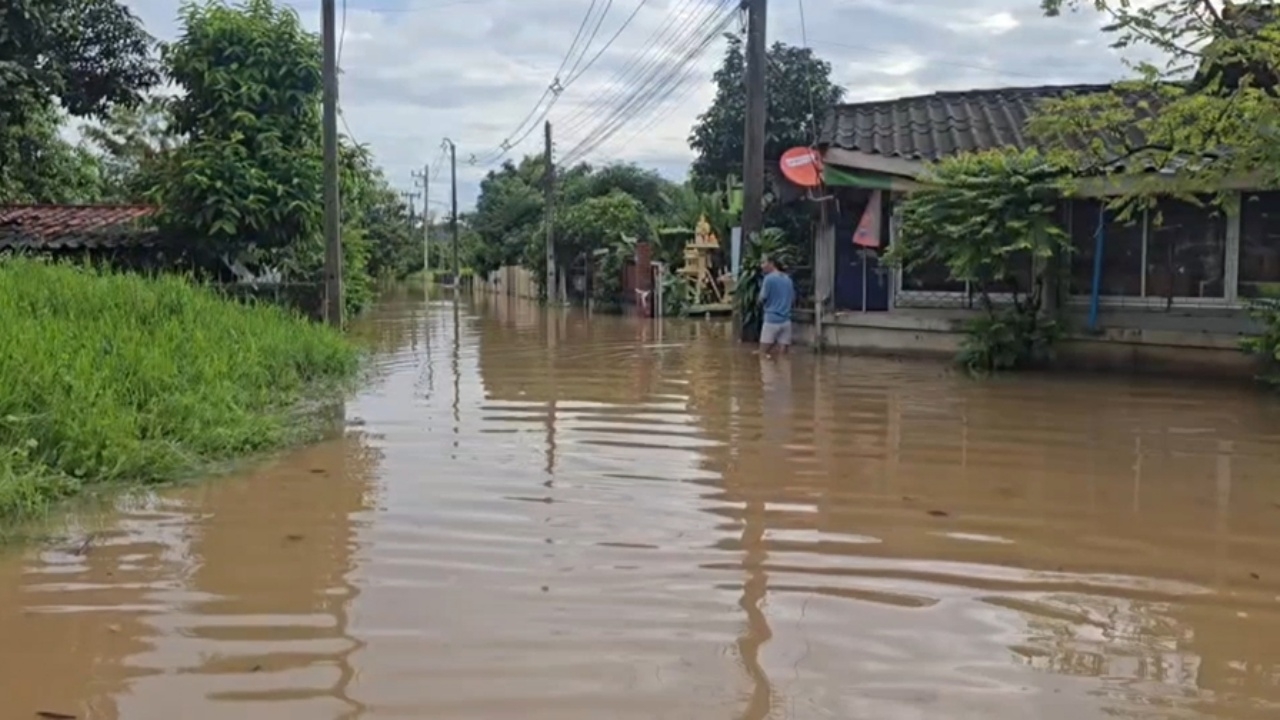
In Pak Chong District, Nakhon Ratchasima, flooding has worsened as flash floodwaters from Khao Yai National Park continue to surge into the Lam Takhong River, inundating homes in multiple areas. Authorities have warned urban areas to prepare for the situation after heavy rainfall, with the Lam Takhong Reservoir water level rising to 54 percent.
On 27 September 2026, reporters noted that late last night, flash floodwaters in Ban Khlong Phlo, Village 17, Moo Si Subdistrict, Pak Chong District, Nakhon Ratchasima Province, increased following continuous rainfall in Khao Yai. This caused water from highland areas to flow into natural streams and canals, passing through Ban Khlong Phlo before continuing into tributaries of the Lam Takhong River.

Field reports found that the floodwaters were voluminous and flowing rapidly, with strong and swift currents reflecting the accumulated water from the headwaters in Khao Yai National Park flowing downstream. The situation requires close monitoring as rainfall persists in the area.

As of the morning of 27 September 2026, flash floodwaters continue to inundate Saphan Dam community in Pak Chong Subdistrict, where dozens of homes have been flooded inside. Although the water flows swiftly, the water level is not very high, and no reports have emerged of homes being damaged or residents injured or killed.
However, according to Khao Yai National Park officials, as of 08:00 AM, rain continues to fall over the park's upper areas, resulting in more flash floodwaters flowing downstream.
Meanwhile, accumulated rainfall over several days has caused significant runoff into the Lam Takhong River, leading to a steady rise in water levels in the Lam Takhong Reservoir. Currently, the reservoir holds 52.78 percent capacity, equivalent to 165.978 million cubic meters of water.
