

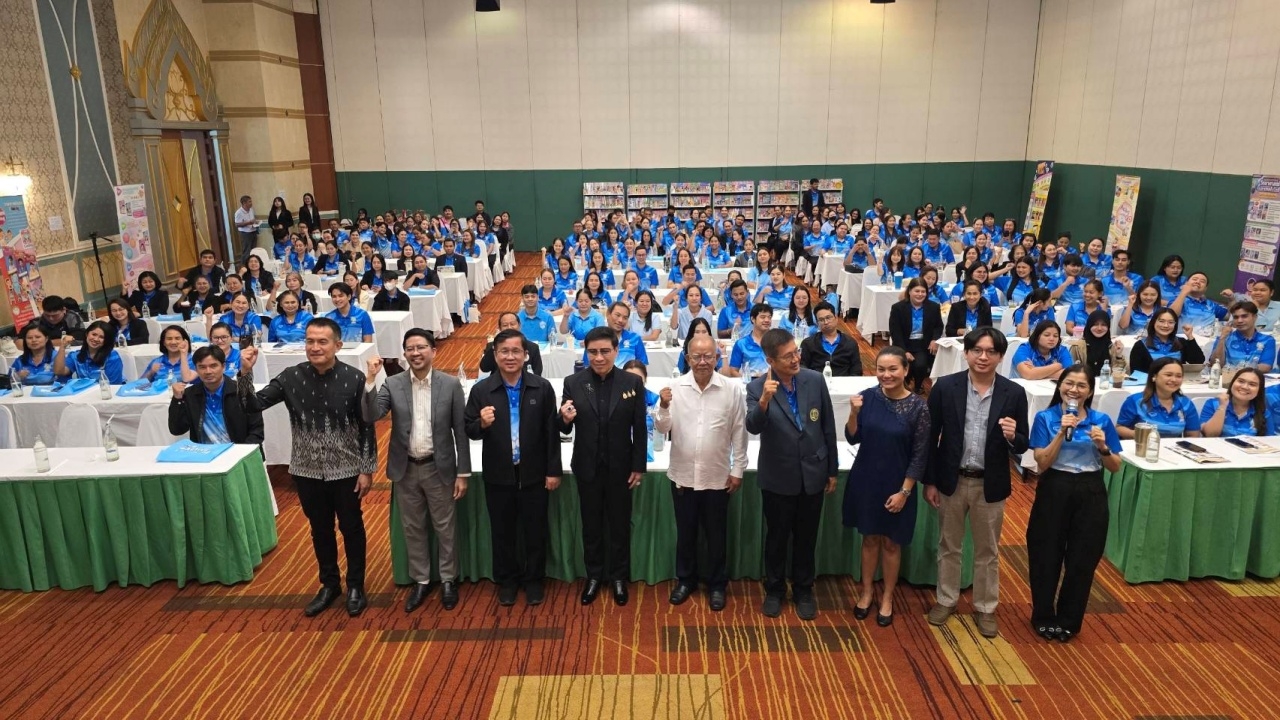
IPAQ marks its first official presence in southern Thailand, expanding the GPAS 5 Steps model from the Ratchaburi prototype to Surat Thani and Nakhon Si Thammarat, igniting youth potential as future innovators.
The Thepmitr Suksa School network, in collaboration with the Institute for the Promotion of Academic Quality (IPAQ), organized a workshop titled "Developing Learner Competencies through Active Learning Innovation Using the GPAS 5 Steps System Thinking Process and Authentic Assessment" at Wang Tai Hotel, Mueang District, Surat Thani Province.
This training marks IPAQ’s first official visit to southern Thailand to transfer and expand approaches from the model school Darun Ratchaburi in Ratchaburi Province to pilot schools in Surat Thani and Nakhon Si Thammarat, aiming to transform classrooms from content reception and memorization to spaces where learners think critically, analyze, cultivate virtues and values, and engage in hands-on knowledge construction independently.
The key objective is to prepare school administrators and teachers to implement Active Learning with the GPAS 5 Steps system thinking process, developing learners’ competencies and desirable attributes concretely, reducing learning disparities, and empowering youth to evolve from "learners" to "thinkers and creators," becoming innovators who apply advanced system thinking to self-development, community growth, and national progress in the future.
Dr. Saksin Rojaranrom, chairman of the Institute for the Promotion of Academic Quality (IPAQ), stated that for Thailand to advance toward Thailand 4.0, the education system must shift from content transmission to developing learners’ abilities to think critically, generate knowledge, and innovate independently.
He added that assessment should not merely judge which students are strong or weak but serve as a tool to discover each learner’s potential and support their development through advanced system thinking processes, enabling them to progress as far as their abilities allow.
Active Learning and the GPAS 5 Steps help learners engage through questioning, data gathering, critical thinking, and practical application, while teachers transition from knowledge transmitters to designers of learning experiences. When students gain genuine knowledge and competencies, examinations cease to be obstacles and become applicable to real life.
The expansion into southern Thailand is a significant step in building a network of schools collaborating to enhance education quality and provide equitable development opportunities for Thai children across all regions.
Mr. Chanchai Chuenprasang, director of Thepmitr Suksa School, noted that educational inequality stems not only from economic differences but also from variations in children’s backgrounds, potentials, and learning abilities.
Within the same classroom, some students learn quickly while others require additional support. Active Learning combined with GPAS 5 Steps enables teachers to design flexible activities that allow all students to participate and develop according to their potential.
The core is to apply these concepts practically rather than remain theoretical, transforming classrooms into spaces where every child feels confident to think, act, and has the chance to succeed without being left behind.
Ms. Supalak Suanchan, assistant principal for lower primary at Thepmitr Suksa School, said the workshop clarified clear learner development paths that teachers can immediately apply in classrooms. Students do not need to learn solely from books, as their environment, community, and surrounding stories also serve as learning sources. Teachers must design activities encouraging students to observe, research, question, and construct answers independently.
The GPAS 5 Steps process links data collection, critical thinking, knowledge creation, communication, and application, helping children not only to "know" but to "use knowledge effectively" and advance to producing work or innovations.
Mr. Chanok Na Vayo, assistant principal for lower secondary at Thepmitr Suksa School, emphasized the school’s focus on learning through practice, analytical thinking, moral cultivation, and fostering joy in learning.
Given students’ diverse backgrounds, the challenge for teachers is to design learning so every child feels valued, involved, and capable of growth. Learning should not bore students or drive them away from class but provide space for expression, experimentation, and discovery of personal strengths.
Having IPAQ as an academic mentor helps schools systematically implement Active Learning and GPAS 5 Steps, leading to clearer learner development outcomes.
Ms. Nipawan Thepirat, head of academic affairs at Thepmitr Suksa School, said GPAS 5 Steps offers teachers a clear framework for activity planning and shifts students’ roles from listeners to independent researchers, critical thinkers, practitioners, and presenters of their own work.
This process also allows students with varying abilities to showcase strengths in thinking, communication, teamwork, and creativity. With participation at every step, learning becomes more meaningful, teachers and students enjoy the process, and an environment emerges that nurtures each child’s growth as a unique creator.
Mr. Sakorn Matapong from Marie Pitak Suksa School in Nakhon Si Thammarat stated that the training enhanced teachers’ understanding of Active Learning and GPAS 5 Steps, enabling immediate application. The process is not difficult; with proper understanding and continuous use, it intensifies and systematizes learning management to better meet learners’ needs.
Teacher development is a crucial starting point because when teachers have the tools and confidence, they can create classrooms where children dare to think, speak, experiment, make mistakes, and learn joyfully.
This southern Thailand visit is more than a training event; it is a catalyst for educational transformation—from the Darun Ratchaburi prototype to pilot schools in Surat Thani and Nakhon Si Thammarat—aiming to create classrooms that reduce inequality, unlock potential, and empower youth to think, do, and create. The students given quality educational opportunities today will grow into innovators who drive change and become the nation's hopeful future.