

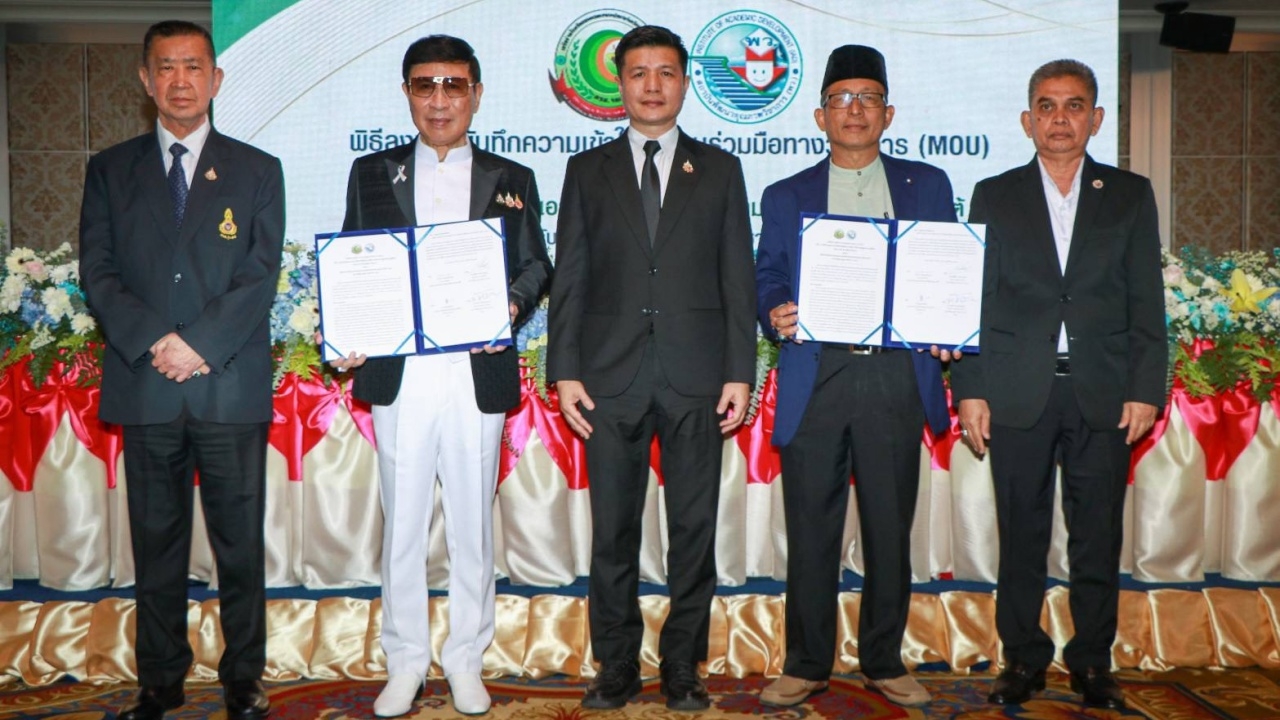
The Office of the Private Education Commission (OPEC), together with the Institute for Academic Quality Development (IAQD), has introduced a new dimension in education across five southern border provinces by promoting "Active Learning" through the high-level systemic thinking process known as GPAS 5 Steps, aiming to develop teachers and sustainably elevate student learning.
On 17 Sep 2026 GMT+7, reporters noted that education in the five southern border provinces is advancing to a new level. The Office of the Private Education Commission (OPEC), the network of Islamic private schools in the southern border provinces, and the Institute for Academic Quality Development (IAQD) have been collaboratively promoting Active Learning through the GPAS 5 Steps systemic high-level thinking process, implementing it continuously in the region over a three-year period.
This collaboration focuses on developing the capabilities of teachers and students to align with 21st-century skills while preserving the religious identity, language, culture, and lifestyles of the local population. The goal is for children to be able to think, analyze, act, solve problems, and apply their knowledge practically.
Mr. Phinya Rattanawarachat, Deputy Secretary-General of the Office of the Private Education Commission, stated that OPEC oversees about 3,000 private schools nationwide with approximately two million students. In the five southern border provinces, many students attend private schools, especially more than 300 Islamic private schools. Education in this area has unique characteristics, combining general subjects with Islamic studies. Therefore, improving educational quality requires adopting processes suited to the local context and practical for classroom use.
A key element is developing teachers to shift their role from knowledge transmitters to facilitators of learning processes, allowing students to ask questions, research information, practice actively, and construct knowledge independently.
Mr. Phinya added that GPAS 5 Steps serves as a tool to help develop students' higher-order thinking skills through learning processes linked to hands-on activities. He emphasized that sustained progress requires shared understanding from school administrators to teachers. The three-year goal is to achieve tangible development in teaching methods that will enhance student quality in the long term.
This collaboration also prioritizes developing Islamic studies alongside general subjects because OPEC oversees Islamic private schools, religious institutions, and many mosque-based Islamic education centers for school-age children in the area.

Lt. Col. Dr. Abdulhafiz Hile, Chairman of the Network of Islamic Private Schools in the Southern Border Provinces, said that this academic collaboration will enhance teacher development, learning materials, lesson plans, and Active Learning processes applicable to both general and Islamic subjects. The primary aim is to advance academics alongside religious principles and community ways of life. GPAS 5 Steps can be adapted as a thinking and learning process to balance modern knowledge with the area's religious and cultural foundations.
Moreover, a major strength of schools in the southern border provinces is linguistic diversity, as many students have backgrounds in Thai, Malay, Arabic, and English languages.
Mr. Masukri Sideh, President of the Association of Islamic Private Schools in Narathiwat Province, said that many schools currently develop continuous language programs in English, Malay, and Arab English. They also have foreign teachers participating in instruction, and some schools are extending toward international education connections. Introducing Active Learning and GPAS 5 Steps offers an opportunity to build on existing strengths, enabling students to link language, religion, science, and local knowledge skills toward creating tangible outcomes.
Mr. Saksin RojanSaranrom, Chairman of the Executive Board of IAQD, stated that the GPAS 5 Steps process aims to develop thinking and learning skills that students will retain long-term. Despite future changes in social and environmental contexts, children with foundations in thinking, analysis, and problem-solving can adapt these processes to new situations. This approach also allows teachers to incorporate cultural capital and community resources into learning—for example, using local raw materials, herbs, or fruits for halal food projects that blend scientific knowledge with religious principles. This lets students learn from their surroundings and develop their own work or portfolios.
Over three years, IAQD will support learning materials, documents, lesson plans, an e-book repository, trainers, as well as ongoing teacher development and supervision. Meanwhile, school networks in the area will drive implementation from administrators to classrooms. The ultimate goal is not just introducing new processes into schools but creating a learning system suited to the context of the five southern border provinces, providing teachers with tools to develop students and equipping children with future-ready skills while fully leveraging religious, linguistic, cultural, and local community assets.
This marks another step in educational development in the southern border region, connecting "academics–religion–language–identity–innovation" to create education quality that grows from local context and can progress sustainably.