

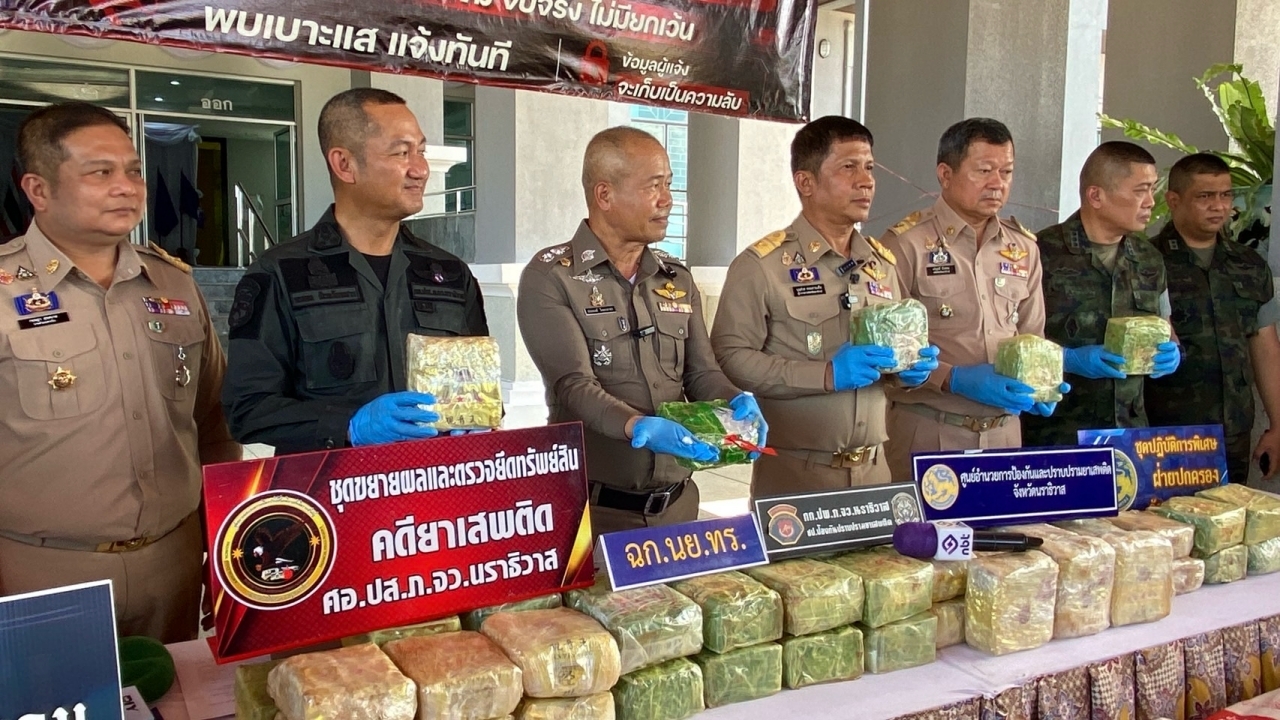
Seizure of 600 kilograms of ice drug sparks questions about violence in the southern border: is it retaliation or coincidence? Attention focuses on the Fourth Army Area Commander’s deep strategy to trace the real network behind the scenes.
On 3 October 2026, reports indicated that a major drug crackdown operation in Narathiwat border province is under close watch after security forces, combining police, military, and administrative officials, raided a house in Panado Village, Moo 3, Nanak Subdistrict, Tak Bai District, Narathiwat, on 30 September 2026. They found 30 sacks of ice drug weighing about 600 kilograms, valued at approximately 90 million baht, and detained one suspect.
This operation resulted from ongoing investigations and monitoring of drug networks in the area. Officials stated that the location served as a storage and distribution point before drugs were forwarded elsewhere, including possible smuggling into neighboring countries, as Tak Bai District is a border area with numerous travel and smuggling routes along the frontier.
What caught security forces’ attention was not only the quantity of drugs seized but also multiple violent incidents occurring continuously after the arrests.
On the same night as the ice drug seizure in Tak Bai on 30 September, a bombing and arson attack occurred at the warehouse of Srisamai (Don Yang) Superstore in Botong Subdistrict, Nong Chik District, Pattani Province.
Then, on the night of 1 October, a bombing happened at a PT gas station in Tak Bai, Narathiwat. On 2 October, there was a shooting that killed a paramilitary officer, and recently, a police officer at Rue So Police Station in Narathiwat was shot and injured.
The close timing of these events prompted security forces to urgently investigate whether the violence is linked or a form of retaliation against the drug crackdown, though it is still inconclusive whether all incidents are directed by the same mastermind or network.

Security officials assess that the drug problem in the southern border is not merely ordinary crime but complicated by the border area’s characteristics, trafficking networks, and influential groups in certain locations.
Thus, the large ice drug seizure is seen as just one piece of the investigative puzzle, since such a substantial quantity requires suppliers, transporters, storage handlers, recipients, and distributors.
The key questions are not only "who owns the drugs" but also "who is behind the financial routes, who commands the operations, and how far does the network extend."
Security sources said the investigation is expanding, with officials examining links among various individuals: drug couriers, suppliers, financial backers, and those potentially facilitating operations.
However, information regarding connections to influential persons, political groups, or insurgent groups remains under investigation and requires evidence before any accusations or identifications of masterminds can be made.
Over the years, security forces have periodically arrested drug networks in the southern border area, while violent incidents sometimes occur following official operations.
This issue requires security forces to consider whether some drug networks have relationships with influential groups or other networks locally, and if so, the nature and extent of those ties.
Importantly, such connections must be proven with evidence, not merely intelligence or assumptions.
Because naming individuals or groups as involved in drugs or unrest requires clear supporting evidence including financial trails, communications, witness testimony, and forensic proof.
Therefore, this operation does not end with seizing 600 kilograms of ice drug or detaining one suspect; the core lies in expanding the investigation to higher-level networks.
Officials must trace the entire chain from funding sources, suppliers, transporters, storage points, recipients to end markets, and also examine assets possibly gained through drug trafficking.
If evidence links to masterminds or major backers is found, it would sever drug networks more effectively than arresting mere couriers or transporters at the lower levels.
A key question under scrutiny is whether the bombings and shootings following the large ice drug seizure are mere coincidences or truly connected.
Security forces are urgently gathering information from CCTV, local witnesses, evidence, escape routes, and intelligence to compare with previously tracked networks.
If evidence shows the violence is retaliation for the drug crackdown, it would indicate that some drug networks have greater capacity to mobilize forces and conduct attacks than previously estimated.
If no link is found, the cases must be clearly separated to avoid investigations being misled by assumptions.
The seizure of 600 kilograms of ice drug in Tak Bai might just be the start of opening a major drug network file.
Going forward, society must watch whether officials can trace the masterminds and supporters, and also prove links between drug networks and the ongoing violence.
Because genuine drug suppression is not merely about seizing large quantities but cutting off financial circuits, dismantling networks, and prosecuting those behind the scenes to the source.
Meanwhile, the continuing violence during this period further complicates security duties and poses a critical test for law enforcement in the southern border area on whether the state can proceed with suppressing illegal networks without allowing influential figures or masterminds to escape justice.
Given the current situation, the key question is how Lieutenant General Chakrit Ucharat, the new Fourth Army Area Commander, can establish operational guidelines and organize security forces in the new area, especially regarding intelligence and deep investigations that look beyond operational-level suspects to networks of supporters, financiers, commanders, and financial routes.
This 600-kilogram ice drug seizure may be a significant test for the new Fourth Army Area Commander on whether he can leverage this arrest to expand the probe into higher-level networks and connect drug intelligence with the area's violent incidents.
The major challenge is not only to increase the number of arrests but to reach the source and dismantle the structures behind: financial networks, influential persons, suppliers, transporters, and potential supporters.
If security forces can conduct in-depth work and expand from "lower-level figures" to "commanders and supporters," it may mark a crucial turning point in breaking drug and crime networks in the southern border area.
If arrests remain limited to transporters or small-scale couriers, the problem may recur in the same patterns.
Therefore, what society is closely watching is how Lieutenant General Chakrit Ucharat will coordinate intelligence and operations to work cohesively and whether he can expand results from the 600-kilogram ice drug seizure to reach the real networks behind.
The true test of drug suppression in the southern border may not be measured by the amount seized but by identifying who sits at the top of the chain and whether the state can trace them.