

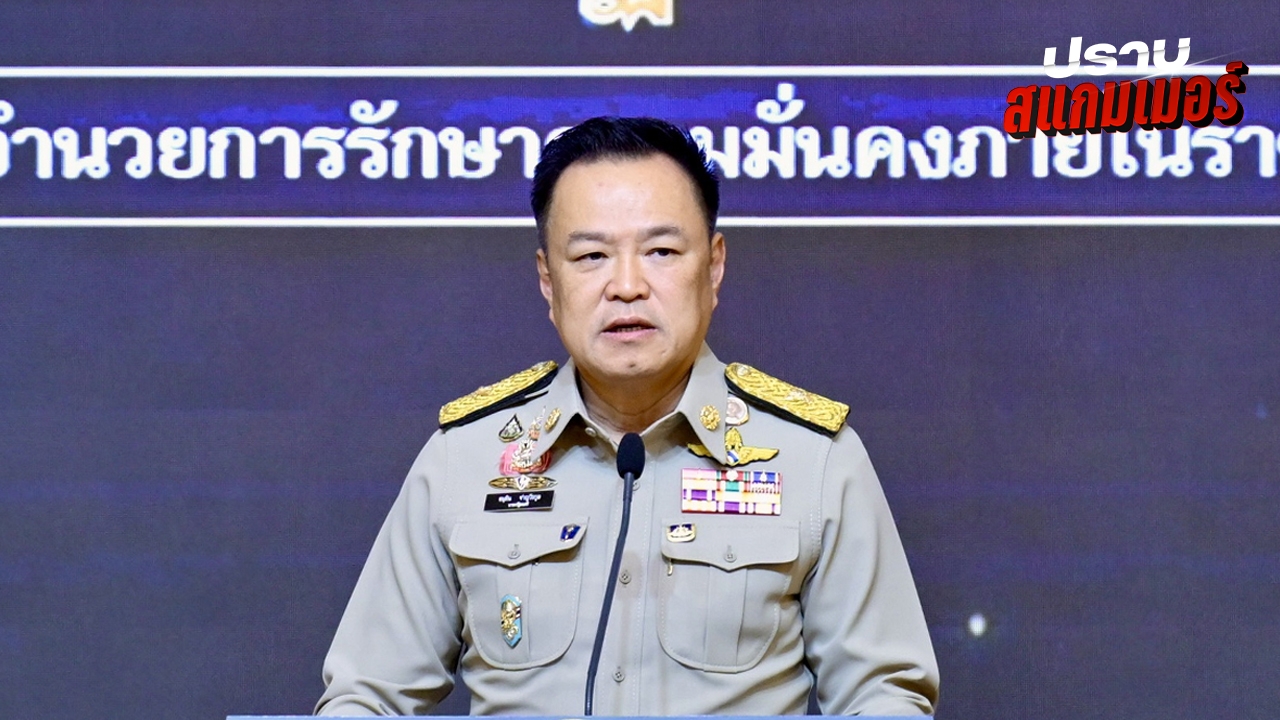
The Prime Minister has issued policy directions to the Internal Security Operations Command (ISOC) for 2026, aiming for a "sustainable and modern" approach. He emphasized accelerating the crackdown on transnational threats and scammers, highlighting proactive work and community collaboration to reach and serve as a reliable support for the people.
On 3 December 2025 at 10:00 AM, at the Santi Maitri Building (Outer Wing) of the Government House, Mr. Anutin Charnvirakul, Prime Minister and Minister of Interior, acting as director of the Internal Security Operations Command (ISOC), attended the annual operational plan review for 2025 and presented the operational plan for 2026.

The Prime Minister stated in his policy address that security issues are a priority for the government requiring urgent action. The goal is to elevate the quality of life for citizens and suppress all forms of threats that impact national security and public order.
He discussed with the Army Commander, who is ISOC’s deputy director, the operational direction for ISOC in 2026, focusing on sustainable, modern security centered on the people. The approach will shift from reactive to proactive, addressing root causes and integrating efforts for clear results that meet citizens’ needs in all situations. He instructed all agencies to adopt these guidelines and prepare to prevent and resolve problems effectively in 2026.

1. Urgent threat prevention will focus on halting incidents that impact national security, prioritizing management of transnational threats and drug problems along border areas. Support will be given to resolving issues in the southern border provinces with deep local engagement and community participation to foster peace, reduce violence, and decrease risk points concretely. Efforts will also include suppressing cybercrime, call center fraud gangs, scammers, and transnational terrorism, building public resilience, and establishing widespread tip-off networks. Additionally, tackling informal debt issues will be expedited through coordination with relevant agencies to achieve clear outcomes. ISOC’s intelligence management must develop accurate, timely, and reliable information, counter fake news that distorts facts and harms national security, preventing social division.
2. Government support efforts will focus on improving livelihoods, addressing land use issues, human trafficking, and stateless persons. Relevant agencies will support security, prosperity, and sustainability plans to protect target communities locally. Priorities include urgent problem solving, readiness in energy and food security, and preventing illegal import-export of agricultural and fishery products. Preparedness will extend to responding to abnormal events or disasters that may affect the economy and overall security. Regarding disaster relief and environmental problems, ISOC is tasked with proactive measures to prevent and mitigate impacts, cooperating with local authorities to resolve PM 2.5 pollution, forest fires, air pollution, industrial chemicals, and chemical-contaminated water.

3. Organizational improvement and enhancing transparency and public trust will begin by upgrading personnel capabilities to keep pace with new threats, including technology and information use, enabling forces to handle rapidly changing and complex security contexts. Transparency must be strengthened with all missions conducted openly and verifiably, including budget use, field operations, and public communications.

The Prime Minister concluded by thanking ISOC leadership and all involved parties for their dedication and cooperation in advancing the country’s security mission continuously. He expressed his gratitude and encouragement for their commitment and sacrifice to translate policy into tangible results that the public can truly experience. He emphasized that everyone present will work together to move Thailand forward with stable and sustainable progress.