

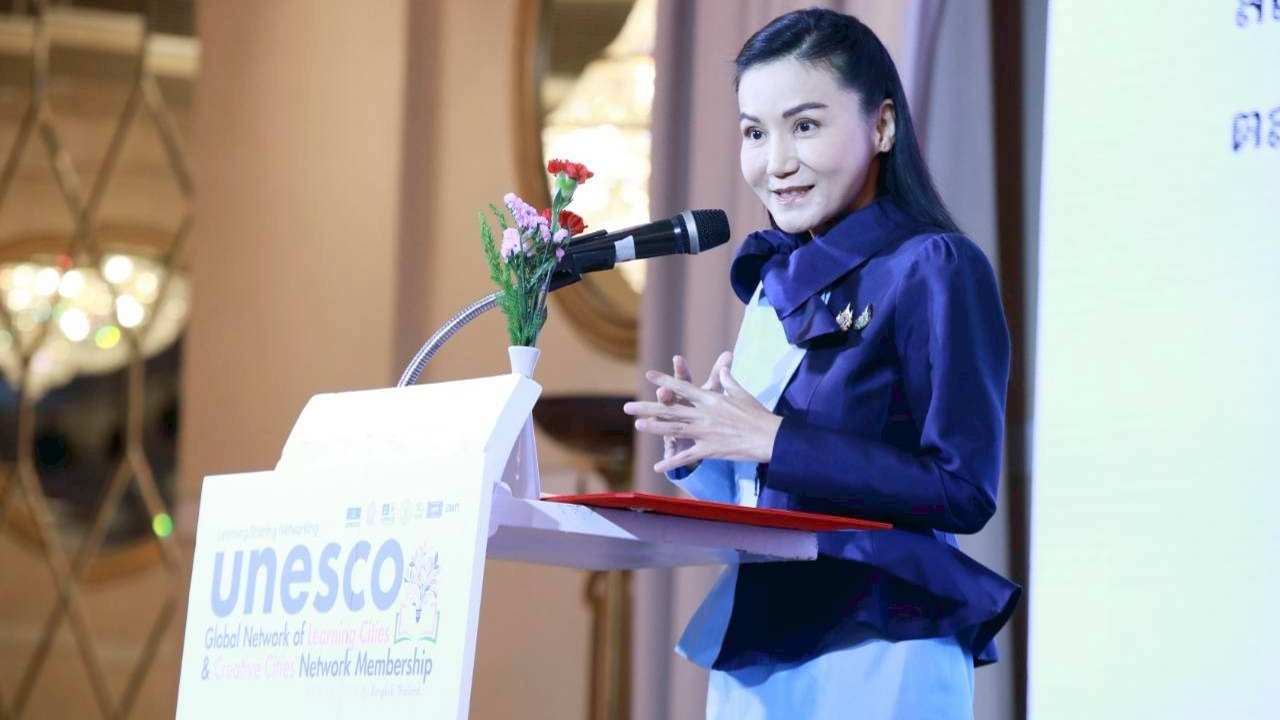
Narumon revealed that UNESCO has recognized Tak, Rayong, and Satun as learning cities, reflecting another step forward in Thai education. This supports lifelong learning policies and elevates standards to a global level.
On 9 Dec 2025 GMT+7, Dr. Narumon Pinyo Sinwattana, Minister of Education and Chair of the National Committee on Education, Science, and Culture under UNESCO, announced that on 4 Dec 2025 GMT+7, UNESCO certified Tak Municipality, Rayong Province, and Satun Province as new members of the UNESCO Global Network of Learning Cities (GNLC), along with 72 other cities from 46 countries worldwide.
Dr. Narumon said UNESCO's announcement reflects Thailand's progress in advancing lifelong learning policies. It also shows the commitment of relevant government agencies and network partners to enhance education and learning opportunities for people of all ages, both inside and outside formal education, through policies and mechanisms that address 21st-century societal changes. The three newly recognized Thai cities each have distinct strengths. Their highlights are: 1. Tak Municipality focuses on developing a “city of opportunity” by managing lifelong education for urban and border populations; 2. Rayong Province drives learning in collaboration with industry, technology, and local resources to prepare workers and youth in the Eastern Economic Corridor; and 3. Satun Province promotes learning based on natural and cultural heritage, developing skills in environment, tourism, and community livelihoods.
Joining UNESCO's network will provide these Thai cities access to knowledge, learning resources, and best practices from leading cities worldwide. It also enhances opportunities to create learning innovations through international collaboration. The learning cities network is a space where everyone can learn anytime, anywhere. UNESCO describes a learning city as a place where “learning is an integral part of daily life.” Whether in schools, workplaces, libraries, museums, public spaces, or even homes, these cities play a vital role in upgrading workforce skills to meet evolving job markets, providing learning opportunities for adults and disadvantaged groups, preparing people of all ages for technology and artificial intelligence, and promoting local entrepreneurship and innovation.
Ms. Stefania Giannini, UNESCO Assistant Director-General for Education, stated that the 72 new cities worldwide are redefining learning by “turning every street and building in the city into spaces of knowledge and opportunity.” In 2025, the network expanded to its largest size ever, with over 425 cities from 91 countries, serving nearly 500 million people globally. That year also welcomed 11 new capital cities, including Porto-Novo, Bissau, Lusaka, Cairo, Riyadh, Lisbon, Ankara, Ashgabat, Hanoi, Buenos Aires, and Caracas. Additionally, 12 new member countries joined: Benin, Burkina Faso, Chile, Cyprus, Guinea-Bissau, Iraq, Mongolia, Niger, Turkmenistan, the United States, Venezuela, and Zambia. For Thailand, having 13 member cities strengthens the momentum for lifelong learning policies and supports further development toward
community-based learning innovations, fostering cooperation between Thai and international cities, and creating provincial policy plans focused on “lifelong learning for all.” This will advance Thailand's development as an internationally recognized learning city.