

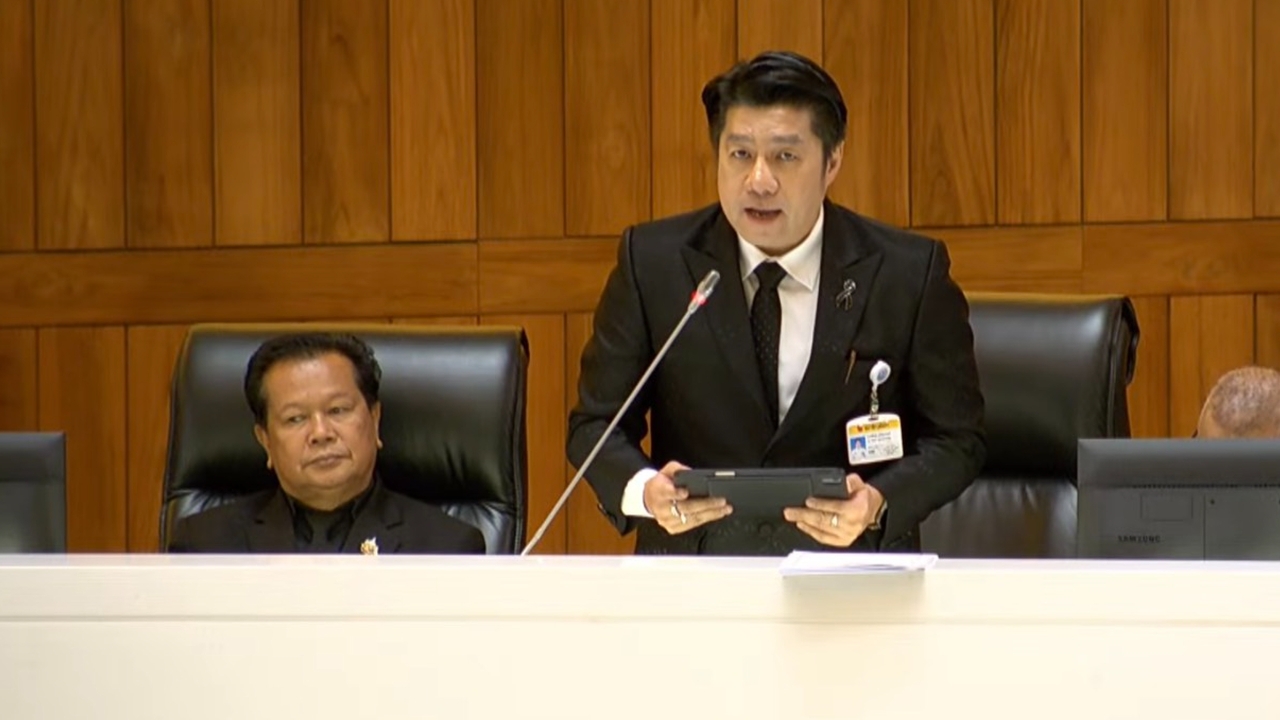
Some senators fear accusations that the constitutional amendments aim to grant special senators extended full terms and worry this might be seen as a hidden agenda. Meanwhile, the Pheu Thai Party is calling for strict laws to control the discretionary powers of independent organizations.
At 1:30 p.m. on 11 Dec 2025 at the parliament, the special session considered the second reading of the constitutional amendment bill. The session proceeded up to Section 256/26, which contains key constitutional provisions. Mr. Chaiyachana Dechadecho, a Democrat MP, proposed adding a clause (10) to establish ethical standards for political officeholders, members of independent agencies, constitutional bodies, and state officials, along with mechanisms for enforcement in cases of violations or failure to comply with these standards.
Meanwhile, Ms. Ratchaneekorn Thongthip, from the minority committee, proposed adding content to preserve the provisions in Chapter 1 General Principles and Chapter 2 The Monarchy of the Constitution of the Kingdom of Thailand, without amendment. She suggested maintaining the amendment chapter, the composition of the Senate, qualifications of political officeholders and members of independent agencies, the Constitutional Court, as well as the duties and powers of independent agencies, the Constitutional Court, and the courts under the 2017 Constitution.
Mr. Phisit Apiwatthapong, a minority committee member who reserved his dissenting amendments, allowed former senators whose terms had ended to run for election as MPs or hold any political office without time restrictions. He also proposed preserving the transitional provisions recognizing the Senate members under the 2017 Constitution and confirming that members of independent agencies serve full terms. Mr. Phisit said his proposals had been misinterpreted, so to avoid further concerns, he decided to withdraw all his previously submitted amendments.
Mr. Teerachai Saenkaew proposed an amendment to Section 256 (6) to limit the discretion of state bodies, independent agencies, and the judiciary, including mechanisms to prevent and monitor abuses of power, as well as removal and punishment measures for officials within these bodies by the House of Representatives and the public. He expressed that some independent agencies had previously overstepped their authority and lacked neutrality, yet there were no mechanisms to scrutinize them effectively.

Ultimately, the assembly approved the majority committee’s amendments with a vote of 547 to 18, with 6 abstentions and 6 absentees. This means that the new draft constitution prepared by the drafting committee and approved by parliament will include the following key contents.
(1) Affirmation of the indivisible unity of the Kingdom.
(2) Governance under a democratic system with the King as Head of State.
(3) Protection of rights, liberties, equality, human dignity, and basic welfare of the people.
(4) Establishment of political institutions and their interrelations.
These must be linked to the people, allowing them to check and balance power, enhancing full democracy.
(5) Establishment of effective mechanisms to monitor state power to prevent and eliminate corruption, misconduct, abuse of power, and conflicts of interest.
(6) Limitation of the scope of state power and discretionary authority of state organizations.
(7) Strengthening the rule of law and good governance principles, including equal application of laws.
(8) Flexible, agile public administration and policy implementation that respond to changes and public needs.
(8/1) Decentralization of power to local administrative organizations.
(9) Establishment of criteria for amending the constitution.
In case of disputes over whether the proposed new constitution contains the key contents stipulated in Section 256/27, the parliament shall decide, and its decision shall be final.