

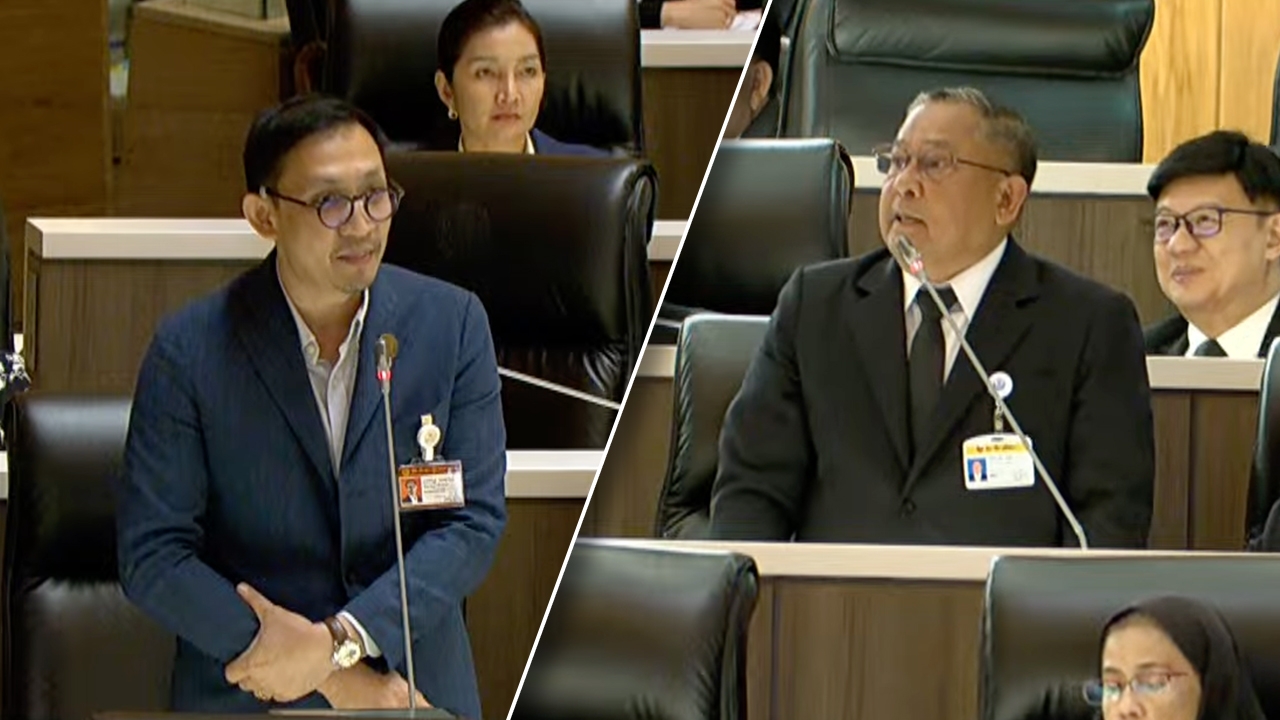
Blue-shirted Senators strongly oppose the constitutional amendment that would remove the one-third Senate approval, fearing it could open the door for a return to parliamentary dictatorship. MPs rebutted sharply. Meanwhile, Senator Prateuang even threatened to see whether the third reading will pass. The pro-Phue Thai committee clarified that majority voting is a common practice worldwide.
On 11 Dec 2025 GMT+7 at 16:10, during the extraordinary joint parliamentary session to consider the amendment draft of the Constitution of the Kingdom of Thailand (No. ..) B.E. .... in the second reading on the second day, the key issue was section 256/28. This section involves the approval of the new constitutional amendment draft, as finalized by the Drafting Committee, where the parliamentary session would use a roll-call and open voting method. Approval requires more than half of all current parliamentary members, differing from the 2017 Constitution, which required more than half of parliament members plus one-third of the Senate to approve. Blue-shirted Senators argued unanimously to retain the one-third Senate approval requirement to prevent a parliamentary dictatorship driven solely by majority votes and to uphold the principle of minority rights. Senator Phisit Apiwatnapong, representing the minority committee, stated that the one-third Senate approval creates four checks and balances: 1. Prevents parliamentary dictatorship by acting as a safety brake, especially if 2-3 parties combine to control over 350 votes in both houses, which could easily amend the constitution for their benefit. The House of Representatives is like an accelerator; the Senate is the brake. Removing the one-third Senate vote is like driving without brakes. 2. The one-third Senate vote is not a special privilege but a quality guarantee ensuring constitutional amendments follow academic principles rather than party mandates. 3. The constitution should be harder to amend than ordinary laws to maintain democratic stability. 4. Constitutional Court rulings published four times in the Royal Gazette have established that one-third Senate approval is mandatory, binding all organizations. The core principle of power separation must not be touched. Retaining the one-third Senate vote is not obstruction but minority protection.

Senator Ratchanikorn Thongthip, a committee member, reserved her opinion on using roll-call and open voting methods, requiring more than half of parliament plus one-third Senate approval. She pointed out that Senators come from expert groups, not political factions. Unlike MPs who must follow party lines, Senators are independent of politics in all countries. Therefore, it is necessary for the constitution to require one-third Senate approval.

Meanwhile, Khajit Chainikom, a list MP from Phue Thai Party, argued that the truth is that each parliamentary member has one equal vote. Using a majority of parliament votes is legitimate and does not require neutrality claims. Whether one is neutral or not is known internally. The constitution defines political parties, so deciding based on one-third Senate votes is unfair to the 700 MPs. He reaffirmed that requiring a majority vote to approve constitutional amendments is appropriate.
Phandin Nuamjeum, an MP from Bangkok's Prachachon Party and committee member, said this section had the most signatures for debate. He urged fellow members to make history together and not let the public label them as obstacles to the constitution. If a majority supports the amendment but cannot gain one-third Senate approval, the new constitution would fail, even though it is already difficult to amend. How can future generations accept a constitution drafted by a coup government? He called for counting MPs' and Senators' votes equally, emphasizing that the ultimate owner of the country is the people through a referendum. He invited Senators to step back and be remembered as truly mature, as the people's voice is the final one to respect.

Senator Pinyaphat Sansaneewichin argued that removing the Senate's power to approve constitutional amendments is unacceptable, leading to a return of majority dictatorship. It is like writing a blank check allowing those in power to push through constitutional content, undermining the independence of autonomous organizations. Power without checks leads to arbitrary use. She affirmed that Senators have no interest in preserving power for themselves, as the current constitution prevents them from serving as Senators again; one term is a lifetime limit. If this amendment is careless, it will open the door for those in power to change rules for their benefit. Removing the Senate's filtering mechanism may cause the decisive third reading to fail approval. She urged everyone to carefully consider the principle of checks and balances before the critical third reading.
Senator Nantana Nantawaropas from the New Breed group said that the one-third Senate vote is an obstacle to constitutional amendment. Amendments must follow the people's mandate and should not be too easy or hard to change, to avoid being discarded by coups as past constitutions were. The problem with the Senate is that they are not elected by the people, lacking legitimacy as representatives. The one-third Senate vote is a distortion drafted by legal clerks and rooted in coups. Empowering the Senate is not checks and balances but stealing people's power for political factions. One cannot grant one-third Senate power. Using a parliamentary majority vote is better than the Senate's overpowering proposal. She invited Senators to show that they serve the people's interests, not their own.
Then, Viroj Lakkhanaadisorn, a list MP from Prachachon Party, said that equal voting rights represent proper proportional checks and balances. If Senator Ratchanikorn dislikes politicians, she should remember that Senators are politicians too.
“I've listened to you for a long time. You point a finger at others but forget the four fingers pointing back at yourself. Ultimately, no power grants a representative authority through indirect means. The supreme power belongs to the Thai people. I urge Senators to accept that true power comes from the people.”
Senator Ratchanikorn invoked her right of reply, saying she never named or criticized anyone like that. She never claimed she was not a politician but said she only recently became one and is not a lifelong politician.
Then, Dr. Tosaporn Serirak, a Phrae MP from Phue Thai Party, argued that the committee's claim that MPs focus only on votes while Senators focus on the country's benefit is insulting. The 500 MPs chosen by the people have their own opinions, even if they gather into political parties.
During the session, protests erupted between Viroj and Phisit, with several MPs standing up in protest. This forced Mongkol Surasajja, Deputy Speaker of Parliament, to intervene and rule that Jirath Thongsuwan, an MP from Nakhon Nayok for Prachachon Party, continue debating. Jirath emphasized that the majority must respect the people's voice, not a dictatorship seizing power.
This caused Senator Prateuang Montri to protest, saying, “Repetitive and going in circles. Don’t overthink it. Think tonight: if you act this way in the third reading, do you think you will get the Senators’ votes? Please think carefully.”
Jirath said not to be afraid and to respect the majority voice in democracy to understand what the people want.
Kattiya Sawatdipol, a list MP from Phue Thai and committee member, explained she disagreed with those reserving amendments to keep the one-third Senate vote or 67 votes, as it complicates the amendment process and might halt the new constitution's creation. How can it be a people's constitution then? She affirmed this is not about reducing Senate power or checks and balances. Majority voting is a global standard but must not violate minority rights. Also, Senate independence does not guarantee freedom from political influence.
Jatuporn Chaiyasang, a list MP from Phue Thai and majority committee member, clarified that the majority of parliament must decide without the one-third Senate vote. The current rule makes constitutional amendment extremely difficult because while 500 MPs can unite, they must still get 134 Senate votes, which blocks the people's opportunities. The claim that a majority drags the minority is incorrect; in fact, the minority is obstructing progress, causing the draft constitution to remain unfinished. He affirmed the country needs comprehensive constitutional reform to overcome backwardness and urged parliament members to understand that their decision will determine the amendment's success.
Meanwhile, Parit Watcharasindhu, a list MP from Prachachon Party and majority committee member, explained that if the majority committee proceeds with the parliamentary vote, a referendum must be held up to three times. He doubts any other country requires three referendums. However, he respects the process and urges no one to claim greater respect for the people's voice here because, ultimately, whether the constitution succeeds depends on the people, not just MPs or Senators.
