

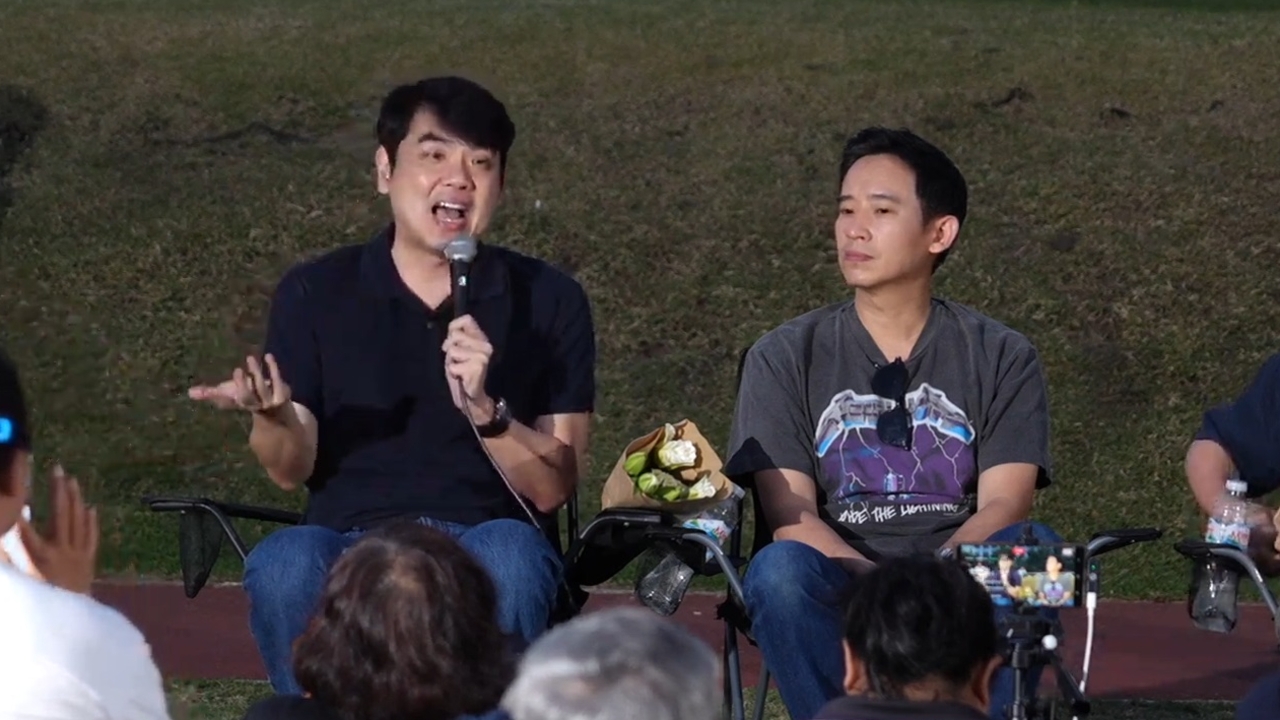
Piyabutr recounted the background of the People's Party signing an MOA with Bhumjaithai to push for constitutional amendments, describing it as an experiment. Despite the slim chances and ultimate failure, he viewed it as a trial and urged citizens to flood the referendum voting with overwhelming support.
On 13 Dec 2025 GMT+7 at the lawn of Srinakharinwirot University Prasarnmit campus, the People's Party (Pop Party) held the event “People’s Party Picnic Meets the People”. Mr. Piyabutr Saengkanokkul, secretary-general of the Progressive Movement and former secretary-general of the Future Forward Party, answered questions about expectations for the new constitution draft referendum. At one point, he said he looked somber and admitted frankly that he was probably among the most disappointed people that the constitutional amendment process failed this time. Many might ask why bother since it seemed pointless, knowing they would renege and the constitution outcome might be poor.
Mr. Piyabutr said we must review that this is the third party formed (Future Forward Party, Move Forward Party, People's Party), whose origin relates to the need to address the 2017 constitution. Without the 2017 constitution, this party wouldn’t exist. We formed it knowing the constitution was very difficult to amend and aimed to use the political system and elected parties to gradually change it bit by bit.
"If you observe from the start, we raised this banner. When Future Forward had 81 seats, we couldn’t propose amendments ourselves as we lacked the 100-seat threshold. We tried various methods. When Move Forward had many more seats, we could propose ourselves, but still none passed except once regarding the election system."
So this was an opportunity. We weighed ignoring everything and just waiting to get at least referendum question 1, or taking a chance to try for amendments, possibly having two questions together during elections, so we wouldn’t need to rely on the Senate again. This was the only time to seek Senate approval for the third reading. In the end, it failed. It’s disappointing; we were so close to the finish line.
Mr. Piyabutr continued by explaining that the 2017 constitution is very hard to amend. Many believe it won’t be changed in their lifetime. Changing it might require extraordinary methods like coups or popular revolutions, which aren’t feasible now because you can’t get 67 Senate votes. We tried imagining scenarios under constraints. There are two groups: those wanting amendments—like us here—and those opposing, who manifest through voters, parties, independent organizations, and more. The opposing group’s strategy is to block amendments by legal challenges and other obstacles, including the need for 1/3 Senate votes.
"Among those wanting amendments, some think about alternatives like referendum questions if amendment isn’t possible now. Another group considered using the small leverage from the MOA to try amending. We assessed and decided to try, even if not everyone agreed. At least it was a trial. The result was failure, but if we hadn’t tried, we wouldn’t know if it was possible. Starting the trial gave us at least the chance to get the first referendum question, so let’s campaign together."
He revealed that they wanted the second referendum question too because the first requires overwhelming public support to pressure the Senate. Even if the first passes, parliament must still amend further, needing at least 67 votes, so a second question would avoid having to ask again. They tried negotiating, but ultimately failed, so they must return to pushing for the first question and pressure again next time.
The scenario is like this: Is there still hope for constitutional amendment step by step? Now, the referendum day should coincide with the election day to save public funds from holding two separate votes. The campaign will be about both choosing a government and deciding on constitutional amendment. Citizens must vote overwhelmingly. Consider that the 2017 constitution referendum in 2016 passed with a majority; if a February 2026 referendum on amendments loses, the current constitution will become even more entrenched and harder to change. This is the riskiest game to gain public consensus, needing 70–80% support for a new constitution.
"If we succeed in February 2026, the next step is drafting the constitution and pressuring the Senate to release those 67 votes. We must proceed stepwise: 1. Hold the referendum on election day, 2. Encourage overwhelming voter turnout—70–80% support is needed to change this constitution. It’s regrettable we almost reached the goal but failed. The trial failed, and participants failed. Next, we prepare for a new stage: holding the referendum alongside the general election to decide who will form the government."