

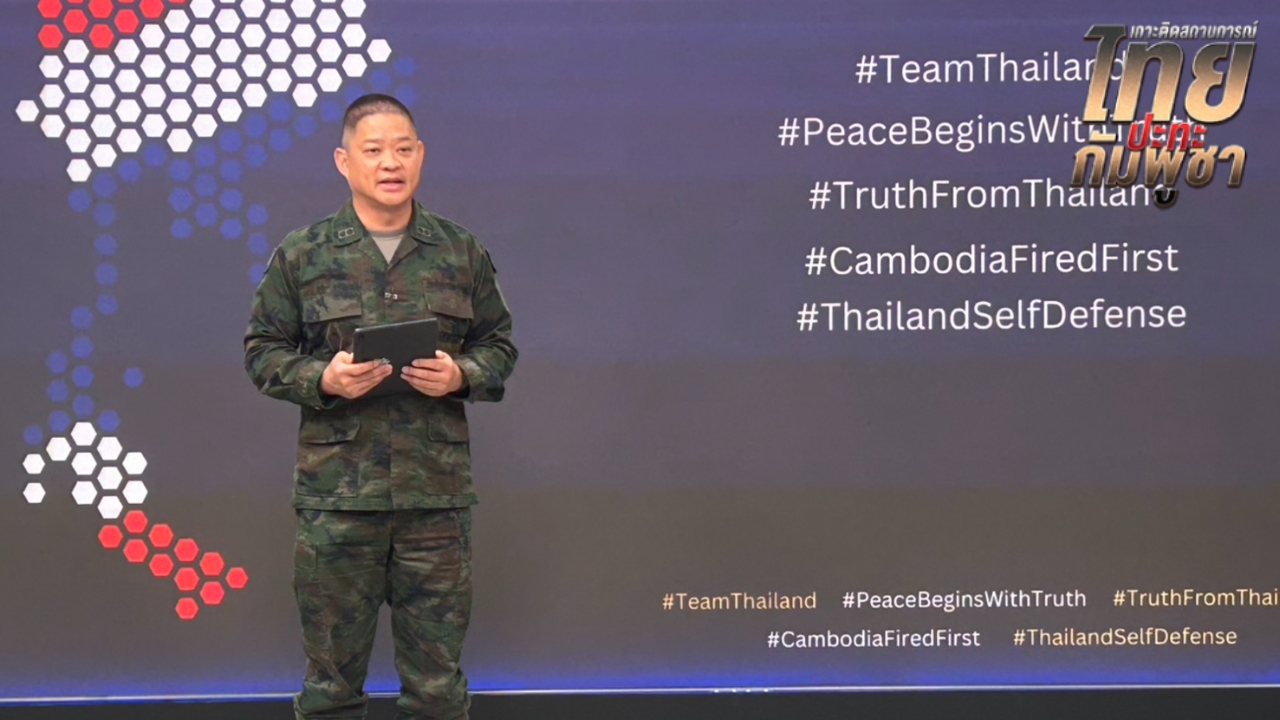
The Defense Ministry spokesperson revealed that the King and all members of the royal family are deeply concerned for the people. Thailand has evacuated more residents from two additional border districts. It was also disclosed that 128 high-risk foreigners potentially linked to mercenaries have been identified.
On 15 December 2025 GMT+7 at 16:00, at the Joint News Center for the Thai-Cambodian Border Situation at Channel 5, Rear Admiral Surasan Kongsiri, Defense Ministry spokesperson, stated that since early morning, Cambodian forces have launched heavy weapon attacks into Ubon Ratchathani, Surin, and Sisaket provinces. Consequently, Thai forces responded. Evacuation orders were issued for residents from Khun Han and Phu Sing districts in Sisaket, which border Cambodia, to move to safe zones or temporary shelters to ensure their safety, as Cambodian forces continue targeting Thai civilians. It was confirmed that Thai forces have fully controlled the Ta Kwai Castle area, though clashes persist in surrounding areas, with ongoing efforts to secure the vicinity.
Rear Admiral Surasan stated that currently, 261,137 evacuees are housed in 996 temporary shelters. There have been 12 indirect civilian deaths related to the situation, 1 direct death from Cambodian attacks, and 5 injured from Cambodian assaults. Twenty hospitals and 218 health promotion hospitals have been affected. Importantly, His Majesty the King, Her Majesty the Queen, and all royal family members have expressed concern for those impacted by the ongoing tension, providing royal kitchens to support affected residents at all locations.
Maratee Nalita Andamo, Deputy Spokesperson for the Ministry of Foreign Affairs, clarified reports circulating on social media about blocking waterways to prevent oil and military supplies from reaching Cambodia. She stated Thailand does not wish to escalate the situation. Thai actions aim solely to protect sovereignty and reduce threats. Thailand adheres to humanitarian principles and international law, specifically the 1982 United Nations Convention on the Law of the Sea (UNCLOS), which prioritizes freedom of navigation. Thailand does not intend to affect trade, transportation, or supply chains and strictly upholds these principles to communicate this to third countries and the international community.

Rear Admiral Parach Rattanachaiyaphan, Royal Thai Navy spokesperson, confirmed there is no blockade or closure of Thai waters and that the navy has no intention of such actions. The navy respects international norms and the global community, aiming only to cut off military supplies to Cambodia. Regarding reports of two Thai oil and cargo ships, Nakharat 26 and Thai Laem Thong, near Koh Kong province, he said the navy is addressing the issue. Several Thai shipping companies use Thai vessels to transport fuel into Cambodia. The navy has engaged with these companies to request cooperation in not transporting military supplies. This matter will be reviewed again at the National Security Council meeting. Curfew measures remain in Trat province but will be shortened to minimize inconvenience and ensure public safety, amid reports of hostile elements entering the area. Residents needing to travel can contact officials at checkpoints.
When asked about measures to protect military units after the attack on the Royal Thai Navy Task Force headquarters in Trat, the navy spokesperson said security checks of government and key locations are ongoing. Coordination with local security forces, including police and administrative authorities, is in place to monitor and gather intelligence.
Police Major General Siriwat Deepor, Deputy Spokesperson of the Royal Thai Police, revealed that the police have intensified proactive measures, including crime sweeps, increased patrols, and prevention during this abnormal situation. They also inspect venues hosting large gatherings by establishing forward operation centers in cooperation with relevant agencies to ensure close safety monitoring. Intelligence efforts have been ramped up domestically and internationally, especially during festivals when people gather to celebrate, identifying these as high-risk areas requiring special attention. Additionally, strict enforcement of traffic laws supports safe and smooth travel during holiday returns and tourism.
The Deputy Spokesperson of the Royal Thai Police added that law enforcement is strict across all areas, including enhanced screening of foreign nationals entering Thailand who may pose security threats. The Immigration Bureau employs the Immigration Act to scrutinize high-risk individuals and immediately denies entry. In December, despite Cambodia being among 93 visa-exempt countries, stringent checks led to the refusal of entry for 78 Cambodian nationals.
"Additionally, 128 other high-risk foreigners suspected of mercenary links were denied entry into Thailand. All figures pertain only to the first ten days of December," he stated.
Regarding warnings about mercenaries in Nakhon Ratchasima province, the Deputy Police Spokesperson said the intelligence community, in cooperation with local police, issued alerts and ordered immediate investigations upon receiving information. No abnormal activities have been detected so far. Continuous monitoring remains in place. The public is urged to assist by reporting suspicious objects, persons, or unusual drones via hotlines 191 or 1599 at any time, as part of the collective effort to protect national sovereignty and security.
Air Chief Marshal Jakkrit Thamvichai, Royal Thai Air Force spokesperson, addressed social media rumors alleging Thai fighter jets bombed areas in Siem Reap and that two bombs fell near a refugee center. He affirmed that air operations comply strictly with international law and rules of engagement. Military targets are selected based on their use for military purposes, not proximity to the border. He stressed that all air strikes target military objectives only, aiming to defend and minimize impact on civilians. The operations prioritize national defense, sovereignty, and humanitarian principles. When targets are near communities, precision weapons are used to avoid civilian harm. Detailed assessments found no impact on Cambodian civilians in the area.