

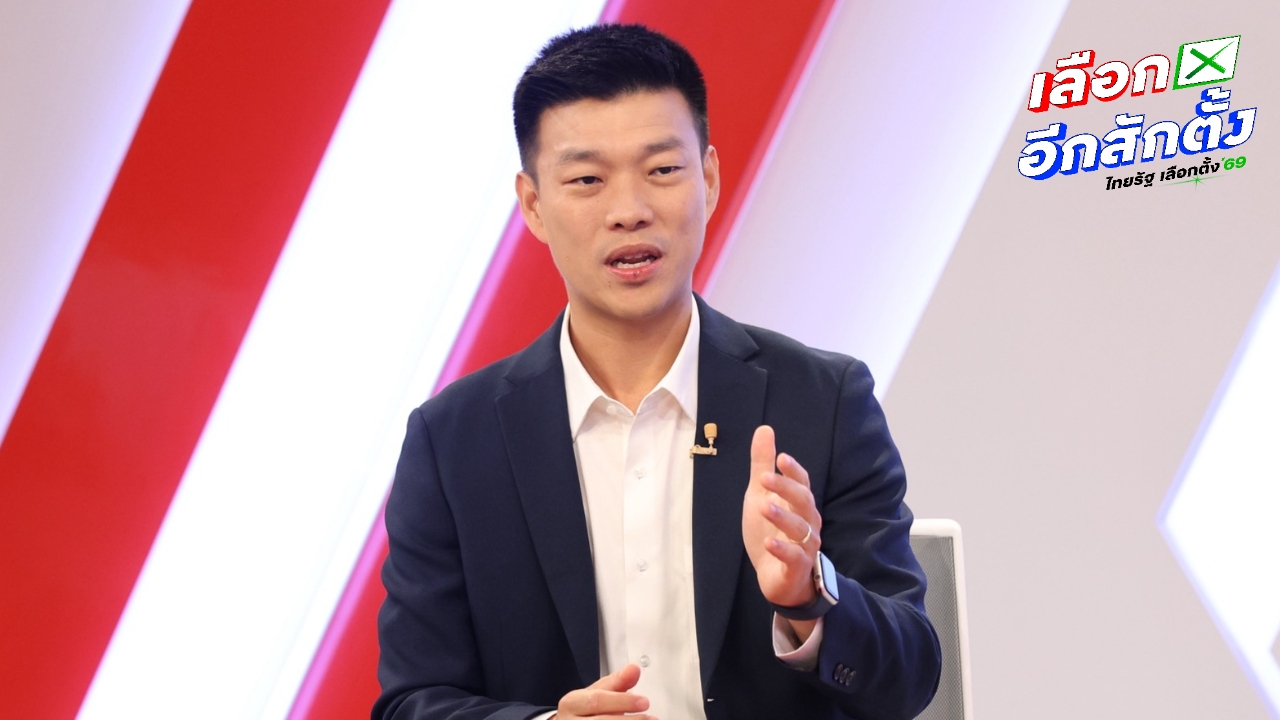
Teng apologizes for voting for Anutin as Prime Minister, pointing out that the 2024 election marks a decisive moment for government formation between the Orange and Blue parties. He hopes the public will establish a government to lift the country out of the abyss, asserting that constitutional reform has stalled because some groups are holding the country back rather than moving it forward.
On 19 Dec 2025 GMT+7, Mr. Natthapong Ruangpanyawut, party leader and prime ministerial candidate of the Prachachon Party, spoke candidly on the program “Open Up with Phakphum” on Thairath TV. When asked whether the cabinet's submission of constitutional referendum questions to the Election Commission fulfilled the MOA obligations, Natthapong responded that it’s better to ask the other side. Regarding his own view, he referred to the events of 11 Dec 2025 GMT+7, when voting occurred. Previously, the government's whip committee had endorsed the draft by the majority commission that excluded the requirement for one-third of Senate votes. However, on the actual voting day, the outcome did not follow the whip committee's resolution. Therefore, from his perspective, the actions did not align with prior agreements.

Regarding the Prachachon Party’s picnic event apologizing to the public over constitutional issues, Natthapong stated: It was an apology for past decisions, including voting for Mr. Anutin Charnvirakul, leader of the Bhumjaithai Party, as Prime Minister, and for failing to successfully push for a new constitution as outlined in the MOA agreed with Bhumjaithai. To supporters of the party and the general public who feel disappointed, I, as party leader, sincerely accept all criticism and apologize frankly. However, I want everyone to understand that our decisions aimed to create solutions for the country, prioritizing national interests. Regarding criticisms related to the party’s popularity, we are aware and believe that our ongoing work will demonstrate our efforts to restore public trust.
When asked if his apology extended beyond constitutional reform failure to also include voting for Mr. Anutin, Natthapong said he humbly accepts all opinions and feelings. He apologized for all past actions but emphasized that decisions were not made by him alone; party executives engaged in extensive internal debate and listened closely to members. Nevertheless, he does not use the voting outcome as a shield for past actions. Party leaders must take responsibility for all actions. Therefore, if anyone demands an apology for voting for Anutin or for failing to amend the constitution, he accepts and apologizes in all cases.

Asked what lessons past experiences imparted to the Prachachon Party, Natthapong replied that it taught not only him but Thai society that straightforward, transparent politics—documented clearly in the MOA—may not yet be feasible because certain groups holding some power, not elected by the people, are obstructing the country's progress. He emphasized that the upcoming election is crucial, urging everyone to decide carefully, as this time Senate votes will no longer count; thus, the people's votes will truly determine the government's composition.
Natthapong likened Thailand to a person standing at the edge of a cliff. The choice is whether to let the country move forward and fall into the abyss or to decide wisely by establishing a people's government that serves the majority's interests, pulling Thailand back from the brink and enabling the country to advance.
In response to perceptions that the Prachachon Party’s political style is too honest or inexperienced—having gone through Future Forward Party, Move Forward Party, and now Prachachon—Natthapong said he wants people to choose between transparent, straightforward politics and politics full of political maneuvering, saying one thing but doing another. If they want the former, the next election will be the turning point for government formation between Prachachon and Bhumjaithai—the Orange versus Blue parties—based on current popularity ratings and political alliances.
Natthapong stated that the Prachachon Party's mission is to secure enough support to prevent the second or third-ranked parties from uniting to form a government competing with the leading party. Therefore, the challenge is to gain enough votes to prevent non-leading parties from forming competing governments.
He declared confidently that problems such as shadow capital, corruption, failed disaster management, and border issues will persist if the Prachachon Party does not win first place or lead government formation next time. To prevent Thailand from falling into crisis, the party is ready to serve as the opposition to conduct oversight effectively.
Natthapong said politicians and institutions currently in power resist change because they may have conflicting interests linked to shadow capital. The only way to prevent the country from falling is to base governance on the people's voice, making it strong enough. When asked about the vote share needed, he replied that the party must gain strong enough support to guide government direction. The party has declared it stands for no shadow influence. If it leads government formation and anyone proposes ministers with questionable backgrounds or ties to shadow interests, the party must have the authority to reject such nominees.

Asked if he sees the next election as a definite contest between Prachachon and Bhumjaithai, and who might place third, Natthapong said it depends on analysis—possibly Pheu Thai. Regarding whether Orange and Red parties could unite, he said if Prachachon becomes number one able to lead coalition government, alliances can be flexible. Their focus is on national agenda and removing shadow politics. Reflecting on past economic policies, he criticized them as short-term fixes aimed at vote-getting rather than long-term solutions, citing ineffective cash handouts that failed to stimulate the economy or support production. He believes no single leader can fix the economy alone; a deputy prime minister is needed to oversee multiple ministries simultaneously. Thus, they propose a strong management team beyond just non-shadow politics.
When asked if the Prachachon Party fears no one will ally with them, Natthapong stressed that there is only one way forward. Since Future Forward Party days, they have faced numerous challenges including party dissolution and denying Mr. Pita the prime ministership. Now, they demonstrate political sincerity and directness by signing the MOA to advance constitutional reform. As long as political problems remain unresolved, prime ministers will only last about a year on average, preventing the resolution of major national issues. The party proposes solutions to unlock political crises tied to the constitution but has yet to succeed due to groups that continue to hold the country back.