

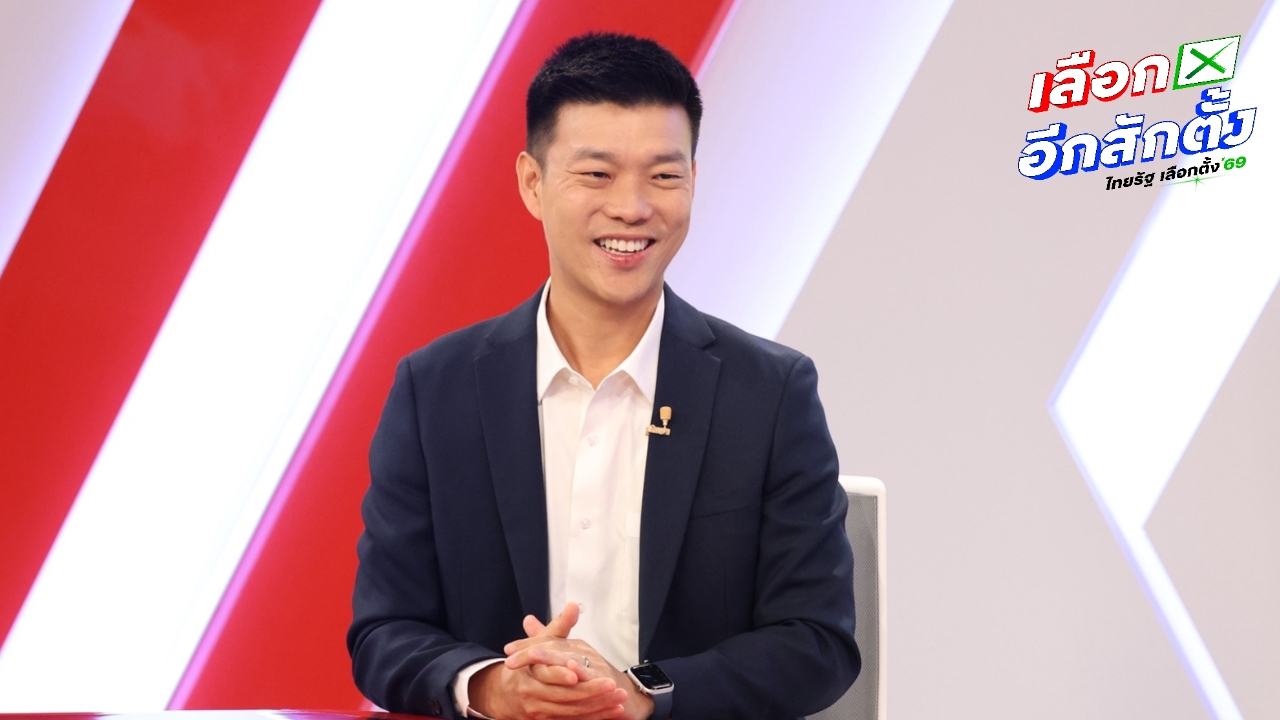
Theng Natthapong clearly stated that the Prachachon Party cannot join a government coalition with the Bhumjaithai Party under their current stance. He has not spoken with Anutin since the announcement of parliament dissolution and accepts managing the risk of placing 44 MPs facing legal cases on the party list.
At 15:44 on 19 Dec 2025 GMT+7 Mr. Natthapong Ruangpanyawut, leader of the Prachachon Party and the party's first prime ministerial candidate, revealed on the program “Open Talk with Phakphum” on Thairath TV Channel 32 in response to questions about the constitutional vote in the second reading, that he tried to call Mr. Anutin Charnvirakul, Prime Minister and Minister of Interior, leader of the Bhumjaithai Party, but was not answered. After the parliament dissolution, when asked if there had been any further discussions, Natthapong said no, but if given the chance, he would gladly talk with Anutin publicly.
He added that looking back at the prime minister’s decision to dissolve parliament, the conditions were quite clear: the prime minister and Bhumjaithai had the option to honor the MOA commitments if sincere in advancing them. If Bhumjaithai had voted with the majority in the committee, there would have been no need to dissolve parliament, and they could have used the remaining 15 days before the third reading to work with everyone. Prachachon was ready to push for understanding with senators to accept the third reading. But if Bhumjaithai insisted on breaking their own coalition whip’s decision and voted with the minority, reclaiming the one-third Senate vote, Prachachon would not accept that. This was the condition set at the time, telling the prime minister to choose, and if they continued to disregard the coalition whip’s decision and prior talks, leaving no options, they would allow the constitution to proceed to the third reading. The only choice left then would be a new election.

Regarding Anutin calling Prachachon the “supporting side,” Natthapong sees this as political rhetoric aimed at possibly affecting Prachachon’s popularity. He said they are straightforward and cannot interpret it otherwise. Currently, they can only move forward. Since they are called the supporting side, the next election will be decisive. He urged all eligible voters to choose wisely in deciding the country’s future. Looking at the current political context, there may only be two choices left: either a government led by Prachachon or one led by Bhumjaithai. Issues like shadow funding should be examined carefully to see which party is involved. Problems of bribery and corruption are linked to certain political groups holding current power. Do we want to let the country continue like this, or have we reached a breaking point? It is essential for all factions to unite to prevent the country from falling into an abyss.
, Regarding whether Prachachon cannot align with Bhumjaithai, after the election, Natthapong replied, “To be clear, if Bhumjaithai leads the government formation with their current stance, we cannot be coalition partners. If that happens, we will be in opposition. I can clearly say that our role now is to campaign and fully engage with the people to gain enough support. We need to be strong enough to guide the government’s direction and prevent the second, third, or other parties from forming a government competing with the leading party.”
When asked if Prachachon, if winning the most votes, would invite Bhumjaithai to form a government, the party leader said it depends on whether they have sufficient support to guide the government. They must be able to control the government. Regarding whether they would refuse to join if there were conditions or bargaining power involved, Natthapong answered clearly, “Correct.” The host asked again if he has no intention to call Anutin, to which Natthapong replied, “Since the day I called and was not answered, I have not tried to contact him again. We have not spoken at all since then.”
Regarding the issue of natural vote canvassers and instructing candidates to find them, Natthapong explained that Prachachon is a mass party owned by all its members. Campaign expenses come from public donations. According to the latest figures from the Election Commission (EC), the party received 96 million baht in public subsidies, mostly from taxpayers’ income tax donations to Prachachon. Reflecting on past successes, he reaffirmed that candidate selection and funding come genuinely from the people. Instructing candidates to find natural vote canvassers is important,
because a key factor behind the Move Forward Party’s 2023 election win was not just the former leaders or Pita Limjaroenrat, nor only MPs, but the power of natural vote canvassers—people willing to advocate for the party, talk to their communities about choosing Move Forward as the country’s real future, help repair campaign signs, and post on social media. This small but powerful force was crucial. For the 8 Feb 2026 election, Prachachon believes similarly that to be strong enough to guide government direction, they must use these natural vote canvassers to help bring change. Political work and campaigning especially in large rural constituencies require people who can be voices for candidates. To truly win constituencies, networks and ideological victories through such canvassers are necessary.
, Regarding the issue of 44 MPs with legal cases, or candidates with cases placed on the party list this time, and whether this cuts the risk of post-election targeting, Natthapong said, “It’s about risk management. People can understand why this approach was chosen. There is no other reason beyond managing political risk.” Meanwhile, Wiroj Lakkhanaadisorn is number 100 on the list, and several others who joined since the Future Forward Party days do not aspire to be MPs forever. They want the party to grow and new candidates to enter politics as MPs and work with the party. Many are ready to work behind the scenes, and if in government, there will be many positions to participate in.

Regarding the party’s policy to be unveiled on 25 December, on the party’s military policy, Natthapong stated, the aim is to modernize the military so it truly protects the country and does not interfere in politics. Structural changes in the military will be made, such as the Defence Council placing civilian government above the military. Regarding personnel, voluntary conscription is considered. The committee where Wiroj serves has produced many studies showing that a gradual increase in volunteers each year can supply enough personnel, possibly eliminating the need for conscription. Conscription causes huge economic and labor losses annually.
At the end, when asked about border issues likely to be raised, the party leader said, “I understand and am ready to answer all questions. Military force is one diplomatic tool but should be the last resort to pressure adversaries to negotiate. I emphasize again that the Thailand-Cambodia situation should not have reached this point. Previously, we advanced all available tools, including diplomatic fronts and combating scammers targeting the Hun Sen regime.”
