

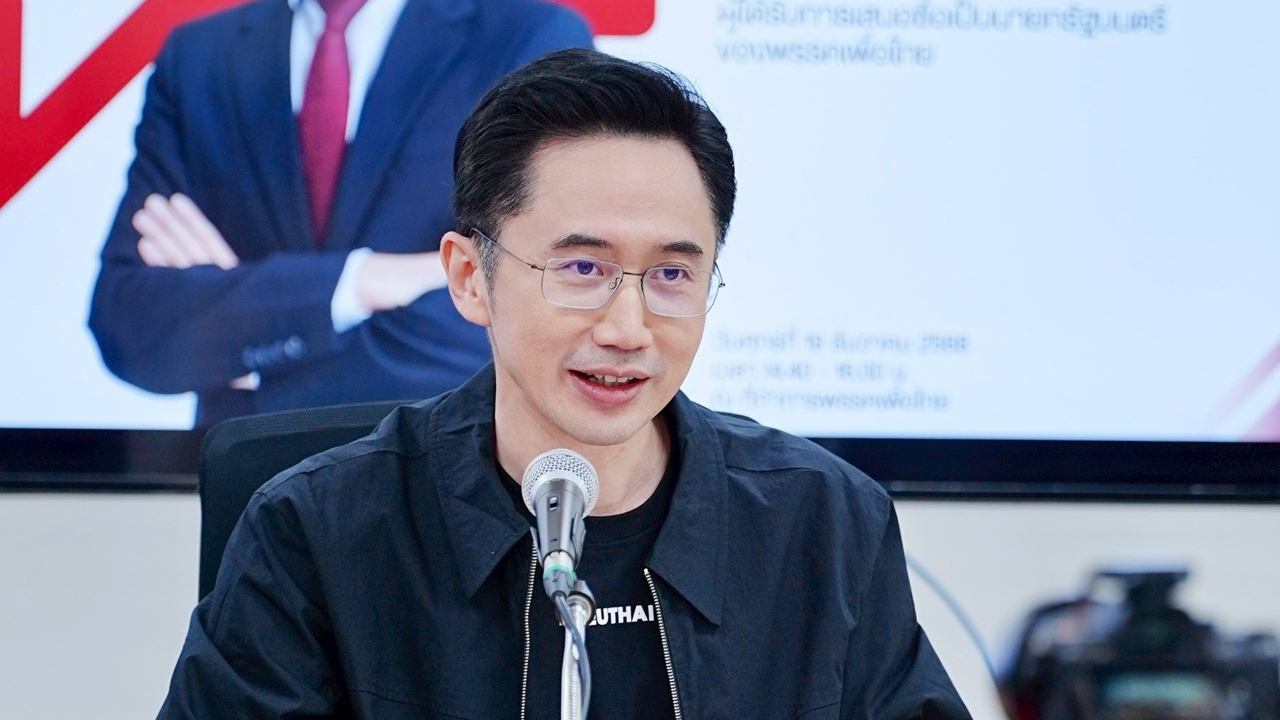
Yotsanan Wongsawat, the Pheu Thai Party's prime ministerial candidate, showcased a new vision to lead Thailand to become a high-income nation during the 3rd YPP Dialogue event, proposing the idea of digital career guidance teachers to help children reach their goals.
On 20 December 2025, a reporter from the Pheu Thai Party reported that at 5:00 p.m. on 19 December 2025, the Pheu Thai Young Professionals Program (YPP), a political skills development initiative for young people at the Pheu Thai Party, held the 3rd YPP Dialogue under the theme "Security Policy and Workforce Development Policy." Members from PTP Academy’s first and second cohorts exchanged views, experiences, and policy proposals. Phumtham Wechayachai, former Deputy Prime Minister and former Minister of Interior, delivered a welcome speech and shared behind-the-scenes experiences in security work, giving an overview of the situation, challenges, and obstacles in advancing the Pheu Thai Party’s security policies.

. Yotsanan Wongsawat, the Pheu Thai Party’s prime ministerial candidate, spoke about his past work experiences and presented a vision linking "education-industry-economy." He summarized that Thailand currently faces complex problems that cannot be solved by a single approach, including currency issues, technological disruption, and new global environmental regulations, which are transforming the Ministry of Higher Education into a full-fledged economic ministry. Workforce development must shift from mere teaching to creating an innovation ecosystem. He emphasized bold, transformative thinking with the goal of elevating Thailand to a high-income country. This involves backward curriculum design to identify the skills industries need and tailoring vocational institutes and universities to meet those demands. Research culture must change to embrace honest failures and allow everyone to rise to top societal positions regardless of their origins.

Regarding upgrading universities and vocational education, Yotsanan proposed transforming the learning model into a lifelong system through a credit bank system that allows accumulation and transfer of credits according to international standards, enabling global competitiveness. He focused on four strategic industries: semiconductors and data centers; biotechnology and medicine; electric vehicles and maritime maintenance; and the low-carbon economy. To address systemic research issues, he suggested using technology to streamline project management and payment processes to reduce delays and paperwork complexity. Measures to attract and retain high-skilled personnel, both Thai and foreign, should include flexible work arrangements, such as allowing talented individuals abroad to serve as coaches or mentors in key Thai projects. He also advocated developing digital personalized guidance teachers using career and skill pathway databases to help children and youth clearly see the steps to reach their target jobs in the future.