

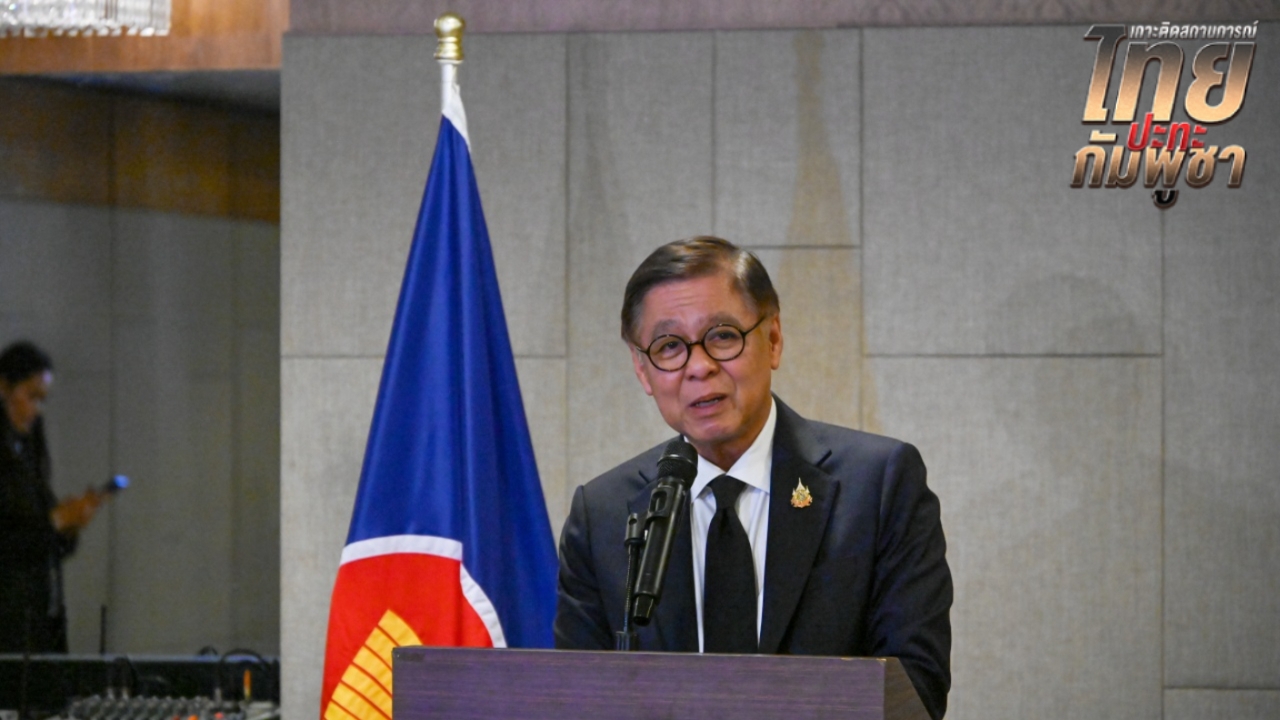
Sihasak emphasized that Thailand does not want the ceasefire to be merely a declaration after Cambodia proposed a ceasefire at 10 p.m. tonight. Ultimately, both sides' military will hold discussions at the GBC meeting on 24 December to determine procedures, returning to the Thailand-Cambodia Peace Declaration. Thailand proposed Chanthaburi province as the meeting location, but Cambodia has not yet accepted.
On 22 Dec 2025 GMT+7 at 12:00 noon Malaysia time, which is one hour ahead of Thailand. Mr. Sihasak Puangketkaew, Minister of Foreign Affairs, participated in the Special ASEAN Foreign Ministers' Meeting to discuss the Thailand-Cambodia situation at the Grand Hyatt Hotel Kuala Lumpur, Malaysia. Thailand was represented by General Natthapong Praokaew, Deputy Chief of Staff of the Royal Thai Armed Forces, who joined the delegation. Representatives from 11 member countries attended, except Myanmar, which participated via videoconference, while Vietnam sent senior officials instead of the Minister of Foreign Affairs.
The meeting followed ASEAN protocols, beginning with an opening by Mohamad Hassan, Malaysia's Minister of Foreign Affairs and ASEAN Chair. The ASEAN Observer Team (AOT) reported on its recent activities before members gave statements, starting with the parties involved, Cambodia and Thailand, speaking in alphabetical order. Cambodia spoke first, followed by Thailand and the Philippines, the next ASEAN Chair, before other members spoke alphabetically.
After the meeting, Minister of Foreign Affairs Sihasak stated that ASEAN is concerned about the Thailand-Cambodia conflict and discussed how ASEAN could help resolve the situation. He thanked Malaysia for hosting the meeting, noting Thailand supports such regional discussions within ASEAN frameworks.

Thailand has consistently held goodwill toward Cambodia, supporting solutions during Cambodia's civil war to restore peace, opening borders to refugees for shelter in Thailand, and promoting economic recovery after peace was achieved, with a desire for peaceful coexistence with neighbors.
Since the conflict arose between the two governments, including the previous administration, Thailand has sought bilateral solutions. However, Cambodia has attempted to internationalize the issue, particularly within the United Nations framework, instead of resolving it bilaterally. The key point emphasized was the importance of trust.
Even the release of recorded discussions raised questions about whether Cambodia aimed to solve problems or undermine the Thai government at that time. The core issue is trust.

Subsequently, meetings were held in Putrajaya and Kuala Lumpur, resulting in the signing of a Peace Declaration as a path to peace. Implementation is critical, especially regarding arms reductions along the border, troop withdrawals, mine clearance, anti-smuggling efforts, and management of encroached areas.
These four points are vital, particularly mine clearance, which is crucial for Thailand due to six incidents of Thai soldiers being injured or losing limbs from landmines. Even after signing, a seventh incident occurred. This is a central issue of the agreement. Thailand needs answers as to why these incidents continue, but Cambodia has not provided clear explanations. The situation has led to ongoing clashes along the border.
Sihasak emphasized that the meeting was not to exchange accusations, as the situation is already understood, but to discuss how to move forward. Cambodia mentioned ceasefire but spoke to multiple parties without addressing Thailand directly. For a ceasefire to progress, it cannot be by declaration alone. Cambodia's proposal for a ceasefire at 10 p.m. tonight is insufficient. A ceasefire must result from discussion, agreement on measures, and monitoring, a view shared by all at the meeting.
Thailand proposed that the two militaries meet at the earliest opportunity and invited Cambodia to propose a meeting date. They agreed on 24 December, with Cambodia proposing the date, which Thailand accepted. The meeting will discuss how to implement a ceasefire under the changed circumstances, what measures to take, and who will monitor compliance.

Thus, the starting point to return to adherence to the Kuala Lumpur Peace Declaration is a genuine ceasefire, not just one declared without substance. The meeting agreed with Thailand's proposal for a military-to-military meeting, ultimately deciding the GBC framework was best for the meeting on 24 December.
The Minister reaffirmed that throughout discussions, Thailand adheres to its principles to uphold its dignity and sovereignty. The current incident stems from Cambodia's violations of the Kuala Lumpur agreements, especially regarding landmines, which Thailand regards as critical—not merely accidents on the roadside.
During the media Q&A, the Minister said Thailand proposed Chanthaburi province as the GBC meeting venue for 24 December, but Cambodia has yet to respond to this proposal.