

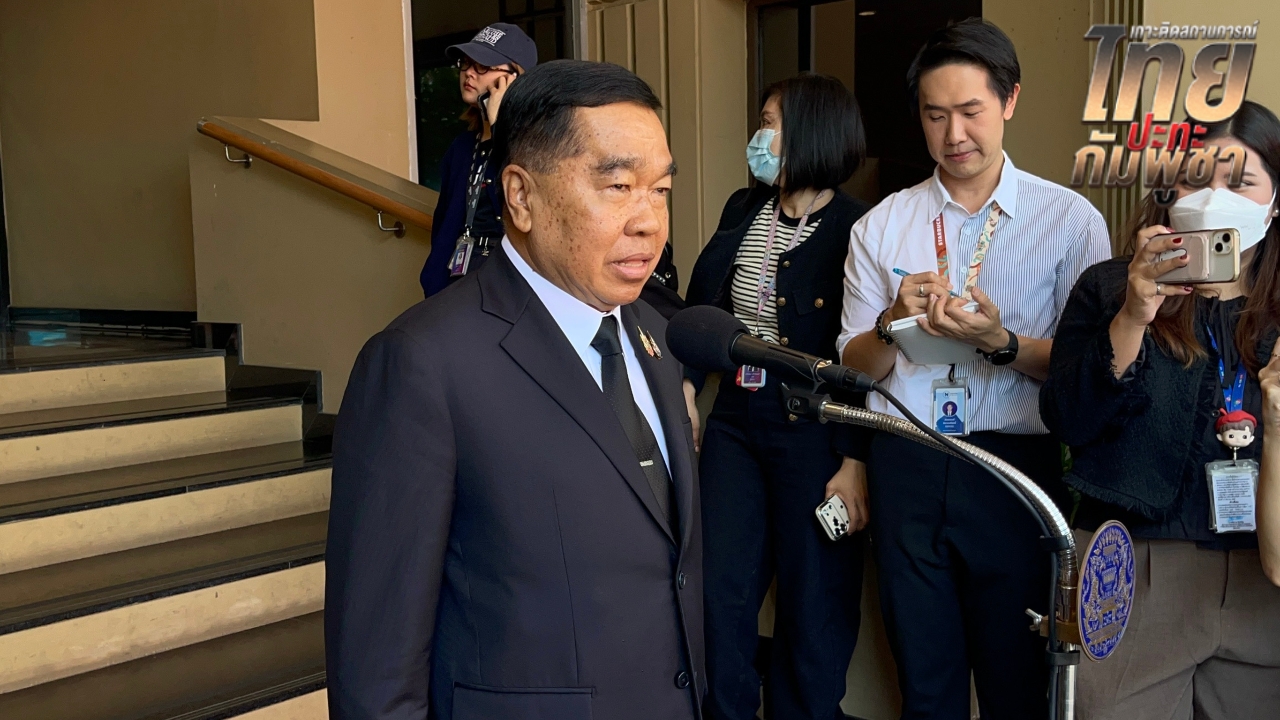
“Big Lek” emphasizes that the border combat strategy is on the right track but declines to comment on when a ceasefire will happen, citing ongoing Cambodian fire into Thailand. “Sihasak” reiterates Thailand’s position, confident it has never initiated aggression and cautions against declaring a ceasefire only to appeal to the international community later.,
23 Dec 2025 GMT+7 General Natthaphol Nakpanich, Minister of Defence, gave an interview at the Government House regarding preparations for the General Border Committee (GBC) meeting in Chanthaburi province tomorrow (24 Dec 2025). He said the meeting is for secretarial-level officials, and if the secretaries do not reach the expected outcomes, he will not sign anything. Based on Cambodia’s recent behavior, he highlighted about five key points.
1. The Cambodian military has violated the Ottawa Treaty in three main ways: possession of anti-personnel mines, production of such mines—evidenced by their conversion of anti-tank mines into anti-personnel mines—and use of newly laid anti-personnel mines. Thanks to some Cambodian soldiers who recorded evidence, documents found in the Ban Sam Lang area include a map dated 30 Oct 2025, indicating mine-laying occurred after the joint declaration signed in Kuala Lumpur, Malaysia on 26 Oct 2025, showing a clear disregard for the agreement.
2. Cambodian troops have used three ancient sites as military strongholds: Ta Kwai Temple, Preah Vihear Temple, and Khnar Temple.
3. Cambodian forces have stationed heavy weapons, especially BM-21 rocket launchers, in civilian communities. After firing, they retreat to these populated areas, which prevents Thai forces from destroying them out of respect for civilian protection rules.
4. Cambodia uses civilian buildings as military bases and ammunition depots. However, Thai forces have managed to strike dual targets with single shots, as these include scammer dens and casinos used by Cambodian forces. The focus remains on destroying military sites, and any damage to scammer operations is incidental.
5. Cambodia uses civilians as human shields and even involves them in combat, as seen in various videos. Any civilian casualties lead to accusations that Thai troops harmed innocent people.
General Natthaphol continued, saying these five points form his initial basis for action, which is the first step. The subsequent steps follow a three-stage process he has always used. The first stage involves negotiation efforts before 24 July, during which he sought peaceful solutions. Cambodia’s government knew he was working to avoid conflict, believing that the best victory is one without fighting, but if fighting occurs, it must be won. Thus, the initial approach was peaceful negotiation to have Cambodia withdraw forces and avoid combat.
After the ceasefire on 28 July, the second stage aimed to maintain the ceasefire. When clashes occurred, the assumption was they might not be intentional invasions, so ceasefire talks continued. However, evidence showed Cambodia laid anti-personnel mines after signing the joint declaration, indicating insincerity and a breakdown in communication. Currently, the situation is in the third phase, which the media can likely anticipate involves tougher negotiation steps. Since last night and into the morning, some areas still experienced BM-21 rocket attacks, and Cambodian Senate President Hun Sen stated readiness for long-term conflict, while the Cambodian government claims willingness to cease fire. This inconsistency undermines trust.
Therefore, this meeting will reaffirm adherence to the joint declaration but with more detailed provisions. Some issues might be postponed temporarily. He urged the public to trust the GBC to protect sovereignty and national interests while abiding by international law, which has been their framework throughout.
“I see that no country truly stands with us. Everyone claims neutrality but seems to side with Cambodia, listening only to their side and viewing Thailand as the larger aggressor. As policy leader, I affirm we defend ourselves under Article 51 of the UN Charter, using necessity and proportionality. I want media and citizens to be reassured that we strictly follow international law. No country condemns Cambodia for laying mines on Thai soil; instead, they urge Thailand to reduce arms and violence. I am confident we are on the right path, relying on law as our refuge.”
General Natthaphol stressed he cannot say more as it may complicate the secretaries’ meeting. He provided these facts for the media’s understanding and asked for public and global comprehension of these realities.
Asked why foreigners trust Cambodia more than Thailand, General Natthaphol said he prefers not to speak as it invites backlash. Many critics harshly accuse Thailand of preemptive preparations when defending itself. Cambodia also employs lobbyists, while he is unsure if the Thai government does. Nevertheless, he believes truth prevails and has always relied on facts despite warnings not to speak out due to criticism. He remains committed to truth, believing over time it will form a verifiable digital footprint.
He expressed confidence in Thai journalists, urging them to contest information against Cambodia. This conflict is not just military but also political, international, diplomatic, psychological, and informational warfare. To address this, a Thai-Cambodian border situation press center has been set up at Channel 5, staffed by military experts. The battlefield spans border combat, diplomacy, and information warfare. He called on the media to help win the information battle, considering journalists as part of the fighting force.
When asked if combat zones have been fully established, General Natthaphol said the military reports so, including Hill 350. Regarding whether combat will continue until GBC negotiations succeed, he said as long as Cambodia fires into Thai territory—as it did this morning in the 1st Army area and in the 2nd Army areas like Ta Kwai and Ta Muen Thom—Thailand must respond proportionally. Only Chanthaburi and Tak provinces remain calm, hence the GBC meeting on 24 December is set in Chanthaburi for safety, as Cambodia also worries about security.
“I ask the people of Chanthaburi to help ensure the safety of Cambodian officials attending. We want Cambodia to feel safe here. Thai people distinguish between combat and negotiation. We want the area to be a diplomatic venue, not a battlefield with weapons involved.”
Regarding whether Cambodia has decided to attend the meeting in Thailand, General Natthaphol said he’s unsure due to Cambodian concerns, similar to Thailand’s worries about meeting in Koh Kong. He urged Cambodia to be confident in safety, noting the meeting is near the border, not deep inside territory.
Foreign Minister Sihasak Puangketkaew said ahead of tomorrow’s GBC meeting that Cambodia announced readiness to cease fire and informed other countries, pressuring Thailand to do the same. However, a ceasefire doesn’t come from announcements alone but from mutual agreements on terms and areas of cessation. Thailand also has conditions to discuss. Cambodia’s strategy includes declaring readiness to cease fire and telling the international community, which leads to global pressure on Thailand. He stressed ceasefire requires bilateral talks, not just international declarations, and urged Cambodia to negotiate directly with Thailand rather than appealing to the world to pressure Thailand.
Asked how to counter the perception that foreign countries trust Cambodia more than Thailand, Sihasak said Thailand must clarify its position. If others do not understand, Thailand should reflect on itself. It’s important to maintain a firm stance that Thailand has not invaded, desires peace, and genuine ceasefire. He hopes Cambodia and friendly countries will understand and listen. Therefore, Thailand need not worry excessively but should confidently uphold its stance and self-assurance.