

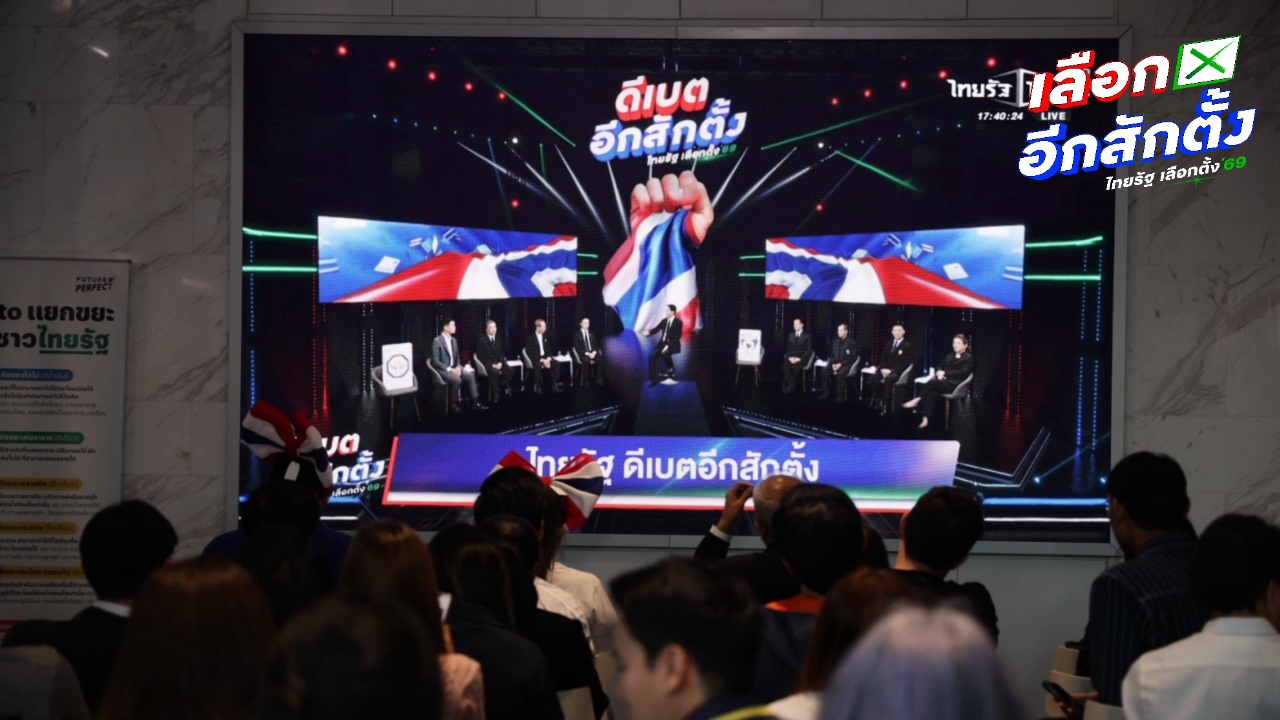
In the Thairath Debate #OneMoreDebate, prime ministerial candidates from eight parties revealed solutions to border issues. "Dr. Ae" supports using technology alongside fence construction, while "Abhisit" views MOU44 as unnecessary, believing it was created to facilitate sharing marine resources rather than resolve disputes.
On 23 Dec 2025 GMT+7, on the program “Thairath Debate” #OneMoreDebate aired on Thairath TV Channel 32, a discussion was held with prime ministerial candidates from eight political parties: Prof. Dr. Yossanan Wongsawat, candidate for Prime Minister from the Pheu Thai Party; Mr. Teerachai Phuwanatnaranuban, candidate from the Palang Pracharath Party; Mr. Peerapan Salirathvipak, leader of the United Thai Nation Party and candidate; Mr. Suchatvee Suwansawat, leader of the Thai Khao Mai Party and candidate; Mr. Natthapong Ruangpanyawut, leader of the Prachachon Party and candidate; Mr. Abhisit Vejjajiva, leader of the Democrat Party and candidate; Khun Ying Sudarat Keyuraphan, leader of the Thai Sang Thai Party and candidate; and General Rangsee Kitiyantrasap, leader of the Economic Party.

Regarding the border situation, referencing previous statements, when asked how they would handle the issue if they held power as prime minister, General Rangsee stated that Cambodia initiated the aggression, encroaching on Thai sovereignty at 28 points across the 2nd and 1st Army Regions and the Chanthaburi-Trat forces. Today, Thailand has reclaimed sovereignty over areas like Ban Nong Jan, Ban Nong Ya Kaeo, Ta Kwai and Khna temples, and three houses in Trat, where Cambodian forces had destroyed homes and set up casino buildings. The military acted rightly and must continue until Hun Sen personally calls for negotiations, not involving third or fourth countries. Since Hun Sen started it, he must also end it.
Mr. Natthapong revealed that the core of the conflict targets the Hun Sen regime, which is undeniably linked to the scammer network and may be providing funds for Cambodian authorities to buy arms for war with Thailand. Beyond military measures, other fronts such as diplomatic efforts and simultaneous anti-scammer campaigns must be pursued. He urged everyone to remember the priorities: first, to preserve Thailand’s sovereignty; second, no one wants prolonged conflict; third, to enable displaced villagers to return home quickly; and fourth, to establish permanent border security. Therefore, the world must encircle Cambodia by combating scammers, garnering support from global powers on Thailand’s side.

When asked if such efforts were too late, Mr. Natthapong admitted the situation has escalated this far, but if earlier measures had been implemented, it might not have reached this point. He expressed sorrow over all losses incurred. While appreciating the military’s full efforts, emphasis must also be placed on suppressing scammers and political networks connected to scammers. He questioned whether the country is truly serious about tackling domestic scammers.
The military’s duty is to protect the country and its sovereignty. If encroached upon, it must use full force to eliminate immediate threats for the safety of the people. Simultaneously, pressure must be applied on Cambodia from all sides to compel them to negotiate with Thailand, as their lack of sincerity is the issue—not Thai weakness.

Mr. Abhisit believes the current situation must be the basis, with the military receiving full support to fulfill its mission: reclaiming Thai territory and degrading Cambodia’s ability to encroach or harass. This includes both military goals and cracking down on scammers who supply and hide weapons. If elected, he would fully support the military as done in 2011 during a 12-day clash, enabling the military to complete its mission. When asked if Hun Sen would likely refuse to call directly and instead complain to other nations, he stressed the importance of diplomacy to gain international understanding and support. Negotiations should require Cambodia to withdraw heavy weapons or forces near the border to prevent recurring problems, with observers overseeing the process. The military and border communities have sacrificed much and support the military wholeheartedly, but if fighting continues without negotiations, the situation will revert to the prior state.

Khun Ying Sudarat stated that Thailand has not been the aggressor and has lived peacefully, but was invaded causing losses. Therefore, signing ceasefire agreements without regaining military control over encroached areas is pointless. If she were prime minister, she would pursue five actions: first, honor the military’s sacrifices and support them fully until the Cambodian army ceases to be a threat; second, back the military to fully resolve border issues by reclaiming all sovereign territory to prevent future problems; third, conduct diplomacy to make the world understand since Cambodia is better at international complaints; fourth, seriously combat scammers—she regrets the government’s anti-scammer efforts have been superficial, mostly just holding meetings without effective enforcement; and finally, care for displaced border residents by providing adequate compensation rather than letting them live without support, acknowledging their expenses.
Regarding current Prime Minister Anutin’s actions, she agrees with some military support but is disappointed in anti-scammer efforts. Similarly, domestic money laundering efforts are incomplete, with progress dependent on whether prosecutions and asset freezes will truly be pursued.

Prof. Dr. Yossanan stated he believes border issues should not be politicized. The most important factor is unity and prioritizing sovereignty. Second is concern for the people and military, which must be addressed concurrently. He supports the policy of encircling Cambodia globally and praises the military for adhering to three principles: international law, UN regulations, and human rights. Thailand aims to lead in combating scammers system-wide, inviting global help. Involving countries like the U.S. and China in some aspects clarifies Thailand’s rightful position. However, this is a bilateral issue between two countries and should be resolved without involving others or escalating to the International Court of Justice.
If he became prime minister, he wants to establish two principles of sovereignty: ensuring citizens live peacefully and minimizing military casualties.

Asked if he would cancel MOUs 43 and 44, Mr. Peerapan confirmed yes, as they have not benefited Thailand. The main point of the MOUs is to negotiate border agreements, but the Thai-Cambodian land border has been established since 1907 under the Franco-Thai Treaty, which clearly delineates boundaries. They should follow these principles, and if lines are missing or unclear, refer to treaty criteria. Regarding MOU 43, it referenced a 1:200,000 scale map, whereas military and international standards use 1:50,000 scales, which Cambodia’s military also uses. Thus, referring to 1:200,000 in MOU 43 is inappropriate and ultimately yielded no gains for Thailand.
MOU 44 concerns maritime boundaries. Thailand’s claims follow international standards, while Cambodia claims areas it believes are theirs, which is incorrect. Since Thailand’s claims are correct, the natural resources beneath those waters belong to Thailand. When disputes arise, joint development is impossible because the resources are Thailand’s.

Mr. Teerachai stated that Palang Pracharath Party’s position is to cancel the MOUs. The purpose of canceling MOU 43 is to build a barrier, which the MOU allows only if both parties agree. He praised the military for securing key points along the border, enabling barrier construction later. If Cambodia disagrees, negotiations can follow afterward.
MOU 44 must be decisively canceled because it references boundary demarcations that do not comply with UN rules, so there is no reason to keep it.
Mr. Natthapong said he believes the Cambodian leadership currently wants to cancel both MOUs to eliminate bilateral mechanisms and escalate the dispute to the International Court of Justice or involve other countries. He urged reflection on whether MOU 43, especially concerning the land border, is problematic. While imperfect, is cancellation necessary? If Thailand proposes cancellation first, what mechanism will replace the boundary markers established over 20 years, including more than 70 posts? Would everything be nullified, and would Cambodia use this as an excuse to take the case to the ICJ?
Mr. Peerapan views the treaty as mutually accepted by both countries since historical times, with clear border divisions. Renegotiating now could result in loss of Thai territory, which would be criminally liable. Therefore, Thailand will never change the boundary lines agreed upon in the Franco-Thai Treaty, backed by concrete evidence.
Mr. Natthapong stated that concrete fences cannot prevent drones, human trafficking, or Cambodian soldiers planting landmines. Instead, smart towers equipped with cameras, AI systems, and sensors can detect drones, traffickers, or soldiers attempting to lay bombs, enabling early capture. This technology also enhances effective law enforcement along the border. He emphasized that the fence construction rationale is not a reason to cancel MOUs 43 and 44.

Dr. Ae Suchatvee said the nation’s heart is its people. The government must speak truthfully to citizens. Having visited border areas, he found people suffering and uncertain about their future or when they can return home. The key is the people’s right to know their future and receive prompt compensation. This concern extends beyond displaced persons to soldiers’ families, volunteers, non-military personnel like doctors and nurses, and local administration volunteers, all deeply affected. He pledges to care for and compensate them fully, which is the first priority.
The Cambodian border conflict has three battlefronts: first, the military front, where Thailand currently holds an advantage. However, two Thai UAVs have been shot down by unknown space-based powers, suggesting Thailand cannot sustain aerial superiority without advanced space technologies. The Thai Khao Mai Party supports strengthening the military with quality personnel and especially space technology for detection, which is crucial.
Second is the fake news war, where Cambodia has the upper hand spreading misinformation globally. If he were prime minister, he would consolidate experts and upgrade the National Security Council, which is currently outdated, to counter fake news. Third is the diplomatic front: Cambodia cannot be allowed to lie and must be pushed to be expelled from ASEAN since it is both a source of scammers and a threat to Thailand.
He insists on rapid and secure fence construction but warns that fences alone cannot provide protection; space-based technology support is essential.
Regarding MOUs 43 and 44, he agrees they should not be politicized and require careful review rather than hasty decisions that disregard national interests. Ultimately, Thailand neither benefits nor gains advantage from them.
Mr. Abhisit added that regarding the statement to avoid politicizing border issues, the current border incidents stem from political factors on both Thai and Cambodian sides since mid-year, serving as an important lesson. Whether building fences or walls, the core remains negotiation conditions to end the current conflict. Cambodia must remove heavy weapons or those capable of attack; otherwise, any constructions will be vulnerable, reverting to the same situation. Regarding the MOUs, he briefly stated MOU 44 is unnecessary now as it was designed to facilitate resource-sharing negotiations by drawing lines arbitrarily, as many have already noted.