

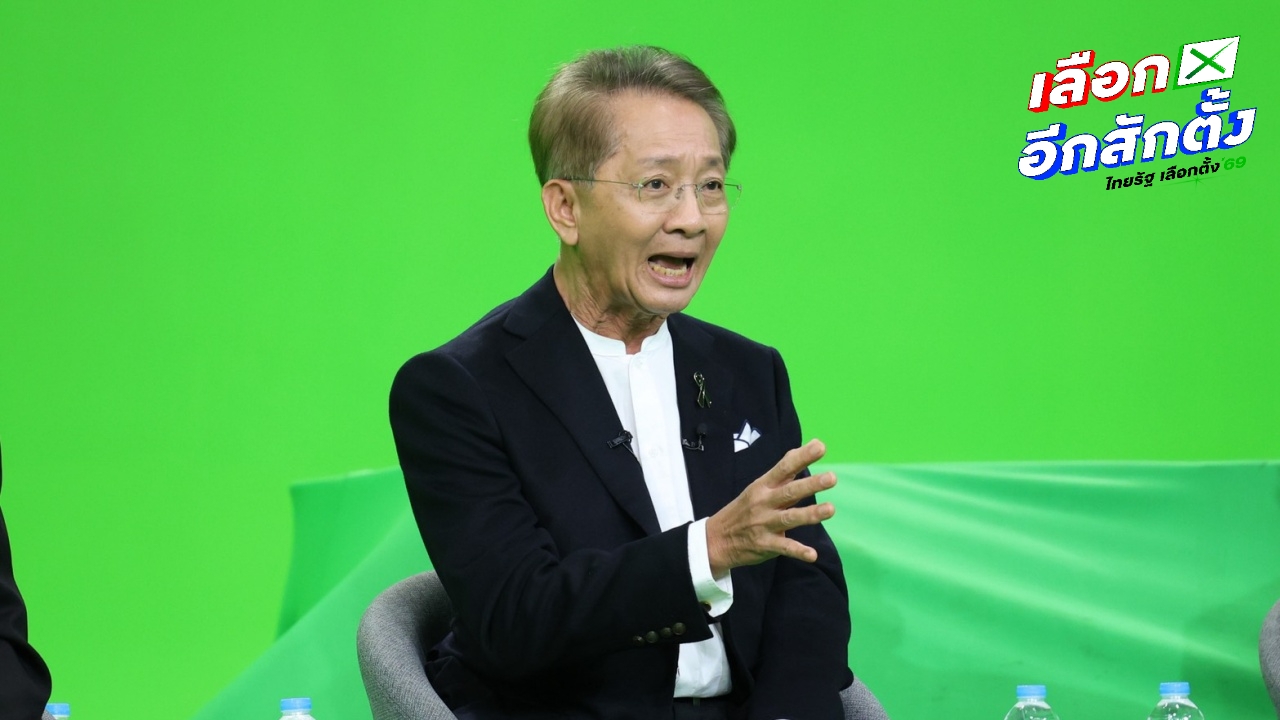
"Teerachai" The Palang Pracharath Party's prime ministerial candidate, Teerachai, showcased his vision in a debate, emphasizing two significant concerns and clearly presenting a way to revive Thailand's economy.
At 17:30 on 23 December 2025 GMT+7, Thairath TV began the first debate forum ahead of the 2026 election, hosted by Kai Pongsakem Satyaprasert. The eight prime ministerial candidates from political parties included Mr. Natthapong Rueangpanyawut, leader of the Prachachon Party and candidate for prime minister; Mr. Yotsanan Wongsawat, prime ministerial candidate from Pheu Thai Party; Mr. Abhisit Vejjajiva, leader of the Democrat Party and candidate for prime minister; Mr. Teerachai Phuwanatnaranubala, deputy leader and prime ministerial candidate of Palang Pracharath; Mr. Peeraphan Saleeratwipak, leader of the Ruam Thai Sang Chart Party and candidate for prime minister; Mr. Suchatve Suwansawat, leader of the Thai Kao Mai Party and candidate for prime minister; Khunying Sudarat Keyuraphan, leader of the Thai Sang Thai Party and candidate for prime minister; and General Rangsi Kittiyantrasup, leader of the Economic Party and candidate for prime minister. Meanwhile, the Kla Tham Party and the Bhumjaithai Party did not send prime ministerial candidates to participate in the debate.
Meanwhile, Mr. Teerachai Phuwanatnaranubala, deputy leader and prime ministerial candidate of Palang Pracharath, expressed his vision that since Palang Pracharath is a smaller party, it would not present sweeping policies but instead focus on two concerns. In his view, this election will determine Thailand’s future based on two issues: first, the problem of scammers; second, the economy. He said the economy currently stands at the edge of a cliff because although fiscal stimulus policies have been used, they have been misapplied by focusing on consumer subsidies.
Therefore, over the past 10 years, debt has doubled to twelve trillion baht, yet our competitiveness remains stagnant. There is a solution: we must promote fiscal stimulus policies that emphasize investment. Instead of focusing on mega projects or water supply schemes,
he believes it would be more appropriate to borrow the revolving fund policy from M.R. Kukrit Pramoj and implement revolving funds at the community level—75,000 villages receiving 1 to 3 million baht each over three years, with the condition that funds be used to develop livelihood tools. Additionally, programs for eldercare and maternal welfare under the state would continue as usual. In his opinion, this approach will clearly revive Thailand’s economy.