

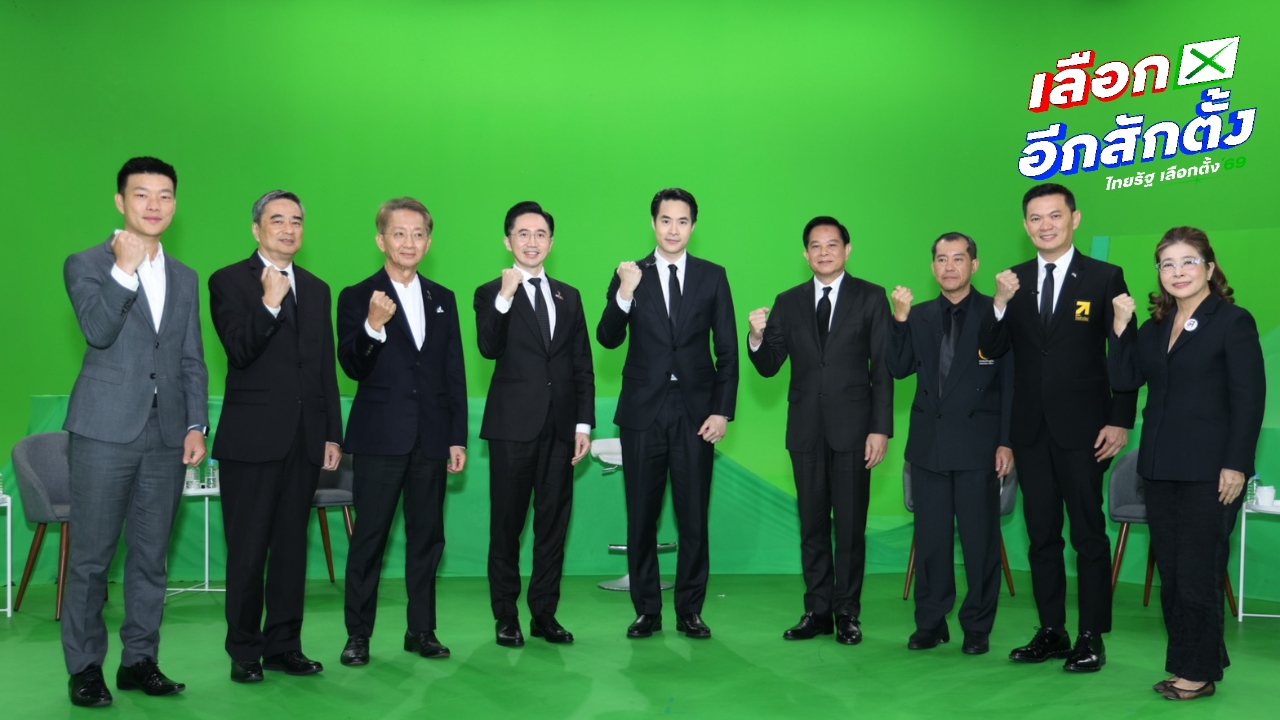
An overview of the economic livelihood policies of 8 prime ministerial candidates, focusing on their perspectives regarding increases to the minimum wage.
At 17:30 on 23 December 2025 GMT+7, Thairath TV held the first debate ahead of the 2026 general election, hosted by Kai Pongsakorn Satyaprasert. The debate featured all 8 prime ministerial candidates from political parties: Mr. Natthapong Ruangpanyawut, leader of the Prachachon Party; Mr. Yotsanan Wongsawat, candidate from the Pheu Thai Party; Mr. Abhisit Vejjajiva, leader of the Democrat Party; Mr. Teerachai Phuwanatnaranuban, deputy leader and candidate from the Palang Pracharath Party; Mr. Peeraphan Saleerathvipak, leader of the Ruam Thai Sang Chart Party; Mr. Suchatveech Suwansawat, leader of the Thai Kao Mai Party; Khun Ying Sudarat Keyuraphan, leader of the Thai Sang Thai Party; and General Rangsee Kitiyanatthap, leader of the Economic Party. Meanwhile, two other parties—the Kla Tham Party and the Bhumjaithai Party—did not send prime ministerial candidates to participate in the debate.
During the debate, a question was posed regarding economic livelihood policies, specifically: “If you become the government leader, will you have a policy on the minimum wage?” The prime ministerial candidates with policies on this issue expressed their visions as follows:

Khun Ying Sudarat Keyuraphan, leader of the Thai Sang Thai Party and prime ministerial candidate, said that the goal is to increase wages and income for the people. The Thai Sang Thai Party will not raise the minimum wage directly but will increase opportunities and incomes for the public. For example, small entrepreneurs or those in the SME sector currently cannot access bank loans and must resort to high-interest informal loans. Therefore, the party plans to use public credit funds and SME funds to help them stabilize, which will drive economic activity. When the system balances, wages will naturally rise. This is just one example of income generation, but generally, everyone should have access to low-interest loans to create jobs and livelihoods, thereby strengthening the grassroots economy together.

Mr. Suchatveech Suwansawat, leader of the Thai Kao Mai Party and prime ministerial candidate, stated that first and foremost, protecting workers is crucial. The core of this is the party's policy of a single ID card enabling an immediate loan of 20,000 baht without complications.
He added that the priority is to stop the economic 'bleeding' before moving on to leapfrog business investments in technology and infrastructure. He is confident that his party has serious, professional expertise to achieve this. If successful, the public's wages will increase for sure. But currently, it is essential that people can access funds first. The amount of wage increase must be appropriate; otherwise, not only will workers suffer, but SMEs that employ over 85% of the workforce could collapse, causing widespread harm.

Mr. Peeraphan Saleerathvipak, leader of the Ruam Thai Sang Chart Party and prime ministerial candidate, said that his party will establish an emergency fund to prevent people from borrowing from informal sources. Regarding the minimum wage, he described it as a double-edged sword: if handled incorrectly, it could harm the economy; if done correctly, it would have positive effects. He sees the minimum income as merely a term, whereas what workers really want is increased earnings. The party intends to implement a profit-sharing system to incentivize workers to dedicate themselves to their companies. When businesses perform well, workers will receive additional rewards from the company's profit sharing.

Mr. Yotsanan Wongsawat, prime ministerial candidate from the Pheu Thai Party, said their philosophy is to reduce debts, increase income, and expand opportunities. Debt relief and assistance will cover all stages from childhood, working age, to old age, with details to be unveiled in January.
Regarding raising wages, they take a holistic approach, emphasizing that financial discipline and fiscal policy are essential for sustainable progress.

Mr. Abhisit Vejjajiva, leader of the Democrat Party and prime ministerial candidate, said they have three plans concerning the minimum wage: 1. The minimum wage is governed by law and reviewed annually, with a trend of increases each year. 2. They will survey the cost of living in each province to determine the minimum living wage. In cases where the cost of living exceeds the minimum wage but the tripartite committee does not approve a raise, the government will provide compensation to ensure residents can meet living costs. 3. They will expand the skills certification system linked to wage increases according to skill levels and promote opportunities for upskilling.

Mr. Natthapong Ruangpanyawut, leader of the Prachachon Party and prime ministerial candidate, addressed minimum wage increases by saying the core issue is not the figure itself but adjusting the wage-setting system involving both employers and employees.
Regarding the employees’ side, which has been a policy since the Future Forward Party era, the goal is to raise the wage figure appropriately per region and ensure fairness for employees. There should be a legal mandate for automatic annual wage adjustments based on inflation or economic growth. This systemic solution is more sustainable than parties using wage increases as election campaign promises to win votes. For the employers’ side,
when wages rise, they will demand more skilled workers. The party has policies for upskilling at all ages to ensure a quality workforce in the future. However, parties proposing wage increases have various direct and indirect policies but none have specified exact figures clearly. Two parties did not address the minimum wage increase policy. Among them,
Mr. Teerachai Phuwanatnaranuban, deputy leader and prime ministerial candidate from the Palang Pracharath Party,
said that wages must align with work efficiency. Before considering wage increases, the priority is to find ways to help SMEs and factories improve productivity; otherwise, costs will rise without reducing expenses. Meanwhile, General Rangsee Kitiyanatthap, leader of the Economic Party and prime ministerial candidate,
said Thailand’s economic problem today is a debt of 55 trillion baht. The focus must be on economic recovery first. If the economy improves, wages and the cost of living will rise naturally. Raising wages now would cause industry collapse. He stressed the need to escape the debt trap first.