

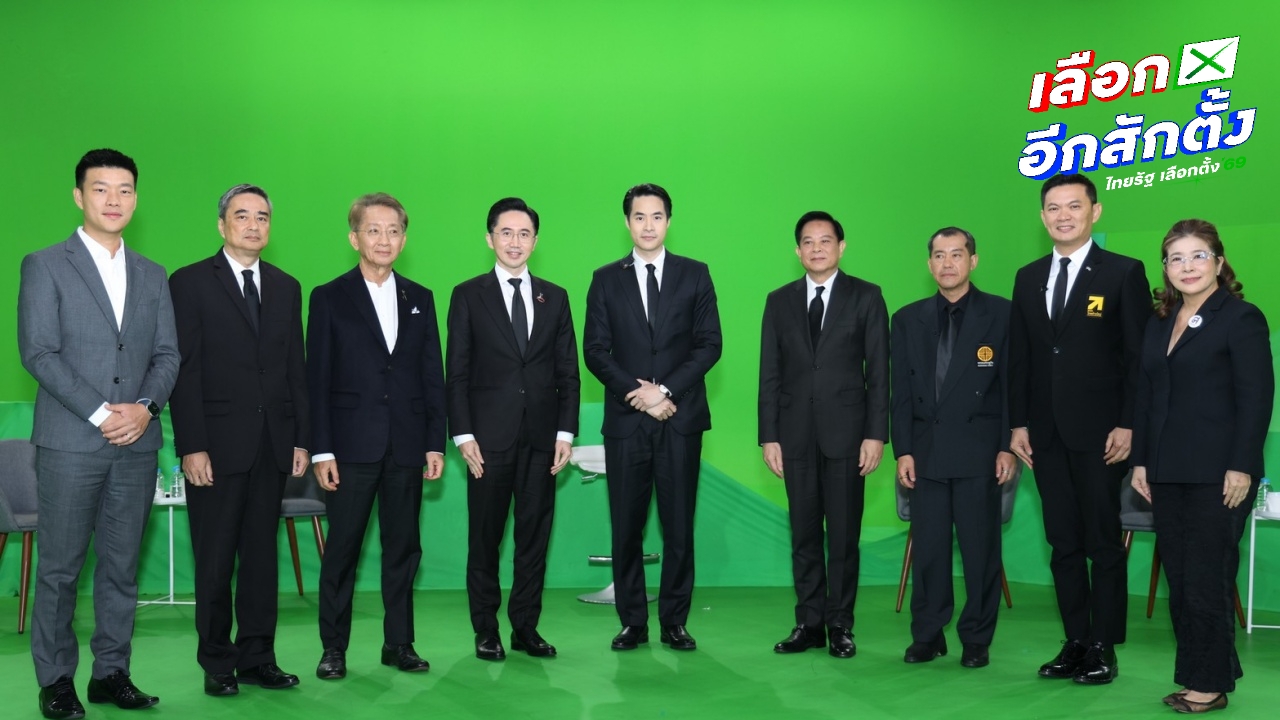
Prime ministerial candidates share their visions and stances on constitutional amendments. "Teerachai" firmly states his opposition to any changes, regardless of the article, believing the problems stem more from individuals.
At 18:30 on 23 December 2025 GMT+7, Thairath TV hosted the first debate ahead of the 2026 general election. The program was moderated by Kai Pongsakem Satyaprasert and featured eight prime ministerial candidates from eight political parties: Mr. Natthapong Ruangpanyawut, leader of the Prachachon Party; Mr. Yossanan Wongsawat, candidate from the Pheu Thai Party; Mr. Abhisit Vejjajiva, leader of the Democrat Party; Mr. Teerachai Phuwanatnaranuban, deputy leader and candidate from the Palang Pracharath Party; Mr. Peeraphan Saleerutthipak, leader of the Ruamthai Sangchat Party; Mr. Suchatwee Suwansawat, leader of the Thai Kao Mai Party; Khun Ying Sudarat Keyuraphan, leader of the Thai Sang Thai Party; and General Rangsee Kitiyantrasap, leader of the Sattahip Party. They presented their visions and policies. Two other parties, Kla Tham and Bhumjaithai, did not participate.
Regarding the question about their stance on amending the 2017 Constitution, all candidates initially noted that the Election Commission (EC) has stated that campaigning for voter turnout is allowed, but directing voters to one side or the other may violate the law.

. Abhisit Vejjajiva, leader of the Democrat Party and prime ministerial candidate, said, "Let me explain. Suppose there is a referendum and the government's question is approved. In reality, that is barely the starting point, because the next step would still be to amend Article 256, which has already caused problems leading to the dissolution of parliament. Initially, the idea was for a group of elected representatives to draft a new constitution, but Article 256, currently limited by the court, effectively acts like a commission, with a '20 picks 1' system resembling a committee. The Democrat Party policy is to listen to the public's voice, but we will definitely proceed with some amendments, such as changing the current composition of the Senate, which is unacceptable, and restoring confidence in independent organizations by ensuring their impartiality and accountability, while maintaining strict oversight of politicians."

Meanwhile, Mr. Suchatwee Suwansawat, leader of the Thai Kao Mai Party and prime ministerial candidate, revealed, "One of the things the Thai Kao Mai Party is committed to advancing is in Chapter 5 regarding the state's duties, which includes disaster management as a direct responsibility of the state. Thailand frequently faces disasters, yet the government often blames heavy rain, and no one takes responsibility. Thai Kao Mai will push for disaster management to be a clear state duty. Citizens should have the right to oversee this, ensuring no leader can evade responsibility. Ultimately, if people die or suffer property loss, this is a matter the party is fully committed to addressing."

At the same time, Mr. Yossanan Wongsawat, prime ministerial candidate of the Pheu Thai Party, said, "Regarding our stance, we can discuss this initially. This constitution was created during a coup. However, if we have the capability to come into power through elections, it is necessary to remake it to restore confidence among investors and citizens. What we can do is: 1. Improve public administration, which is essential; 2. Uphold justice; and 3. Ensure equality. These are points we consider important."

Meanwhile, Mr. Teerachai Phuwanatnaranuban, prime ministerial candidate from the Palang Pracharath Party, stated, "I want to express the Palang Pracharath Party's position. The party is opposed to any constitutional amendments, regardless of the article, because from what I see, the problems stem more from individuals. The current debate centers on individuals who are morally ambiguous or corrupt trying to re-emerge and play roles in politics. I believe this is the real source of the problems and has sparked significant controversy."

On the other hand, Mr. Natthapong Ruangpanyawut, leader of the Prachachon Party and prime ministerial candidate, said, "I would like to respectfully disagree slightly with Professor Teerachai. Looking back at the 2023 election, in just two years, Thailand has had three prime ministers. Zooming out to the political crisis over the last 20 years, there have been about ten prime ministers, excluding General Prayut for about eight years. Nine others served roughly twelve years collectively, with one lasting just over a year."
"Due to political crises, the 2017 Constitution is a result of two military coups. If we do not fix the political system properly, I honestly see no real way to solve the problems we are debating today. If a prime minister only lasts a short time before being removed by parliamentary mechanisms or independent organizations, then I affirm that the Prachachon Party's policy is to address political crises by drafting a new constitution. We also want to encourage the public to vote in large numbers and follow their own views."

Meanwhile, Mr. Peeraphan Saleerutthipak, leader of the Ruamthai Sangchat Party and prime ministerial candidate, said, "We cannot speak directly as it might be considered politically biased. However, regarding constitutional amendments, we must consider whether changes benefit the people or political parties. If amendments serve political interests, we do not support them. But if they protect the people—such as preventing abuse of state power or enabling citizens to conduct their livelihoods swiftly and honestly—then we agree."

Meanwhile, Khun Ying Sudarat Keyuraphan, leader of the Thai Sang Thai Party and prime ministerial candidate, revealed, "Our party's stance is to definitely not amend Chapters 1 and 2. We propose amendments in areas many call 'Pain Points' and see as results of the coup constitution, with some inconsistencies. Apart from not changing Chapters 1 and 2, we want to amend citizens' rights, allowing 50,000 citizens to recall independent organizations, including the Constitutional Court, if these bodies do not genuinely promote justice or protect corrupt individuals. Corruption, a deep-rooted cancer in Thailand, partly persists because independent organizations like the National Anti-Corruption Commission or the Election Commission delay cases until statutes of limitations expire. Given these facts, we must accept that while we want independent organizations to fight corruption, if they become protectors of corrupt officials, the public has the right to recall them."
"Secondly, laws that hinder citizens' livelihoods and professions under Article 77 of the Constitution—if laws conflict with this article, they violate the constitution. As I mentioned earlier, we will unlock barriers to ease citizens' ability to make a living and prevent business extortion by suspending redundant licenses—at least 1,000 within one year."
"We will also declare that orders from the NCPO or its leaders violate the constitution. We will establish civil society organizations to monitor corruption, such as groups from the Medical Council, Bar Association, Chambers of Commerce, and Industry Councils, giving them full authority. Lastly, current politics is deteriorating due to vote-buying, party switching, and banana politics, all enabled by parliamentary immunities that were intended to protect public interests but are instead exploited for personal gain. Therefore, members expelled from parties should lose their parliamentary status. We will address these Pain Points."