

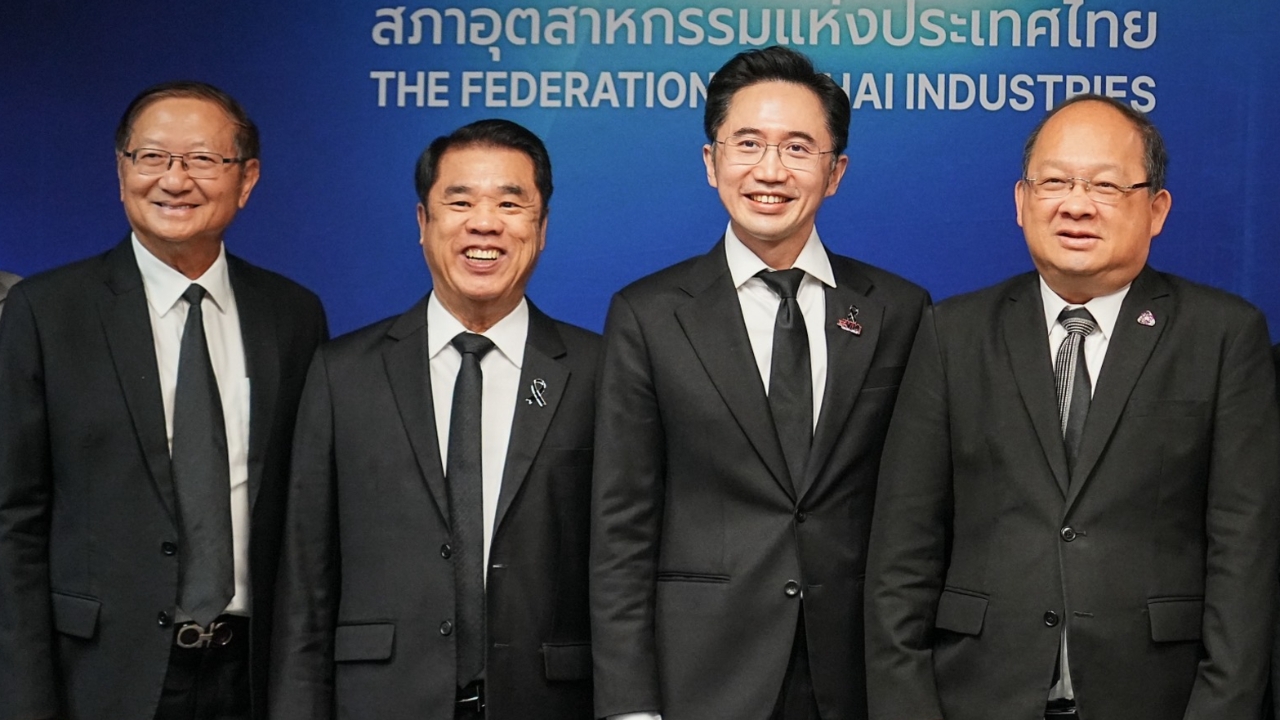
“Yotsanan–Suriya” led the Pheu Thai economic delegation in talks with the Federation of Thai Industries (FTI), promoting the use of AI and technology to expand research into industry. They proposed that the government procure copyrights to reduce investment costs, stressing that if all parties share the same goal, the country can progress.
On 24 Dec 2025 GMT+7 at the Federation of Thai Industries (FTI) in Bangkok, the Pheu Thai Party (PT) led by Mr. Yotsanan Wongsawat, prime minister candidate, and Mr. Suriya Junrungreangkit, party election director and prime minister candidate, along with Dr. Prommin Lertsuridej, former secretary-general to the prime minister, Mr. Chakrapong Saengmanee, deputy party leader, Mr. Paopoom Rojanasakul, deputy party leader, Mr. Thitipong Kiewpaisan, deputy party leader advisor, and Mr. Sukit Srijomkwan, party spokesperson, met with Mr. Kriangkrai Thiananukul, chairman of FTI, to exchange views on the economic situation, industrial challenges, and future economic development strategies for Thailand.
Mr. Kriangkrai said he felt honored that the two Pheu Thai prime minister candidates and party executives visited FTI during a period when the country is entering election mode amid a very fragile Thai economic situation.
“Livelihoods and the economy are issues the public awaits answers on—how to revive the country, get the economy moving, and remain competitive. The industrial sector accounts for about one-third of the country's GDP and employs many workers but faces numerous challenges, so urgent adaptation is necessary,” Mr. Kriangkrai said.
He added that the industrial sector is impacted by new technologies, geopolitics, and shifts in global trade directions, resulting in many goods flowing into the region, including Thailand, especially affecting SMEs that form the country's core but are the most vulnerable group. Meanwhile, protective and support measures remain insufficient, and the situation is worsening.
Furthermore, although export figures this year appear positive, a deeper look shows that Thailand’s manufacturing sector and Consumer Price Index (CPI) have not expanded accordingly, raising questions about the types of exported goods, which require further detailed discussion. FTI hopes for economic and industrial restructuring toward future industries to create added value and sustainable strength.

Mr. Yotsanan said this visit to FTI is the first agency the Pheu Thai Party has consulted with, emphasizing it is not their first meeting as they have continuously worked with the industrial sector through universities and academic roles. The FTI’s approach aligns with Pheu Thai’s vision for the country to move in the same direction, regardless of which party governs.
“The important thing is to reduce minor conflicts that divide the country and help the public see who truly works to advance the nation,” Mr. Yotsanan said.
Mr. Yotsanan also highlighted Thailand's strengths as a geopolitical hub connecting large markets like India, southern China, and ASEAN, with over 600 million people. Establishing factories in Thailand is thus not limited to the domestic market but links to the entire supply chain. He stressed the need for coordinated monetary, fiscal, currency, and export policies to attract more investment into the country.
Regarding economic engines, Mr. Yotsanan noted Thailand already has a foundation but must accelerate the integration of science, technology, and AI to improve production efficiency, especially as the country moves into an aging society. He supports advancing transportation systems and advanced manufacturing.
A key challenge is attracting new technology into the country. The government should play a role in procuring technology licenses (License-in) to reduce private sector investment burdens. For example, the tablet procurement project for Thai children should consider investing in core technologies and allow domestic industries to participate in production, alongside establishing concrete research and development (R&D) and technology transfer foundations.
Thailand must also prepare its workforce through upskilling and reskilling in all dimensions. If specialized personnel remain scarce, the country could allow foreign experts to assist via a One Stop Service system, with the government ensuring compliance with laws.
For new growth engines, Mr. Yotsanan said they must align with Sustainable Development Goals (SDGs) and Net Zero policies, especially for heavy industries like steel and cement that need to adapt. Thailand also has potential in synthetic biology, linking university research to the private sector and promoting a Green Premium so green industries can compete.
Regarding liquidity and innovation, Mr. Yotsanan believes the government should support building an innovation ecosystem, enabling startups and SMEs to collaborate with large companies through venture capital or angel investors, allowing new ideas to be commercially developed and creating a strong economic structure that can persist regardless of government changes, ensuring continued national progress.

